
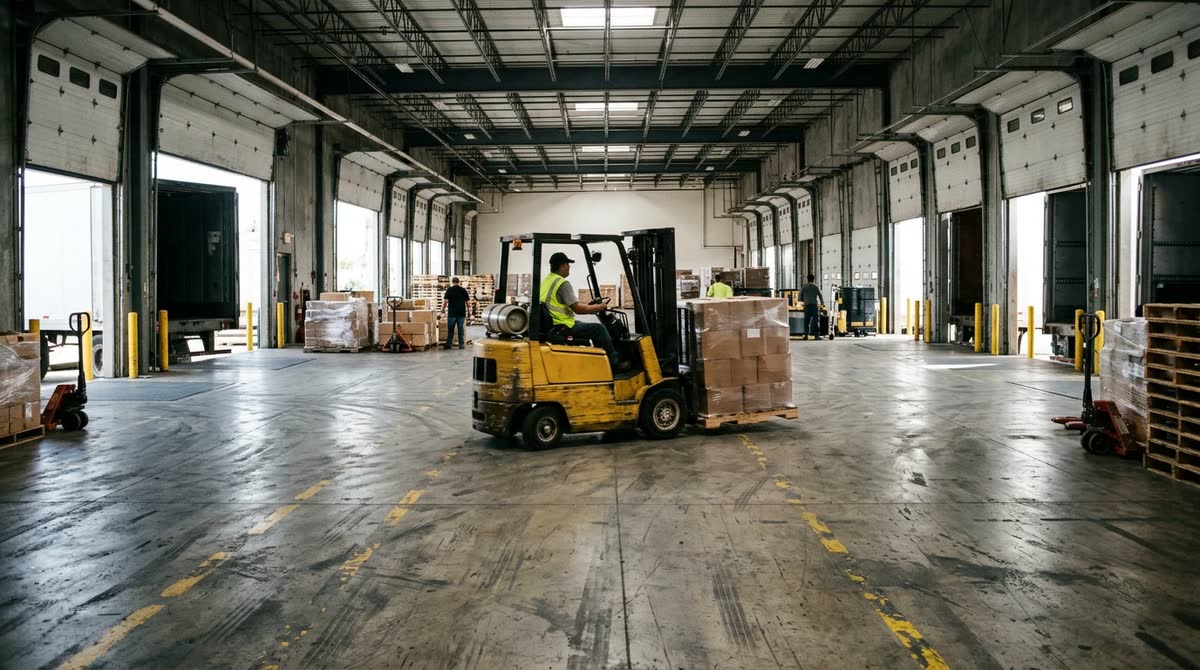
In a cross-dock, dimensioning means capturing the length, width, height and weight of every handling unit as it comes off the inbound trailer, so its density and freight class are known before it is loaded outbound. After that, measure again only where a handling unit changes (when freight is broken down, consolidated onto a new pallet or restacked), because the next carrier rates what you tender, not what you received.
Why does dimensioning matter more in a cross-dock than in a warehouse?
In a warehouse, freight sits long enough for someone to notice a bad measurement and fix it. In a cross-dock it does not. Bartholdi and Gue's 2000 study of LTL crossdocking terminals describes two kinds of doors: strip doors, where full trailers are parked to be unloaded, and stack doors, where empty trailers collect freight for one destination. Workers move each shipment from one to the other, and the authors call that work labor-intensive because a wide variety of freight has to be unloaded, sorted and transferred. Any measuring step you add sits directly inside that flow, so it has to be quick and happen where the freight is already standing still.
The data matters because LTL pricing depends on it. Old Dominion's NMFC resource page states that on 19 July 2025 the classifications in Docket 2025-1 moved from commodity-based to density-based, with density measured in pounds per cubic foot. A pallet that crosses your dock with dimensions copied from the inbound paperwork carries whatever error that paperwork had, and the outbound carrier may be the one who finds it.
Carriers do check, and checking has its own price. FedEx Freight's surcharge quicksheet lists a Weight (Reweigh) and Freight (Inspection) Validation charge under Item 981 at $40 per shipment, with rates effective 5 January 2026. That fee comes on top of any change a corrected weight or class makes to the freight charges.
Where in the cross-dock flow should you measure?
There are three points where a measurement can be taken, and each answers a different question.
- At the inbound door, right after unloading. This catches the gap between what the shipper or the previous carrier declared and what actually arrived. It is the best moment to raise an inbound discrepancy with evidence, and the freight is already stopped on the dock floor.
- After consolidation or breakdown. When you build a mixed pallet for one consignee, or split a multi-pallet shipment across several destinations, you create new handling units. Their dimensions did not exist before, so there is nothing to copy. They have to be measured.
- At outbound staging, before the door. This is the final check against the outbound bill of lading. It pays off on freight that was restacked or re-wrapped during handling, because fresh stretch wrap and cartons added on top change both height and overhang.
Most cross-docks do not need all three on every pallet. A practical rule: measure every handling unit once at inbound, then re-measure only the units that were built, split or reworked on your floor. Freight that moves from strip door to stack door untouched keeps its inbound measurement, and the team spends its time on the units where errors are actually created.
What should you capture for each handling unit?
For density you need the greatest length, width and height of the unit as it will be tendered, including the pallet, packaging and any overhang, plus the weight of that same unit. Overhang is a common source of error on a cross-dock: a pallet consolidated against a departure time often has cartons sticking past the deck on one side, and measuring the pallet footprint instead of the load understates the cube. The details of measuring past the deck are covered in freight measurement with overhang and pallet dimensions.
Irregular freight needs one more rule. The code for dimensioning devices in the 2026 edition of NIST Handbook 44, Section 5.58, says that an irregularly shaped object that must be shipped on a stable side has to be measured while placed on that side. That is a sound working rule for a crew with a tape measure too: measure the unit in the orientation it will ride in the trailer.
Next to the numbers, record:
- the handling unit's identifier (PRO number or pallet label), so the measurement can be matched to the unit later;
- photos showing the full unit with the label visible;
- who measured, when, and with which device;
- whether the unit was received as is or built on your dock.
A measurement that cannot be tied to a label is a number nobody can use when a bill is questioned weeks later.
Which dimensioning equipment fits a cross-dock?
The right tool depends on how much freight passes each door, how many places you need to measure, and whether the number is used to bill anyone.
| Method | Where it fits in a cross-dock | Main trade-off |
|---|---|---|
| Tape measure and floor scale | Low volume, occasional checks at inbound | Slow, and results vary from one person to the next |
| Fixed static pallet dimensioner | One busy inbound or outbound lane | Freight must be brought to the station, which adds travel on the dock |
| Mobile LiDAR app on a phone or tablet | Several doors, or exceptions spread across the dock | The device goes to the freight, but it depends on the operator's technique |
If you do look at a fixed dimensioner, read its NTEP Certificate of Conformance before you buy. The certificate lists the device's size range, its division and its operating temperature range. Two of those lines matter on a cross-dock in particular: the size range must cover your largest consolidated units, and the temperature range must cover a dock with doors open in January.
Mobile measuring suits docks where exceptions turn up at many doors rather than one lane. FreightSizer is an iPhone and iPad app that measures freight dimensions with LiDAR, calculates density and determines LTL freight class in line with NMFTA guidelines, including the NMFC standards effective 19 July 2025, so the measurement happens at the pallet instead of at a fixed station. For a fuller comparison of hand measurement and automated systems, see Should You Measure Freight Manually or With Automated Dimensioning?.
Do cross-dock measurements need certified equipment?
That depends on what the number is used for. NIST Handbook 44, Section 5.58, applies to dimension and volume measuring devices used to determine the dimensions or volume of objects for the purpose of calculating freight, storage or postal charges, and the same section states that the National Type Evaluation Program accepts for type evaluation only devices that comply with all of the code's requirements.
In practice, a cross-dock uses its measurements in two different ways:
- To charge someone. If you bill customers on measured cube, for example for storage or handling, ask your state weights and measures office whether that use requires a certified device.
- To check and document. If you measure to catch errors on inbound freight, build a correct outbound bill of lading, or keep evidence for a dispute, the carrier can still reweigh and inspect the shipment at its terminal, and your measurement is your record of what you tendered.
The question is examined in more depth in Do You Need Certified Dimensioning Equipment for Billing?.
How do you keep dimensioning from slowing the dock?
A cross-dock lives on dwell time, so the measuring step has to fit the flow rather than add a new one. The Bartholdi and Gue paper notes that congestion on the dock leads to excessive labor cost and can cause shipments to miss service commitments. A measuring station that pulls forklifts across the building adds travel and invites that kind of congestion.
What keeps it fast:
- Measure where freight already stops. The staging lane behind the strip doors is the natural spot, not a station on the far side of the dock.
- Measure by exception after inbound. Only units built, split or reworked on your floor get a second measurement.
- Write the result straight into the shipment record. Measurements typed from a clipboard at the end of a shift arrive after the trailer has left. Ways to move mobile measurements into your system without a development project are described in getting mobile dimensioning data into your WMS or TMS.
- Flag by class, not by inches. A small difference that keeps the unit in the same density bracket can be logged and released. A difference that moves it into another class should stop the unit before it is loaded outbound.
- Use one method across shifts. The same orientation, the pallet always included, overhang always included. When two measurements of the same unit disagree, check the method before blaming the tool.
What should you do when your measurement and the paperwork disagree?
On inbound freight, record the difference with photos and the unit's label before the freight moves on, and pass it to the shipper or the upstream party while the evidence is still on your dock. Once the unit has been loaded into another trailer, the original condition is gone.
On outbound freight, correct the bill of lading before tender. Under density-based classification, the class follows the density of the unit you hand over, and a reweigh or inspection at the carrier's terminal can bring both an inspection charge and a corrected class onto the bill.
Whatever tool you use, whether a fixed dimensioner, a tape and scale, or an app like FreightSizer, keep the measurement, the photos and the timestamp together with the shipment record. That record is what lets you compare your numbers with the carrier's if the invoice changes.
Frequently Asked Questions
Do you need to measure every pallet that moves through a cross-dock?
Not always. Measure every handling unit once at inbound, then re-measure only the units that were built, split, restacked or re-wrapped on your floor. Freight that moves from strip door to stack door untouched keeps its inbound measurement.
Can you copy dimensions from the inbound paperwork to the outbound bill of lading?
Only after you have checked them. Since 19 July 2025, the classifications in Docket 2025-1 have been density-based, so a wrong dimension on the inbound paperwork turns into a wrong class on the outbound bill. The inbound door is the earliest point on your dock to catch it.
What counts as the dimensions of a consolidated pallet?
The greatest length, width and height of the whole unit as it will be tendered, including the pallet, wrap and any overhang. Measure it in the orientation it will ride in the trailer and weigh the same unit, so the density reflects what the carrier will actually handle.
Does a measurement taken on the dock replace the carrier's dimensioner?
No. Once the shipment is tendered, the carrier can reweigh and inspect it with its own equipment. Your measurement is your record of what you handed over, and it is most useful when it carries photos, a timestamp and the unit's label, so it can be compared with the carrier's inspection if the bill changes.