
Mastering Freight Measurement with Overhang and Pallet Dimensions in 2026
Accurately measuring freight with overhang and understanding pallet dimensions is crucial for correct LTL freight classification, preventing costly reclassifications and ensuring efficient logistics operations by providing precise cargo volume data. In 2026, the complexity of supply chains demands meticulous attention to detail in how freight is measured, particularly when items extend beyond standard pallet boundaries or when multiple items are consolidated. Miscalculations can lead to significant financial penalties and operational delays, impacting profitability for freight forwarders, LTL carriers, 3PL providers, warehouse teams, and shippers alike. This article delves into the critical aspects of measuring freight with overhang and pallet dimensions, offering actionable insights and best practices for the modern logistics professional.
The NMFTA (National Motor Freight Association) continually updates its guidelines to reflect evolving shipping practices. As of July 19, 2025, these updated NMFC (National Motor Freight Classification) standards place an even greater emphasis on accurate dimensional weight calculations, directly influenced by precise freight measurements. Studies indicate that incorrect LTL freight classification, often stemming from inaccurate dimensional data, can result in an average of 15-20% in unexpected freight charges annually for businesses. This article will explore the challenges, methodologies, and technological advancements that are transforming how we approach freight measurement in complex scenarios.
Key Takeaways
- Overhang on freight requires specific measurement protocols that add the overhang's dimensions to the base item's footprint.
- Pallet dimensions are not just the pallet's own size but also the space it occupies with the freight secured upon it.
- Understanding the nuances of LTL freight classification, especially concerning density calculations with overhang, is vital for cost control.
- New technologies are emerging to streamline the accurate capture of complex freight dimensions, including overhang.
- Adherence to the NMFC standards, particularly the updates effective July 19, 2025, is paramount for compliant shipping.
- Accurate measurement directly impacts freight class determination, density calculations, and ultimately, shipping costs.
How Does Overhang Affect Freight Measurement for LTL Classification?
Freight overhang, where a shipment extends beyond the dimensions of its base pallet or container, necessitates a measurement that encompasses the total volume occupied, including the extended portions. This means measuring the maximum length, width, and height of the entire consolidated unit, treating the overhang as an integral part of the overall dimensions. Failing to account for overhang accurately will lead to an underestimation of the freight's cubic volume, directly impacting density calculations and potentially resulting in misclassification.
When an item or items extend beyond the standard pallet footprint, the measurement must capture the absolute maximum extent of the shipment in all three dimensions. For instance, if a crate is 48 inches long by 40 inches wide, but a component juts out an additional 6 inches on one side, the measured length for LTL classification purposes becomes 54 inches. Similarly, if the height is impacted by an irregular shape extending upwards, that maximum height must be recorded. This comprehensive approach ensures that the freight occupies the space it truly does within a trailer, which is the fundamental principle behind dimensional weight and LTL freight class.
What are the Standard Measurement Protocols for Freight with Overhang?
The standard protocol for measuring freight with overhang is to determine the maximum extent of the shipment in each of the three primary dimensions: length, width, and height. This involves identifying the furthest point of the freight in each direction from a common reference plane, typically the base of the pallet. Imagine the freight encased in an imaginary box; the dimensions of this box, including any protrusions, are what matter for classification.
For length, measure from the furthest forward point to the furthest rearward point. For width, measure from the furthest left point to the furthest right point. For height, measure from the surface the freight rests upon to its highest point. This process applies regardless of whether the overhang is a single protrusion or multiple irregular extensions. The goal is to capture the entire three-dimensional space the freight occupies, ensuring accurate volume calculations for density and freight class.
Why is Accurate Overhang Measurement Critical for Density Calculations?
Accurate overhang measurement is critical for density calculations because density is volume-dependent. Density is calculated as weight divided by volume (Density = Weight / Volume). If the volume is underestimated due to unmeasured overhang, the calculated density will be artificially higher than the actual density. This inflated density can lead to the freight being assigned a higher freight class than it warrants, resulting in increased shipping costs.
For example, a shipment weighing 500 lbs might have a base volume of 30 cubic feet. If it has an overhang that increases its total volume to 35 cubic feet, and this overhang is not measured, the carrier will calculate density based on 30 cubic feet. This would yield a density of approximately 16.7 lbs/cubic foot (500/30). However, the actual density is closer to 14.3 lbs/cubic foot (500/35). This difference can be enough to push the freight into a higher class, incurring additional charges.
How Do LTL Carriers Handle Freight with Overhang?
LTL carriers typically have specific procedures for handling and measuring freight with overhang to ensure accurate billing and space utilization. When freight is presented for shipment, the carrier's receiving personnel are trained to identify and measure any overhang. They will use the standard protocols described above to determine the overall dimensions. This measurement is then used in conjunction with the freight's actual weight to calculate its dimensional weight and determine the appropriate freight class.
Carriers also factor in how the freight will fit within their trailers. Freight with significant overhang can be more challenging to palletize and load efficiently, potentially taking up more space than a similarly weighted but compactly dimensioned item. This space utilization aspect is implicitly covered by accurate dimensional measurements, as the classification system aims to reflect the space consumed. Some carriers may have specific surcharges for exceptionally large or irregularly shaped items with overhang, though these are usually factored into the overall classification and pricing structure.
What are the Key Considerations for Pallet Dimensions in LTL Freight?
Pallet dimensions in LTL freight extend beyond the physical boundaries of the pallet itself. The critical factor is the total footprint and volume occupied by the pallet with the freight secured upon it. This includes any dunnage, wrapping, or bracing that adds to the overall dimensions. Understanding these combined dimensions is essential for accurate freight classification and efficient trailer loading.
The standard pallet sizes (e.g., 40x48 inches in North America) serve as a base, but the freight's configuration on top can dramatically alter the space occupied. For instance, a pallet loaded with items stacked neatly within the pallet's footprint will have different dimensional characteristics than one where items extend beyond the edges or are stacked high and unevenly. Accurately capturing these dimensions ensures that the volume calculation reflects the true space commitment.
How Does Freight Stacking Affect Pallet Dimensions and Measurement?
The way freight is stacked on a pallet significantly affects its overall dimensions and how it should be measured. If items are stacked squarely and do not exceed the pallet's perimeter, the measurement is straightforward. However, if items are staggered, overhang the edges, or form an irregular shape at the top, these deviations must be incorporated into the measurement.
For example, a pallet loaded with boxes where some boxes extend 2 inches beyond the pallet's width on one side and another 3 inches on the opposite side means the effective width measurement for classification is the pallet width plus these overhangs. Similarly, if the stacking creates a peak or an uneven top surface, the measurement must capture the highest point of the stacked freight. This ensures the volume calculation accurately represents the entire unit.
What is the Role of Dunnage and Securing Materials in Pallet Dimensions?
Dunnage and securing materials, such as shrink wrap, banding, or bracing, play a direct role in the final dimensions of a palletized shipment. While these materials are often flexible, they can add to the overall width, length, or height. For LTL freight classification, the measurement should include the dimensions of the freight as it is presented for shipment, which includes these securing elements.
For instance, a pallet wrapped tightly might not significantly increase dimensions. However, if shrink wrap is applied loosely, creating bulges, or if bracing extends beyond the freight, these added dimensions must be accounted for. The goal is to measure the space the consolidated unit occupies, and securing materials are part of that consolidated unit. It is important to differentiate between dunnage that merely fills voids within the pallet's footprint and dunnage that increases the overall external dimensions.
How are Non-Standard Pallets Measured for LTL Classification?
Non-standard pallets, or pallets with freight exceeding standard dimensions, require careful measurement to determine their effective footprint and volume. The principle remains the same: measure the maximum length, width, and height of the entire unit. If a shipment is placed on a pallet that is larger than a standard 40x48 inches, the actual pallet dimensions are the starting point, and any freight overhang from that non-standard pallet is then added.
For example, if a custom pallet measuring 48x60 inches is used, and the freight on it extends an additional 5 inches in length and 4 inches in width, the measured dimensions would be (60+5) inches in length and (48+4) inches in width, plus the maximum height. This ensures that the volume calculation reflects the true space commitment, regardless of whether a standard or custom pallet is used.
Why is Accurate Freight Dimensioning Essential for LTL Freight Class?
Accurate freight dimensioning is the bedrock of correct LTL freight classification, directly influencing density calculations, which are a primary determinant of class. The NMFC system categorizes freight into 18 classes, ranging from Class 50 (lowest density, lowest cost) to Class 400 (highest density, highest cost), with some reaching Class 500 for extremely low-density items. Density, calculated as weight per cubic foot, is a key metric used to assign freight to these classes.
If freight dimensions are underestimated, the calculated density will be artificially inflated. This can lead to a higher freight class assignment, resulting in increased shipping costs. Conversely, if dimensions are overestimated, the freight might be placed in a lower class, potentially leading to disputes with the carrier and back-billing for underpayment. The NMFC standards, particularly the updates effective July 19, 2025, emphasize the importance of precise dimensional data.
How Does the NMFC Classify Freight Based on Density and Dimensions?
The NMFC classifies freight primarily based on density, which is derived from the freight's weight and its dimensions. Carriers use a formula to calculate the dimensional weight of a shipment. This dimensional weight is compared to the actual weight. The greater of the two is used for billing purposes. For LTL, this calculation is crucial for determining the freight class.
The general principle is that lower density freight (more space per pound) occupies more trailer space relative to its weight and is therefore assigned a higher class and cost. Higher density freight (less space per pound) is more efficient in terms of space utilization and receives a lower class and cost. The NMFC provides specific density thresholds for each freight class. For example, freight with a density between 10 and 12 lbs/cubic foot might fall into a different class than freight with a density between 12 and 15 lbs/cubic foot.
What Are the Consequences of Incorrect LTL Freight Classification?
The consequences of incorrect LTL freight classification are primarily financial and operational. Shippers who inaccurately report dimensions or weights, leading to a lower-than-actual freight class, risk significant back-charges from carriers. These back-charges often include the difference in freight charges, plus administrative fees. This can lead to unpredictable budgeting and cash flow issues.
From a carrier's perspective, incorrect classification can lead to undercharging, impacting their revenue and profitability. It can also lead to inefficient trailer loading if the actual space commitment of the freight is greater than what was classified. For freight forwarders and 3PLs, maintaining accurate classification is part of their service offering and crucial for client trust and retention.
How Do the NMFC Standards Effective July 19, 2025, Impact Measurement Practices?
The NMFC standards effective July 19, 2025, reinforce the need for precision in freight measurement, particularly in light of evolving logistics practices and the increasing use of dimensional data. While the core principles of density-based classification remain, these updates often refine how dimensions are captured, reported, and utilized, especially for irregular or complex shipments. The updated standards may include more granular guidance on measuring items with overhang or specific instructions for consolidated shipments.
These revisions are designed to ensure that the classification system accurately reflects the value and the space commitment of freight in the current logistics landscape. For professionals in the LTL space, staying abreast of these updates is not optional; it's a necessity for compliance and competitive operations. This often means adopting more robust measurement techniques and potentially leveraging technology to ensure consistent and accurate data capture.
What Technologies Can Improve Freight Measurement Accuracy, Including Overhang?
The traditional methods of measuring freight using tape measures and manual calculations are prone to human error and can be time-consuming, especially when dealing with complex shapes or overhang. Fortunately, advancements in technology are providing more accurate and efficient solutions for capturing freight dimensions. These technologies are becoming increasingly accessible and vital for businesses seeking to optimize their LTL operations.
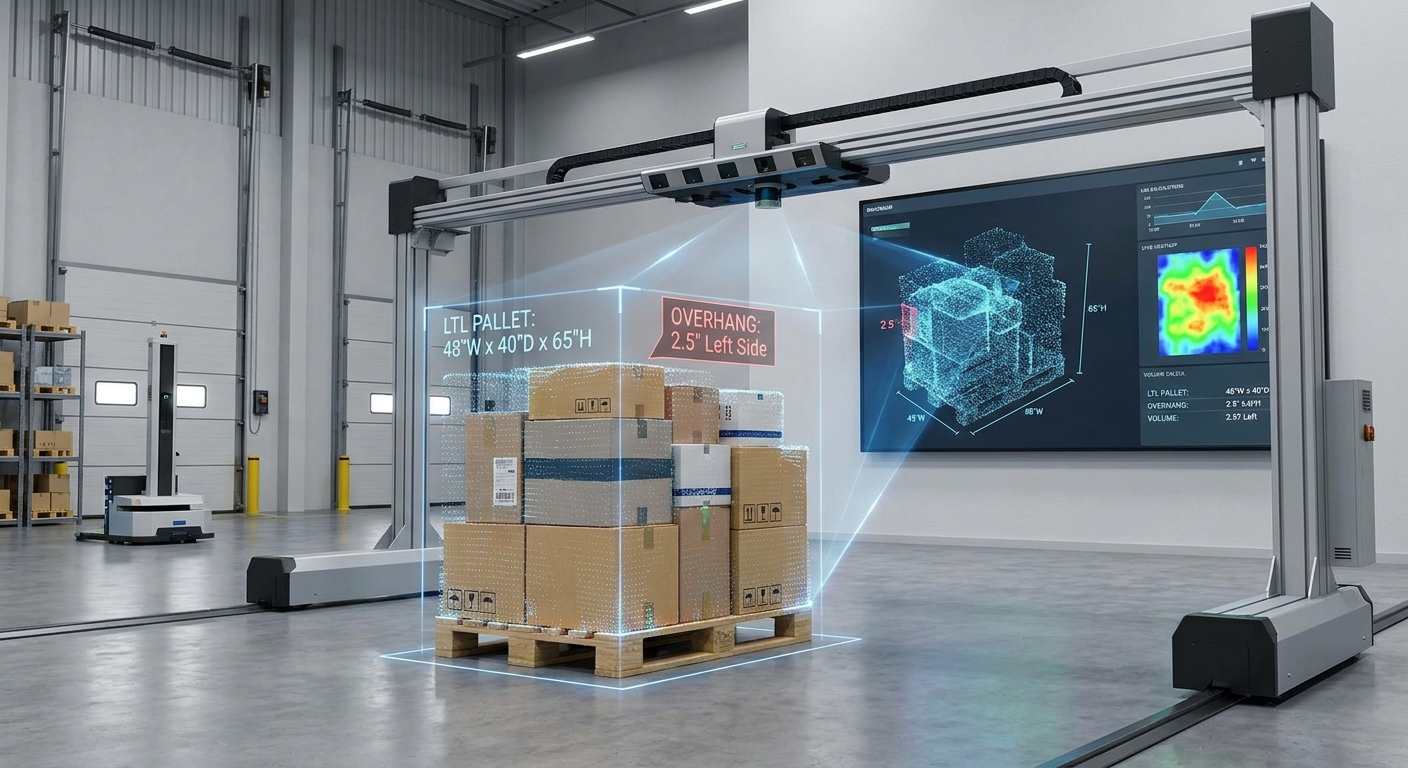
Digital dimensioning tools utilize sensors and software to capture precise measurements. These can range from laser scanners to advanced LiDAR (Light Detection and Ranging) systems. By automating the measurement process, these technologies minimize the risk of human error associated with manual measurements, particularly for items with irregular shapes or overhang.
How Can LiDAR Technology Enhance Freight Dimensioning?
LiDAR technology offers a sophisticated approach to capturing precise 3D data of objects. When applied to freight measurement, LiDAR sensors can rapidly scan a shipment, creating a detailed point cloud that accurately represents its shape and dimensions, including any overhang. This data can then be processed to calculate the total volume occupied by the freight.
For example, an iPhone or iPad equipped with LiDAR, when used with specialized software, can capture the exact dimensions of a palletized load, even if it has significant overhang or an irregular profile. This digital capture replaces manual measurements and provides verifiable, precise data that can be directly used for LTL freight classification. This ensures that all protrusions and irregular shapes are accounted for in the length, width, and height calculations.
What is the Role of Mobile Apps in Modern Freight Measurement?
Modern mobile applications are transforming freight measurement by integrating with advanced sensors and providing user-friendly interfaces. These apps can guide users through the measurement process, ensuring all necessary dimensions are captured according to NMFC guidelines. They often perform automatic calculations for volume and density, and some can even suggest or verify freight class.
Applications like FreightSizer leverage the LiDAR capabilities of modern smartphones and tablets to quickly and accurately measure freight dimensions. This eliminates the need for separate, bulky dimensioning hardware and reduces the reliance on manual tape measurements. By providing a digital record of each measurement, these apps also enhance traceability and can be integrated into broader logistics management systems.
How Does Automated Dimensioning Improve LTL Carrier Operations?
Automated dimensioning systems offer significant benefits to LTL carriers. They expedite the receiving and dock operations by capturing dimensions much faster than manual methods. This increased speed can improve throughput and reduce dwell times. More importantly, automated systems ensure a higher degree of accuracy in dimensional data capture, leading to more accurate freight classification and billing.
This accuracy reduces disputes with shippers and ensures that carriers are properly compensated for the space their freight occupies. By minimizing errors in dimensional weight calculations, carriers can optimize their trailer loading, improve capacity utilization, and enhance overall operational efficiency. The consistent data output from these systems also supports better analytics and forecasting for logistics planning.
Frequently Asked Questions
How do I measure a pallet with items that stick out on all sides?
Measure the furthest extent of the items in each direction (length, width, height) from a common reference point, treating the entire assembly as a single unit. This captures the maximum dimensions occupied by the pallet and its contents.
What if my freight has an irregular shape that overhangs the pallet?
You must measure the absolute maximum length, width, and height that the freight occupies. Imagine an invisible box that perfectly encloses the entire freight unit, including all overhangs and irregular protrusions.
Does shrink wrap add to the freight dimensions for LTL classification?
Yes, if the shrink wrap causes the overall dimensions of the freight to exceed its base footprint, those added dimensions must be included in the measurement for accurate volume calculation.
How often are NMFC standards updated, and where can I find the latest versions?
The NMFC standards are typically updated periodically, with significant revisions occurring annually or as needed. The most current versions are available through the National Motor Freight Association (NMFTA) website and official publications.
Can using a mobile app for measurement guarantee the correct LTL freight class?
While mobile apps like FreightSizer provide highly accurate dimensional data, freight classification also depends on the correct commodity description, weight, and adherence to all NMFC rules. The app facilitates accurate input for classification.
Conclusion
In the dynamic landscape of LTL logistics in 2026, mastering the intricacies of measuring freight with overhang and understanding pallet dimensions is no longer optional—it's a strategic imperative. Accurate measurements are the foundation for correct LTL freight classification, ensuring fair pricing and operational efficiency. By embracing precise measurement protocols and leveraging advanced technologies, freight forwarders, LTL carriers, 3PL providers, warehouse teams, and shippers can navigate the complexities of the NMFC standards, mitigate costly reclassification charges, and optimize their supply chain performance. A commitment to accuracy in every measurement translates directly to a more predictable, cost-effective, and reliable shipping experience.