
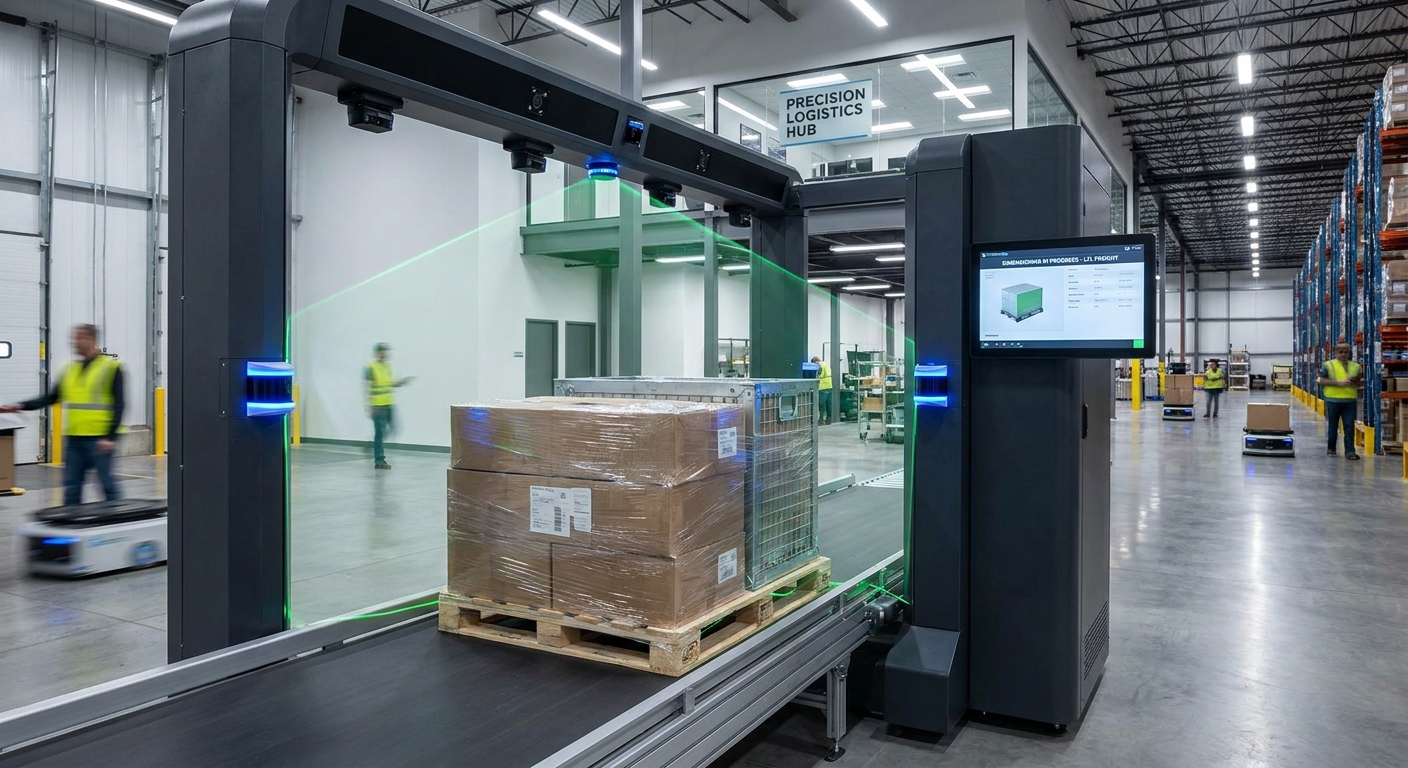
Do You Need Certified Dimensioning Equipment for Billing in 2026? Understanding LTL Freight Class Requirements
No, certified dimensioning equipment is not strictly mandated for LTL freight billing in 2026, but accurate, verifiable dimensioning and density calculations are essential for compliance and avoiding costly reclassification charges. The accuracy of your measurements directly impacts your freight class, which dictates your shipping costs.
As of July 19, 2025, new NMFTA (National Motor Freight Association) guidelines are in effect, reinforcing the importance of precise freight classification. Inaccurate dimensions or density calculations can lead to significant financial penalties. Approximately 15% of LTL shipments experience reclassification due to incorrect data, costing shippers an estimated $500 million annually.
This article will delve into the nuances of LTL freight classification, the role of dimensioning equipment, and how to ensure your billing is accurate and compliant with current industry standards. We will explore the necessity of accurate data, the impact of NMFC updates, and the evolving landscape of freight measurement technology.
Key Takeaways
- Accurate freight dimensions and density are critical for correct LTL freight classification and avoiding billing disputes.
- While "certified" equipment isn't universally required, verifiable and repeatable measurement accuracy is non-negotiable.
- The NMFC standards, updated July 19, 2025, place greater emphasis on precise data for classification.
- Utilizing advanced technology can significantly improve measurement accuracy and streamline the classification process.
- Understanding freight density is paramount, as it directly influences class determination and potential surcharges.
- Proactive measurement and classification are more cost-effective than reacting to reclassification notices.
Why is Accurate Dimensioning Crucial for LTL Billing?
Accurate dimensioning is the bedrock of correct LTL freight classification because the National Motor Freight Classification (NMFC) system relies heavily on the physical characteristics of a shipment. Specifically, density, which is derived from dimensions and weight, is a primary factor in determining the freight class. Incorrect dimensions lead directly to an incorrect density calculation, and consequently, an incorrect freight class.
This incorrect freight class can result in undercharging or overcharging. Undercharging can lead to disputes, backbilling, and potential loss of customer trust. Overcharging, while seemingly beneficial to the carrier, is detrimental to the shipper and can lead to lost business if rates are consistently higher than competitors. The NMFC, administered by the NMFTA, uses a system of 18 classes, ranging from class 50 (lowest risk, most dense) to class 500 (highest risk, least dense).
The relationship between dimensions, weight, and class is not arbitrary. Carriers use this information to assess the space a shipment will occupy in their trailers, the potential for damage, and the handling requirements. For instance, a shipment that occupies a large amount of space relative to its weight (low density) is classified higher, as it is less efficient for the carrier to transport. This inefficiency is directly reflected in the freight rate.
The advent of new NMFC standards effective July 19, 2025, further emphasizes the need for precise data. These updates aim to harmonize classification across the industry and reduce ambiguity. Carriers are increasingly relying on sophisticated systems to verify shipment data, making manual or imprecise measurements a significant liability.
What Are the Consequences of Inaccurate Freight Dimensions and Classification?
The repercussions of inaccurate freight dimensions and subsequent misclassification in LTL shipping are multifaceted and can significantly impact operational efficiency and profitability. The most immediate consequence is financial. Carriers will issue reclassification bills, often with significant backcharges, to recover the revenue lost due to the initial underestimation of the freight class. These backcharges can include the difference in freight charges, plus administrative fees.
Beyond direct financial penalties, inaccurate data erodes trust between shippers, carriers, and 3PLs. Frequent reclassifications signal a lack of attention to detail or inadequate processes, which can damage long-term relationships. For freight forwarders and 3PLs, this can lead to a loss of clients who seek more reliable partners. For carriers, it means increased operational overhead in investigating and resolving billing discrepancies.
Furthermore, inaccurate classification can disrupt warehouse operations. If shipments are consistently misclassified, it can lead to an underestimation of the space required for staging and loading, causing bottlenecks. It also impacts the planning for specialized handling equipment if the actual freight class suggests a need that wasn't initially accounted for.
Data integrity is paramount in modern logistics. Carriers are investing in technology to audit shipments, and the ability to provide accurate, auditable data is becoming a competitive advantage. In 2026, the expectation for precision is higher than ever, driven by industry-wide efforts to standardize and streamline processes.
Does the NMFC Mandate Specific Dimensioning Equipment?
The NMFC, as of its 2026 implementation, does not mandate the use of a specific brand or type of "certified" dimensioning equipment for LTL freight billing. Instead, the focus is on the accuracy and verifiability of the dimensions and weight provided. The NMFTA guidelines emphasize that the data used for classification must be correct and consistently reproducible.
What this means in practice is that while a tape measure might technically provide dimensions, it is highly susceptible to human error and subjectivity. Carriers and auditing services are increasingly adopting technology that offers higher degrees of accuracy and eliminates manual input. If a carrier's audit reveals dimensions that are significantly different from their own measurements, they have the right to reclassify the shipment.
The new NMFC standards effective July 19, 2025, further underscore the need for reliable measurement. They are designed to reduce disputes by promoting a clearer, more data-driven classification process. This implies that the method of measurement needs to be robust enough to stand up to scrutiny.
The absence of a specific equipment mandate does not equate to a lack of requirement for precision. Shippers are expected to employ methods that yield accurate results. For many, this has led to the adoption of advanced dimensioning tools that provide objective, digital records of freight dimensions, which are far more defensible than manual measurements.
How Does Freight Density Influence Classification and Billing?
Freight density is a critical determinant in LTL freight classification, directly impacting the class assigned and, consequently, the shipping cost. Density is calculated by dividing the weight of a shipment by its volume (length x width x height). The NMFC uses density breaks within each commodity class to refine the classification further.
For example, a shipment of electronics might be class 150. However, if its density falls below a certain threshold (e.g., less than 6 pounds per cubic foot), it might be reclassified to a higher class, such as class 175 or even higher, depending on the specific NMFC item. Conversely, a denser shipment of the same commodity would remain in or be moved to a lower class.
Understanding these density breaks is crucial for shippers. By accurately measuring dimensions and weight, a shipper can proactively determine the correct freight class and avoid unexpected reclassification charges. This is particularly important for shipments that might be on the cusp of a density threshold.
The NMFC standards, updated as of July 19, 2025, continue to place significant emphasis on density as a primary factor for classification accuracy. Carriers utilize density to understand how efficiently a shipment utilizes trailer space. High-density shipments are generally more cost-effective to transport, hence their lower freight class. Low-density shipments, or those that are "light and bulky," occupy more space relative to their weight, making them less efficient and thus assigned higher classes and rates.
The following table illustrates a simplified example of how density impacts freight class, assuming a hypothetical commodity:
| Freight Class | Minimum Density (lbs/cu ft) | Maximum Density (lbs/cu ft) | Example Description |
|---|---|---|---|
| 70 | 12.0 | 15.0 | Moderately dense goods, standard packaging |
| 92.5 | 10.0 | 11.9 | Slightly less dense goods, some void space |
| 125 | 8.0 | 9.9 | Lighter goods, more void space, potentially fragile |
| 150 | 6.0 | 7.9 | Light and bulky items, significant void space |
| 175 | 4.0 | 5.9 | Very light and bulky, requires careful handling |
This table highlights that a shipment of the same commodity, weighing 100 lbs, could be class 70 if it measures 8.33 cubic feet (100 lbs / 8.33 cu ft = 12.0 lbs/cu ft), but class 150 if it measures 16.67 cubic feet (100 lbs / 16.67 cu ft = 6.0 lbs/cu ft). The difference in cost between class 70 and class 150 can be substantial, underscoring the financial importance of accurate density calculation.
What Technologies Can Ensure Accurate Freight Measurement?
Ensuring accurate freight measurement in 2026 requires moving beyond manual methods to more sophisticated technologies that provide objective and verifiable data. Traditional methods like tape measures are prone to human error, inconsistent application, and are time-consuming. This is where advanced dimensioning solutions become invaluable.
One such technological advancement is the use of LiDAR (Light Detection and Ranging) technology integrated into mobile applications. These solutions can quickly and accurately capture the dimensions of a piece of freight. By leveraging the LiDAR sensor found in modern smartphones and tablets, they create a precise 3D scan of the cargo.
These systems can then automatically calculate the cubic volume and, when combined with an accurate weight reading (often obtained from a connected scale or manual input), determine the freight density. This data can be directly used to cross-reference against NMFC guidelines or integrated into existing Transportation Management Systems (TMS) for automated freight class lookup.
The benefits of such technologies extend beyond mere accuracy. They reduce the time spent on manual measurements, minimize the potential for human error, and provide a digital audit trail for each shipment. This audit trail is invaluable in case of disputes with carriers. The ability to quickly and accurately determine freight class on the dock can prevent costly reclassification charges later in the supply chain.
For freight forwarders, LTL carriers, 3PL providers, and warehouse teams, adopting these technologies can lead to more efficient operations, improved billing accuracy, and stronger relationships with their clients and partners. The investment in accurate dimensioning technology in 2026 is not just about compliance; it's about operational excellence and cost control.
How Can Shippers Proactively Manage Freight Classification?
Proactive management of freight classification starts with a commitment to accurate data collection at the point of shipment preparation. This involves implementing standardized procedures for measuring and weighing every piece of LTL freight before it leaves the dock. Instead of waiting for carrier audits or reclassification notices, shippers should aim to classify their freight correctly from the outset.
This proactive approach requires understanding the NMFC guidelines thoroughly. While the system can be complex, key factors like density, fragility, value, and stowability are consistently used. Shippers should train their warehouse teams on how to measure accurately and how to use available tools to determine density.
Utilizing technology that automates the measurement and classification process can significantly enhance this proactive strategy. Solutions that can measure dimensions, calculate density, and even suggest a preliminary freight class based on NMFC data empower shippers to make informed decisions before tendering the freight. This reduces the likelihood of errors and the associated costs.
Furthermore, maintaining a historical database of classified shipments can provide valuable insights. Analyzing past classifications and any disputes can help identify patterns or common errors, allowing for process improvements. Building strong communication channels with carriers regarding classification expectations can also be beneficial.
The NMFC standards effective July 19, 2025, highlight the increasing importance of data-driven classification. By embracing proactive measurement and classification, businesses can mitigate risks, reduce operational friction, and establish a more predictable and cost-effective LTL shipping process. This forward-thinking strategy is essential for navigating the complexities of LTL freight in 2026 and beyond.
Frequently Asked Questions
What is the primary reason for LTL freight reclassification?
The primary reason for LTL freight reclassification is inaccurate data regarding the shipment's dimensions, weight, or density, leading to an incorrect freight class assignment.
Are there specific NMFC classes for all types of goods?
Yes, the NMFC system categorizes goods into 18 classes (50-500) based on characteristics like density, stowability, handling, and liability, ensuring a class exists for most types of freight.
How often are NMFC guidelines updated?
NMFC guidelines are updated periodically, with significant revisions often occurring annually. The most recent comprehensive update to which we refer in this article was effective July 19, 2025.
Can a freight forwarder be held responsible for incorrect freight classification?
Yes, freight forwarders, as intermediaries, are often responsible for ensuring accurate freight classification, and can be held liable for reclassification charges if their provided data is incorrect.
What is the most effective way to prevent freight reclassification charges?
The most effective way to prevent freight reclassification charges is to ensure accurate measurement and weight recording of all LTL shipments, and to proactively determine the correct freight class using reliable data and tools.
Conclusion
In 2026, the landscape of LTL freight classification demands precision and adherence to evolving industry standards, particularly the NMFC guidelines effective July 19, 2025. While "certified" dimensioning equipment isn't a universal mandate, the requirement for accurate, verifiable, and repeatable freight dimensions and density calculations is non-negotiable. Inaccurate measurements lead directly to costly reclassification charges, strained carrier relationships, and operational inefficiencies.
By embracing advanced dimensioning technologies and implementing proactive measurement strategies, shippers, carriers, and logistics providers can significantly mitigate these risks. Investing in solutions that provide objective data not only ensures compliance but also fosters greater operational control and cost predictability in the complex world of LTL freight.