
Should You Measure Freight Manually or With Automated Dimensioning?
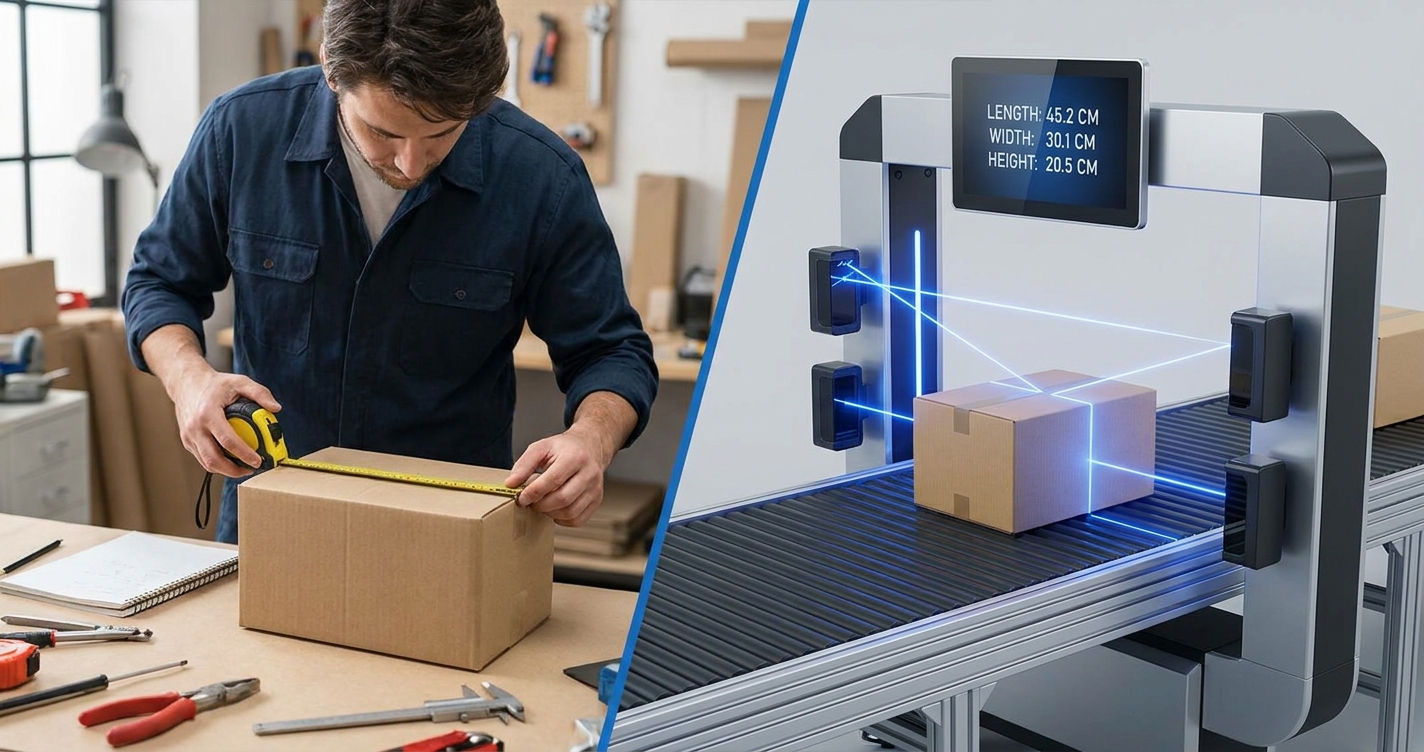
Manual measurement with a tape costs almost nothing and works on any freight, but the numbers vary by person and by shift. Automated dimensioning gives repeatable measurements that go straight into your systems, and certified legal-for-trade units give figures you can bill on. The right choice depends on your freight volume and on whether you invoice from your own dimensions.
Fixed, certified dimensioners suit high-volume billing docks. Mobile LiDAR tools fill the gap for shippers, forwarders and warehouses that still rely on a tape.
What is the actual difference between manual measurement and automated dimensioning?
Manual measurement means a dock worker with a tape measure. They pull length, width and height on the pallet, write the numbers down or remember them, and type them into a WMS, TMS or bill of lading.
Automated dimensioning replaces that chain with a sensor. A fixed pallet dimensioner, a conveyor system or a LiDAR-equipped device captures the dimensions and passes them on digitally.
The difference matters because of density. Freight density is weight divided by cubic feet, where cubic feet is length x width x height in inches divided by 1,728. Warp describes density as the single biggest input into NMFC freight class and a primary driver of LTL cost. Under the NMFC standards that took effect on 19 July 2025, a small dimension error is a classification error.
Here is a concrete case. A 500 lb pallet measured at 48 x 40 x 50 inches is 55.56 cubic feet, or about 9.0 lb per cubic foot. Measure the same pallet at 52 inches tall because someone caught the top of a stretch-wrap tail, and it becomes 57.78 cubic feet, or about 8.65 lb per cubic foot. Two inches can be enough to push freight across a density breakpoint into a different class. That is how reclass invoices start.
Where does manual tape measurement still work, and where does it break?
Where it works
- No capital cost. A tape measure and a trained person are all you need.
- Works anywhere. Inside a trailer, at a customer site, in a yard, on freight that will never pass a dimensioning station.
- Handles odd freight. A careful person can work out how to measure crated machinery, long items or loads with overhang.
- Fine at low volume. If you ship a few pallets a week and one experienced person measures them all, results can be consistent.
Where it breaks
The problem is not the tape. It is the people using it under pressure. Cubiscan reports that dock associates measuring stretch-wrapped pallets with a tape under throughput pressure produce results that vary by person and by shift. It calls this variability the primary source of pallet dimension discrepancies.
The second failure point is data entry. Cubiscan also notes that manual measurement combined with hand-keyed entry introduces errors into WMS records. A correct measurement can still become a wrong record if 48 is typed as 84.
Typical manual mistakes:
- Measuring the pallet deck instead of the outermost point of the load, including overhang.
- Rounding down to the nearest convenient number.
- Measuring height at the low corner of a domed or bulging load.
- Leaving no record of how the measurement was taken, so there is nothing to show when a carrier disputes it.
If these sound familiar, our breakdown of common freight measurement mistakes that cost money goes through each one.
What do fixed automated dimensioners do better, and what are their limits?
Strengths
Consistency. A fixed pallet dimensioner applies the same method every time, regardless of who runs it or which shift it is. It is designed to remove exactly the person-to-person variation described above.
Clean data. Dimensions go straight to the WMS or billing system, which removes the hand-keying step.
Billing authority. This is the big one for carriers and anyone who invoices on dimensions. Dimensioners used for billing in LTL must carry legal-for-trade certification from bodies such as NTEP in the US, Measurement Canada, OIML or under the EU Measuring Instruments Directive.
In the US, NIST Handbook 44 sets the specifications and tolerances for commercial measuring devices, including multiple dimension measuring devices. As vMeasure puts it, certification confirms a system has been tested and approved for commercial use, which matters because buyer and seller both have to trust the billed figures.
Limits
- Cost. It is a capital purchase with installation, integration and upkeep. Our article on what a freight dimensioner costs walks through the components.
- Fixed location. Freight has to come to the machine. That costs forklift trips, floor space and a possible bottleneck at peak.
- Coverage. One unit covers one dock. Multi-site operations either buy several or measure most freight some other way.
- Upkeep. Certified devices need to stay within tolerance, which means inspections and maintenance.
Whether you actually need certification depends on what you do with the numbers. We cover that in do you need certified dimensioning equipment for billing.
Is a mobile LiDAR app a middle ground between the two?
For many operations, yes. Recent iPhones and iPads carry LiDAR sensors that can capture a pallet's dimensions without a tape.
FreightSizer uses that sensor to measure freight, calculate density and determine LTL freight class in line with NMFTA guidelines, including the NMFC standards effective 19 July 2025. It is built to replace both the tape measure and dedicated dimensioning hardware for that job.
Strengths:
- It goes to the freight, not the other way round. That helps on a customer's dock, in a trailer or across several warehouses.
- The device does the arithmetic. Density and class come out of the same step as the dimensions, so there is no separate calculation where errors creep in.
- No hardware install. The device is one many teams already carry.
Limits to be honest about:
- A person still positions the device, so a consistent routine matters. Same angles, full load in frame, overhang included.
- If you invoice third parties directly from your dimensions, check whether your jurisdiction and contracts require a legal-for-trade certified device. Do not assume any tool meets that bar without confirming it.
For most shippers, the job is different. They need to know their real dimensions and class before tender, so the carrier's dimensioner confirms their numbers instead of correcting them. For the accuracy question in detail, see can you measure freight accurately with a phone.
How do the three options compare side by side?
| Factor | Manual tape measure | Fixed automated dimensioner | Mobile LiDAR app |
|---|---|---|---|
| Consistency between operators | Varies by person and shift | Same method every time | Consistent method, but depends on a disciplined routine |
| Data entry | Hand-keyed, prone to transcription errors | Direct to WMS or billing system | Digital output, no transcription of dimensions |
| Density and class | Calculated separately by hand or spreadsheet | Depends on the software it is paired with | Calculated in the same step |
| Billing on dimensions | Weak position in disputes | Certified legal-for-trade units are built for this | Confirm certification needs before billing third parties |
| Upfront cost | Negligible | Capital purchase plus installation | Uses existing iPhone or iPad |
| Where it works | Anywhere | One fixed station | Anywhere the device goes |
| Throughput at peak | Slows as people rush | Can bottleneck if all freight routes through one unit | Scales with number of devices |
| Best fit | Very low volume, one trained measurer | Carrier terminals and high-volume billing docks | Shippers, forwarders, 3PLs, multi-site warehouses |
Which should you choose for your operation?
Start from what you do with the numbers.
- LTL carrier terminal billing on dimensions: a fixed, certified dimensioner. Legal-for-trade status is the point.
- High-volume 3PL or warehouse with one main dock: a fixed unit for billing-grade freight, plus a portable method for overflow, oversized loads and other sites.
- Shipper tendering LTL: you need accurate numbers before the carrier measures. A mobile LiDAR tool or a strictly disciplined manual process does this; the goal is to declare what the carrier will find.
- Freight forwarder working across many locations: fixed hardware rarely makes sense. Mobile measurement travels with your team.
Mistakes when moving from manual to automated
- Fixing dimensions but not weight. Density needs both. A perfect cube on a bad scale weight is still a wrong class.
- Keeping the hand-keying step. Buying a dimensioner and then retyping its readings brings the transcription error straight back.
- Measuring differently from the carrier. Carriers capture the outermost points of the load. If your method skips overhang, automation will just repeat the mistake reliably.
- No measurement record. Whatever you use, store the dimensions, weight, date and who measured it so you can answer a reclass.
What to do next
Pull your last few months of reweigh and reclass adjustments and check which locations and shifts they came from. If they cluster around manual measurement under time pressure, that is your answer. Pilot automated measurement at that point first, then compare your declared dimensions against carrier-measured ones before rolling it out more widely.
Frequently Asked Questions
Is a tape measure accurate enough for LTL freight class?
It can be when one trained person measures carefully, but results tend to vary by person and shift under dock pressure. Since class depends on density, a couple of inches on height can change the result. Hand-keying the numbers adds a second source of error.
Do automated dimensioners need to be certified?
If the dimensions are used for billing or trade, yes. In LTL they need legal-for-trade certification from bodies such as NTEP, Measurement Canada, OIML or under the EU Measuring Instruments Directive. For internal checks before tender, certification is not what you are buying for.
Can a phone replace a fixed dimensioner?
For shippers, forwarders and warehouses that need accurate dimensions, density and class before tender, a LiDAR app like FreightSizer can replace both the tape and dedicated hardware for that task. If you bill third parties on dimensions, confirm your certification requirements first.
What causes most pallet dimension discrepancies?
Cubiscan identifies person-to-person and shift-to-shift variation in manual tape measurement as the primary source. Missed overhang, rounding and typing errors in the WMS add to it. Automated measurement removes the variation and the retyping step.