
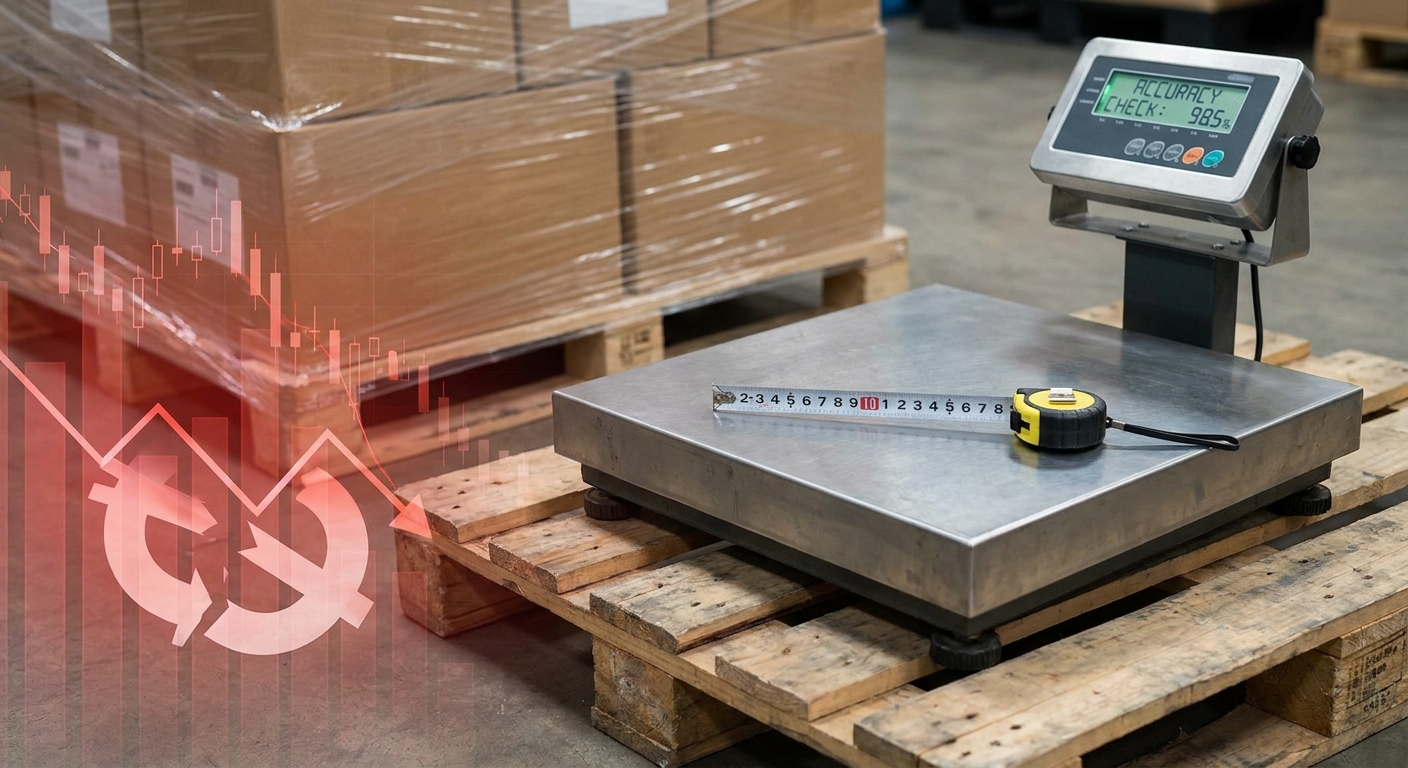
The measurement mistakes that cost money in LTL are the ones that make your declared density differ from the carrier's: measuring the product instead of the handling unit, missing overhang, measuring the wrong height, rounding down, using the wrong weight, and reading the class from the wrong table. Since 19 July 2025 many more commodities are classed by density (NMFTA Disposition Bulletin 1371, Docket 2025-1 (21 March 2025)), and since 6 December 2025 the NMFC bill of lading rule explicitly lets carriers verify dimensions as well as weight (NMFTA, updates to Item 250100 in Supplement 2025-2 (updated 16 March 2026)).
1. Measuring the product instead of the handling unit
NMFC density is calculated on the handling unit as tendered: the greatest straight-line length, width and height including all projections, and the weight of the whole unit (NMFTA, Calculating Density Best Practices (updated 21 October 2026)). A palletized unit includes the pallet and anything banded, strapped or wrapped onto it (NMFTA, NMFC Classification Glossary of Terms (updated 16 March 2026)). Measuring only the cartons gives a smaller cube, a higher density and a lower class than the carrier will find.
2. Missing overhang and projections
Cartons that hang over the pallet edge, handles, flanges and loose wrap all count. A machine on a 48 x 40 inch pallet, 50 inches high and weighing 600 pounds, is 10.8 pounds per cubic foot and class 92.5 if a 6-inch handle is ignored, but 9.6 pounds per cubic foot and class 100 when it is measured (Bulletin 1371). See measuring freight with overhang.
3. Measuring the wrong height
Height runs from the floor to the highest point of the unit, pallet included. Measuring the average height of an uneven top, or starting at the pallet deck, understates the cube.
4. Rounding down
Every inch rounded down raises the density on paper. A pallet measuring 48 x 40 x 48 inches and weighing 800 pounds is exactly 15.0 pounds per cubic foot, class 70; if it is really 49 inches tall, it is about 14.7 and class 85 (Bulletin 1371). Near a breakpoint, one inch decides the class.
5. Using the wrong weight
Density uses the weight of the handling unit as tendered (NMFTA density guide). The product's net weight leaves out the pallet and packaging and gives a lower density than the truth, which can push the declared class up and make you overpay; an estimated or outdated weight can push it either way.
6. One density for a whole multi-pallet shipment
Density is calculated on each handling unit, unless the shipping papers show only a total weight; then total weight and total cube may be used (NMFTA, How to classify a mixed-freight package, skid, or crate (updated 16 March 2026)). Averaging a light pallet with a dense one can put both in the wrong class.
7. Reading the class from the wrong table
For items classed by density, the standard scale has had 13 subprovisions since 19 July 2025 (Bulletin 1371):
| Sub | Density (pounds per cubic foot) | Class |
|---|---|---|
| 1 | Less than 1 | 400 |
| 2 | 1 but less than 2 | 300 |
| 3 | 2 but less than 4 | 250 |
| 4 | 4 but less than 6 | 175 |
| 5 | 6 but less than 8 | 125 |
| 6 | 8 but less than 10 | 100 |
| 7 | 10 but less than 12 | 92.5 |
| 8 | 12 but less than 15 | 85 |
| 9 | 15 but less than 22.5 | 70 |
| 10 | 22.5 but less than 30 | 65 |
| 11 | 30 but less than 35 | 60 |
| 12 | 35 but less than 50 | 55 |
| 13 | 50 or greater | 50 |
A chart with classes such as 77.5 or 110 among its density bands is not this scale. And the scale only applies if the commodity's NMFC item is density-based; items with handling, stowability or liability concerns are not fully density-based (NMFTA, NMFC Classification FAQs (updated 7 April 2026)). Many item numbers were also cancelled in Docket 2025-1 with a reference to a new item (Bulletin 1371), so an old item number can be a mistake in itself.
8. Leaving item, sub and class off the bill of lading
Since Supplement 2025-2, Item 250100 says commodity descriptions on the bill of lading must match the tariff, including the NMFC item number, sub provision and class (Item 250100 summary).
9. Not keeping a record
Without your own dimensions, weight and a photo of each unit, you have nothing to compare with a carrier's re-measurement. See documenting shipment dimensions to win disputes.
How do you avoid these mistakes?
Use one written method for every shipment: unit as tendered, greatest dimensions with projections, highest point from the floor, no rounding down, weight of the whole unit, density per unit, class from the item's own table, and a record kept. A dimensioner or a LiDAR app applies the same method every time. FreightSizer does it on an iPhone or iPad: it measures with the LiDAR scanner, calculates density and determines the class in line with NMFTA guidelines, including the standards effective 19 July 2025, and keeps an exportable log.
Frequently Asked Questions
What is the most common LTL measurement mistake?
Leaving part of the handling unit out of the measurement: the pallet, overhang or a projection. NMFC density uses the whole unit as tendered (NMFTA density guide).
Does stretch wrap count in the dimensions?
Yes, if it extends the unit. Density uses the greatest dimensions of the handling unit as tendered, including all projections (NMFTA density guide).
Should I round dimensions up or down?
Never down. Rounding down raises the density on paper and invites a reclass when the carrier measures the real unit.
Can a carrier re-measure my freight?
Yes. Item 250100 covers the carrier's right to verify weight and/or dimensions (Item 250100 summary).