
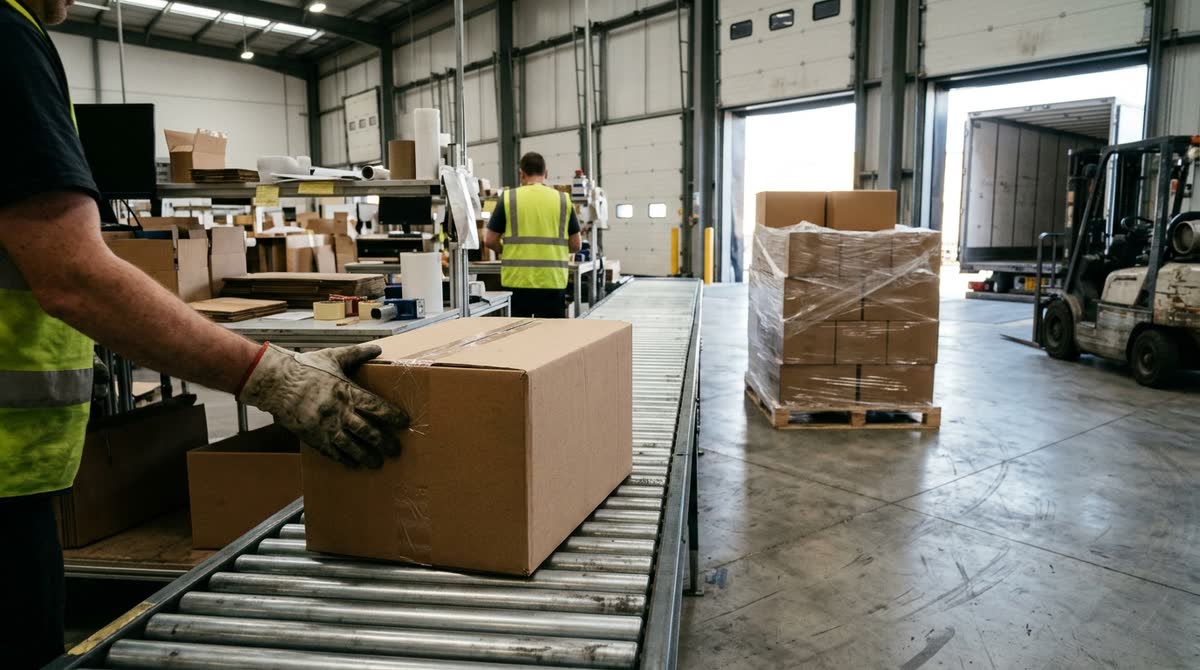
Ecommerce fulfilment teams should measure at three points: each SKU and its packaging when the item is set up, every outbound parcel after it is sealed, and every pallet or other LTL handling unit after it is wrapped and before the bill of lading is written. Parcel carriers bill large, light boxes on dimensional weight and LTL carriers class pallets by density, so a dimension that is off by an inch can change the invoice in both channels.
What has to be measured in a fulfilment operation?
A fulfilment operation moves goods in three shapes, and each one needs its own numbers.
Products and cases. The item master in the WMS holds the length, width, height and weight of every SKU, plus the inner packs and cases it arrives in. Carton selection, slotting and every parcel rate estimate start from these records. The GS1 Package and Product Measurement Standard (Release 3.2, ratified March 2024) sets out one method for measuring everything from the consumer unit up to the pallet. It says measurements should be retaken whenever a change to the product or package may affect its dimensions or weight, that periodic audits should catch changes nobody recorded, and that several random samples should be measured because products and packaging vary between production runs and manufacturing sites.
Outbound parcels. Most direct-to-consumer orders leave as parcels. What counts here is the box as sealed, not the product inside it, because the sealed box is what the carrier measures and bills.
Pallets and other LTL handling units. Wholesale orders, retail replenishment, marketplace inbound shipments and bulky items often travel LTL. The measured unit is the whole handling unit: pallet, cartons, stretch wrap and anything that sticks out.
| Shipment level | When to measure | What to record | What the numbers drive |
|---|---|---|---|
| SKU, inner pack and case | At item setup, and again after any packaging change | Length, width, height and weight of each packing level | Carton choice, slotting, parcel rate estimates |
| Outbound parcel | After packing and sealing, before the label is bought | Sealed carton dimensions and actual weight | Dimensional weight, carrier manifest data |
| LTL handling unit | After the pallet is built and wrapped, as it will be tendered | Greatest length, width and height including pallet and overhang, plus gross weight | Density, NMFC class, bill of lading |
How do parcel carriers use your dimensions?
For larger parcels, carriers charge the greater of actual weight and dimensional weight. USPS changed its formula on 12 July 2026. According to Postal Bulletin 22705 of 25 June 2026, for Priority Mail Express, Priority Mail, USPS Ground Advantage and Parcel Select, each length, width and height is rounded up to the next whole inch; if the cube exceeds 1,728 cubic inches, it is divided by 139 and rounded up to the next whole pound.
A worked example shows why fractions matter. A packed carton measures 17.2 × 12.5 × 9.1 inches. Under the rounding rule it counts as 18 × 13 × 10, or 2,340 cubic inches, and 2,340 ÷ 139 rounds up to a dimensional weight of 17 pounds. If the item master had stored the nominal 17 × 12 × 9 box, the system would have expected 1,836 cubic inches and 14 pounds. The three-pound gap comes entirely from fractions of an inch that the record left out.
Accurate dimensions are also a compliance requirement. Postal Bulletin 22700 of 16 April 2026 says that from 12 July 2026, mailers must report accurate length, width and height in the manifest for all parcels sent with those four commercial products, with Flat Rate-priced and USPS Returns pieces excluded. In Phase Two, tentatively scheduled for early 2027, USPS plans to detect missing or inaccurate dimensions automatically and charge the Dimension Noncompliance fee. Until then, it keeps charging that fee for parcels over 1 cubic foot or 22 inches in length whose dimensions are omitted or inaccurate. The same bulletin lists questions USPS says it will answer as it develops Phase Two, including tolerances, rounding rules and whether measuring equipment must be certified as legal for trade.
Other parcel carriers set their own divisors and rounding rules, and negotiated contracts can change both. The practical answer is to store one measured set of dimensions per parcel and let the shipping system apply each carrier's rule to it, rather than hard-coding one formula.
How are pallets measured and classed for LTL?
For any commodity whose NMFC item is density-based, the class starts from a density calculation. NMFTA's 2025 NMFC changes FAQ sets out the method: multiply the greatest straight-line length, width and height in inches, including all projections, as tendered to the carrier, divide by 1,728 to get cubic feet, then divide the weight by the cubic feet. Its example is a pallet of boxes measuring 48 × 40 × 45 inches and weighing 450 pounds, which comes to 50 cubic feet and 9.00 pounds per cubic foot.
Docket 2025-1 took effect on 19 July 2025, as stated in NMFTA's Disposition Bulletin 1371, and moved many items onto a standard 13-subprovision density scale. On that scale, 8 but less than 10 pounds per cubic foot is class 100, and 10 but less than 12 is class 92.5. Not every item uses the standard scale, so check the NMFC item for each commodity you ship.
The breakpoints are where measurement errors cost money. Take a 48 × 40 × 50 inch pallet weighing 560 pounds: 55.6 cubic feet and 10.08 pounds per cubic foot, which is class 92.5 on the standard scale. If the carrier's dimensioner reads 52 inches because the wrap bulges or one carton sticks up above the top layer, the same pallet becomes 57.8 cubic feet and 9.69 pounds per cubic foot, which is class 100. Two inches of height moved it one class. Cartons that overhang the pallet deck change length and width in the same way; our guide to measuring overhang and pallet dimensions covers those cases.
Multi-pallet orders need one more rule. The same FAQ quotes NMFC Item 110, Sec. 8(d): where a shipment has several handling units, density is calculated on each handling unit, unless the shipping papers show only a total weight, in which case total weight and total cube may be used. Recording each pallet separately lets you see which one drives the class.
Which measuring tools fit a fulfilment floor?
Most fulfilment sites use a mix, because parcels and pallets have different needs.
A tape measure costs almost nothing and works at low volume. It relies on the person finding the greatest dimension, rounding the right way and typing the figure correctly, and those are the steps that slip on a busy pack line.
Fixed parcel dimensioners at pack stations or over conveyors capture every carton without extra handling and can pass the figures straight to the WMS. They suit high parcel volumes, but they only measure what passes through them, and each model has a minimum and maximum size it can handle.
Fixed pallet dimensioners on the dock do the same for handling units, in one fixed spot that every pallet has to pass.
Mobile LiDAR puts measurement wherever the freight is. FreightSizer is an iPhone and iPad app that measures freight dimensions with LiDAR, calculates density and determines the LTL class in line with NMFTA guidelines, including the NMFC standards effective 19 July 2025. That fits docks where pallets are built in different places, or sites that do not ship enough LTL to justify fixed hardware.
If you bill your own clients by dimensions, for example a 3PL charging storage or shipping by cube, or a carrier asks how your figures were captured, the question of certified equipment comes up. Our article on whether you need certified dimensioning equipment for billing explains where that line falls.
Where do fulfilment teams lose measurement accuracy?
Accuracy tends to slip in the same few places:
- A stale item master. A supplier changes the case or the inner pack, and nobody remeasures. GS1's standard covers exactly this case: measurements should be retaken after any change that may affect dimensions or weight.
- Product dimensions instead of packed dimensions. The parcel is the sealed box with its void fill, not the product listed on the item page.
- Rounding the wrong way. USPS rounds each dimension up to the next whole inch. A system that rounds to the nearest inch under-declares every box with a fraction below one half.
- Measuring the pallet too early. Dimensions taken before wrapping, without the pallet deck or without overhanging cartons are not the dimensions "as tendered".
- One figure for many pallets. A shipment total does not show which pallet is light enough to fall into a higher class, and it makes a reclassification harder to dispute.
- Mixed units. Supplier specifications in centimetres, a WMS in inches and a bill of lading typed by hand are a common source of transposed figures.
How do you set up a measurement routine that holds up?
- Measure at item setup. Capture every packing level of every new SKU, flag items for remeasurement when a supplier changes packaging, and audit a sample of existing SKUs on a regular cycle.
- Measure the sealed parcel. Store measured dimensions on the shipment record and send them in the carrier manifest, rather than copying dimensions from the item master.
- Measure each pallet as tendered. Wrap first, measure the greatest length, width and height including the pallet and any overhang, weigh it, and record each handling unit on its own line of the bill of lading. FreightSizer can take these dimensions on an iPhone or iPad and calculate density and class from them.
- Keep evidence. A photo of each pallet showing its dimensions, with the date and shipment reference, gives you something to show when a carrier reclassifies a shipment; see documenting shipment dimensions to win disputes.
- Connect the data. Every time a dimension is retyped, there is another chance to transpose it. Our guide to getting mobile dimensioning data into a WMS or TMS covers options that do not need a custom integration.
- Review adjustments by cause. Sort carrier corrections by SKU, packing station and lane each month. A cluster often traces back to one stale record or one station measuring the wrong way.
Frequently Asked Questions
Do I need to send dimensions for every USPS parcel?
For most manifested commercial parcels, yes. From 12 July 2026, USPS requires accurate length, width and height in the manifest for every Priority Mail Express, Priority Mail, USPS Ground Advantage and Parcel Select parcel, except Flat Rate-priced and USPS Returns pieces. Until Phase Two, tentatively scheduled for early 2027, the Dimension Noncompliance fee applies only to parcels over 1 cubic foot or 22 inches in length whose dimensions are missing or inaccurate.
What dimensional weight divisor does USPS use?
From 12 July 2026, USPS uses 139 for Priority Mail Express, Priority Mail, USPS Ground Advantage and Parcel Select. Each dimension is rounded up to the next whole inch first, and the divisor applies only when the cube exceeds 1,728 cubic inches.
Does the pallet count in LTL dimensions?
Yes. NMFTA's density method uses the greatest straight-line dimensions of the handling unit as tendered, including all projections. The pallet deck, the wrap and any overhanging cartons are all part of the measurement.
Is a multi-pallet shipment classed by pallet or as a whole?
Under NMFC Item 110, Sec. 8(d), as quoted by NMFTA, density is calculated on each handling unit unless the shipping papers show only a total weight. In that case the total weight and total cube may be used, so listing each pallet separately keeps a light pallet from going unnoticed.