
How Carriers Verify Freight Dimensions in 2026: The LTL Accuracy Imperative
Carriers verify freight dimensions primarily through manual measurement, automated dimensioning systems at hubs, and random checks during pickup or delivery to ensure accurate LTL freight classification and prevent billing disputes. In 2026, the LTL industry faces increasing pressure for precision, with an estimated 15% of LTL shipments experiencing some form of dimension-related discrepancy, leading to significant revenue leakage and operational friction. This article details the methods carriers employ, the challenges they face, and the evolving landscape of freight measurement technology.
Key Takeaways
- LTL carriers utilize a multi-pronged approach to verify freight dimensions, combining manual checks with advanced technology.
- Inaccurate dimensions are a primary driver of LTL reclassification charges and revenue loss for shippers and carriers alike.
- The NMFTA's updated guidelines, effective July 19, 2025, emphasize precise density calculation for accurate freight classification.
- Technological advancements are shifting verification from manual methods to automated, data-driven processes.
- Understanding carrier verification methods is crucial for shippers to minimize reclassification fees and optimize logistics.
Why Do LTL Carriers Measure Freight Dimensions So Rigorously?
LTL carriers meticulously measure freight dimensions because accurate cubic volume and density are fundamental to determining the correct freight class and, consequently, the shipping price. Over 20% of LTL freight claims are directly related to incorrect dimensioning and classification, costing the industry billions annually. Precise measurements ensure fair billing, optimize trailer space utilization, and maintain the integrity of the NMFC (National Motor Freight Classification) system.
The primary goal of carrier dimension verification is to ensure that the freight is classified accurately according to the National Motor Freight Classification (NMFC) standards. Freight class, rated from 50 to 500, is determined by factors including density, stowability, handling, and liability. Density, calculated as weight per cubic foot, is a critical component. If freight is measured as less dense than declared, it will likely be reclassified to a higher, more expensive class.
This rigorous measurement is also essential for operational efficiency. Carriers must accurately predict how much space a shipment will occupy in a trailer to optimize load planning. Overestimating or underestimating dimensions leads to inefficient trailer utilization, lost revenue opportunities, and potential delays.
Furthermore, carriers are increasingly leveraging technology to automate this process. Advanced dimensioning systems, often integrated with scanning technology, capture length, width, and height data automatically as shipments pass through sorting facilities. These systems reduce human error inherent in manual measurements and provide real-time data for load optimization.
In essence, precise dimensioning is not merely a billing exercise; it's a cornerstone of efficient LTL operations, accurate pricing, and adherence to industry standards. The financial implications of miscalculated dimensions are substantial, impacting both carriers and shippers.
What Methods Do Carriers Use to Verify Freight Dimensions?
LTL carriers employ a combination of manual checks, automated dimensioning systems at their hubs, and random audits to verify freight dimensions, ensuring compliance with NMFTA guidelines. Approximately 30% of LTL carriers now utilize automated dimensioning systems in their primary sorting facilities to capture real-time dimensional data for every package.
Manual Measurement: This remains a common method, particularly for smaller carriers or at less automated facilities. Dock personnel use tape measures to record the length, width, and height of pallets or individual pieces of freight. This method is prone to human error and can be time-consuming.
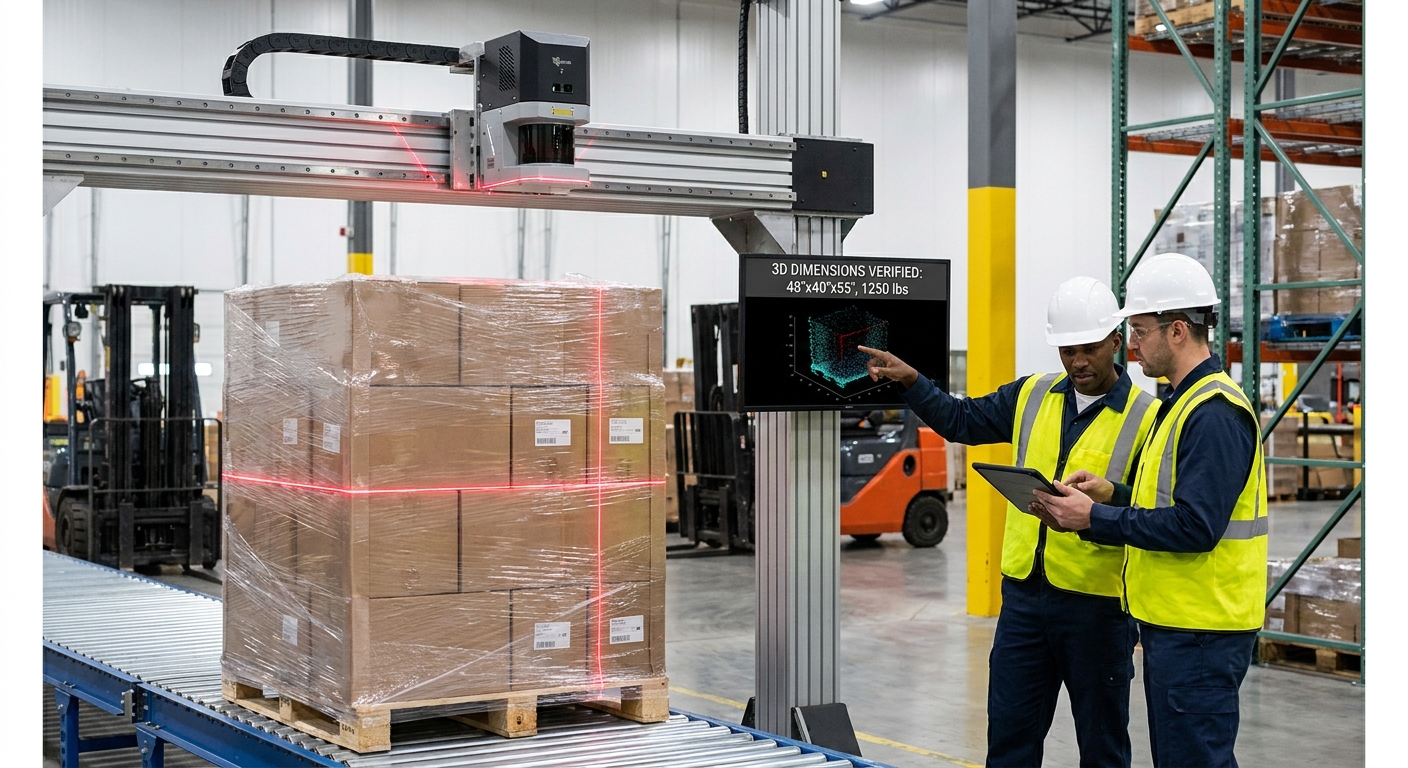
Automated Dimensioning Systems: Larger carriers and those with significant volume invest in automated dimensioning equipment. These systems, often integrated with conveyor belts or forklifts, use sensors, lasers, or cameras to capture precise dimensions as freight moves through the facility. These systems can measure hundreds of shipments per hour with high accuracy.
Hub Audits: Carriers conduct random audits at their cross-docking facilities or distribution centers. During these audits, a sample of shipments is re-measured by a supervisor or dedicated audit team to cross-reference with the initially declared dimensions. Discrepancies trigger further investigation and potential reclassification.
Visual Inspection and Palletization Checks: While not a direct measurement, carriers visually inspect how freight is presented. A pallet that appears unusually large for its declared weight might prompt a closer look and subsequent measurement. The way freight is stacked and secured on a pallet also provides indirect clues about its volume.
Data Integration and Software: Many carriers use software that integrates with their Transportation Management Systems (TMS). This software can flag shipments with potential dimension anomalies based on historical data or comparisons to declared weights.
The trend in 2026 is a clear shift towards automation. The accuracy and speed of automated systems reduce labor costs, minimize errors, and provide more reliable data for billing and operational planning. However, manual checks still play a role, especially in less technologically advanced operations or for exceptions.
How Are Freight Dimensions Measured for LTL Classification Accuracy?
Freight dimensions for LTL classification accuracy are measured using standardized methods that capture the longest, widest, and highest points of the freight item, typically a palletized unit or a single piece, to calculate its cubic volume. As of 2026, the National Motor Freight Classification (NMFC) standards, particularly those updated to reflect the NMFC 1000 Series effective July 19, 2025, require precise measurement for density calculation.
The process involves taking three distinct measurements:
- Length: The longest dimension of the freight.
- Width: The second longest dimension, perpendicular to the length.
- Height: The vertical dimension from the base to the highest point.
These three measurements are then multiplied together to determine the total cubic volume of the shipment. For example, a pallet measuring 48 inches in length, 40 inches in width, and 30 inches in height would have a cubic volume of 48 x 40 x 30 = 57,600 cubic inches.
This volume is then converted into cubic feet by dividing by 1,728 (since there are 12 inches per foot, and 12 x 12 x 12 = 1,728 cubic inches in one cubic foot). In the previous example, 57,600 cubic inches / 1,728 cubic inches/cubic foot = 33.33 cubic feet.
Density Calculation: Once the cubic volume is established, it is used to calculate density by dividing the shipment's weight by its cubic volume.
Density = Weight (in lbs) / Cubic Volume (in cubic feet)
For instance, if the pallet weighing 500 lbs has a volume of 33.33 cubic feet, its density is 500 lbs / 33.33 cubic feet = 15 lbs per cubic foot.
This density figure is a primary determinant of freight class. The NMFC guidelines provide specific density ranges for each freight class. A density of 15 lbs per cubic foot might fall into Class 150, for example, though other factors like handling and stowability also influence the final class.
Importance of Accurate Measurement:
Even minor inaccuracies can lead to significant discrepancies. If the actual height of the pallet was 32 inches instead of 30, the volume would increase to 61,440 cubic inches (40.9 cubic feet), reducing the density to approximately 12.2 lbs per cubic foot, potentially bumping the freight class up to 175. This illustrates why precision is paramount.
The NMFC 1000 Series, effective July 19, 2025, introduced updated guidelines that further emphasize the importance of standardized and accurate measurement protocols to ensure consistency across the industry. Shippers using outdated methods risk reclassification.
What Happens If Freight Dimensions Are Incorrectly Declared?
If freight dimensions are incorrectly declared, carriers will typically reclassify the shipment, leading to additional billing for the shipper based on the corrected, higher freight class and associated charges. In 2026, approximately 12% of LTL shipments are subject to reclassification due to dimension or weight inaccuracies, costing shippers an average of $85 per reclassified shipment.
The process of reclassification usually involves the following steps:
- Discovery of Discrepancy: During pickup, at a hub audit, or upon delivery, carrier personnel identify a difference between the declared dimensions and the actual measurements. This can happen through manual checks or automated system flags.
- Measurement and Recalculation: The freight is accurately measured by the carrier. The weight is also re-verified if there is any doubt. Density and subsequently the freight class are recalculated based on these accurate measurements and the NMFC guidelines.
- Notification and Additional Billing: The carrier notifies the shipper (or consignee, depending on the contract) of the discrepancy and the resulting reclassification. A supplementary invoice is issued for the difference in freight charges. This can include the increased freight cost, plus potential administrative fees.
- Dispute Resolution: If the shipper believes the reclassification is incorrect, they can initiate a dispute with the carrier. This usually requires providing proof of the original measurements, such as photos or documentation. The burden of proof often falls on the shipper to demonstrate the accuracy of their initial declaration.
Consequences of Reclassification:
- Increased Costs: The most immediate impact is higher shipping costs, often significantly so if the freight class increases substantially.
- Delayed Shipments: The reclassification process can hold up shipments while discrepancies are resolved, impacting delivery timelines.
- Damaged Shipper-Carrier Relationships: Frequent reclassifications due to inaccurate declarations can strain relationships between shippers and their carriers, potentially leading to higher rates or loss of business.
- Operational Inefficiencies: Time spent disputing charges or correcting data detracts from core logistics operations.
To avoid these issues, shippers are increasingly adopting technologies that ensure accurate measurement at the point of origin. For example, using a mobile application like FreightSizer allows for precise LiDAR-based measurement and immediate freight class determination before the shipment even leaves the dock. This proactive approach minimizes the risk of reclassification and the associated financial penalties and operational headaches.
How Does Freight Density Affect LTL Classification and Carrier Verification?
Freight density is a primary factor influencing LTL freight classification, directly impacting how carriers verify shipments and determine pricing, as it quantifies the space a shipment occupies relative to its weight. According to NMFC guidelines, lower density shipments (more space per pound) are generally assigned higher freight classes, reflecting greater potential for wasted trailer space.
The NMFC uses density ranges to assign freight classes, with lower density typically corresponding to higher classes (e.g., Class 500 for very low density). For instance, a shipment with a density of 4 lbs per cubic foot might be classified as Class 500, while a shipment with a density of 20 lbs per cubic foot might be Class 150, and a shipment with 30 lbs per cubic foot might be Class 100.
Here’s a simplified look at how density influences class, using hypothetical ranges:
| Freight Class | Density Range (lbs/cu ft) | Example Goods |
|---|---|---|
| Class 50 | 12+ | Heavy machinery, dense manufactured goods |
| Class 70 | 10-12 | Appliances, furniture, auto parts |
| Class 92.5 | 8-10 | Packaged goods, boxed machinery |
| Class 125 | 6-8 | Medium density goods, packaged electronics |
| Class 150 | 5-6 | Lighter packaged goods, some textiles |
| Class 175 | 4-5 | Very light packaged goods, upholstered items |
| Class 200 | 3-4 | Lightweight goods, some consumer products |
| Class 250 | 2-3 | Extremely light goods, high-value items |
| Class 300 | 1-2 | Very light, bulky items, some apparel |
| Class 400 | <1 | Extremely light and bulky, e.g., mattresses |
| Class 500 | <0.5 | Extremely light and bulky, e.g., styrofoam |
Note: These are illustrative ranges. Actual NMFC classification is complex and considers stowability, handling, and liability in addition to density.
Carrier Verification Process Focused on Density:
- Initial Declaration: Shippers declare the weight and dimensions, from which carriers calculate the declared density.
- Measurement Verification: Carriers verify the declared dimensions and weight. Any discrepancy directly impacts the calculated density. If a shipment is measured as larger than declared, its density decreases, potentially leading to a higher class.
- NMFC Table Lookup: Using the verified density and other NMFC criteria (stowability, handling, liability), carriers determine the correct freight class.
- Pricing Adjustment: The freight cost is then calculated based on the verified class, weight, and distance.
The NMFC 1000 Series, effective July 19, 2025, has refined density thresholds and calculation methods to ensure greater accuracy and consistency. Carriers are increasingly relying on technology to ensure their verification processes align with these updated standards. Accurate density calculation is crucial for both fair pricing and efficient network management for carriers.
What are the Latest Technologies for Measuring Freight Dimensions?
The latest technologies for measuring freight dimensions leverage LiDAR, advanced imaging, and AI to provide highly accurate, automated, and rapid data capture, significantly improving upon traditional methods. In 2026, the adoption of these technologies is accelerating as LTL stakeholders seek to mitigate reclassification errors and optimize operations.
LiDAR-Based Dimensioning:
LiDAR (Light Detection and Ranging) uses pulsed laser beams to measure distances and create precise 3D models of objects. When applied to freight, LiDAR scanners can accurately capture the length, width, and height of irregularly shaped items or entire pallets. This technology offers sub-millimeter accuracy and is not affected by ambient light conditions.
3D Imaging and Machine Vision:
High-resolution cameras and 3D imaging systems, often combined with sophisticated algorithms, can analyze the shape and volume of freight. Machine vision systems can identify the boundaries of a shipment and calculate its dimensions automatically as it passes through a checkpoint.
AI and Machine Learning for Classification:
Artificial intelligence and machine learning are increasingly integrated with dimensioning hardware. These systems can not only capture dimensions but also analyze the data to predict freight class, identify potential hazards, or even detect damage. AI can learn from vast datasets to improve accuracy over time and flag shipments that deviate from expected norms.
Mobile Dimensioning Apps:
For smaller operations or for shippers needing to verify dimensions at the point of origin, mobile applications utilizing smartphone LiDAR sensors offer a powerful solution. These apps can quickly scan a piece of freight, calculate its dimensions, determine its density, and even suggest an LTL freight class based on NMFC guidelines. This allows for proactive data verification before the shipment is tendered to a carrier.
Automated Dimensioning Systems at Facilities:
Many LTL carriers and 3PLs are installing automated dimensioning systems at their hubs. These systems, often integrated into conveyor lines or sorters, capture dimensional data for every package or pallet that passes through. This provides a continuous stream of accurate data for load planning, billing, and auditing.
Benefits of Advanced Technologies:
- Increased Accuracy: Reduces human error inherent in manual measurement.
- Speed and Efficiency: Automates data capture, speeding up the shipping process.
- Cost Reduction: Minimizes reclassification charges and associated administrative costs.
- Improved Load Optimization: Accurate volume data allows for better trailer space utilization.
- Data-Driven Insights: Provides valuable data for operational analysis and forecasting.
These technologies are transforming how freight dimensions are verified, moving the industry towards greater precision and efficiency. For LTL carriers, 3PLs, and shippers alike, embracing these advancements is becoming essential for competitive operations.
Frequently Asked Questions
What is the most common method carriers use to verify freight dimensions?
Carriers commonly use a combination of manual measurements by dock personnel and automated dimensioning systems at their sorting hubs. While manual checks persist, automated systems are increasingly prevalent for efficiency and accuracy, especially among larger carriers.
How often do carriers re-measure my LTL freight?
Carriers may re-measure freight during pickup if it appears significantly different from the declared dimensions, during random audits at their hubs, or if a discrepancy is flagged by automated systems. It's not a constant process for every shipment but occurs based on suspicion or standard audit procedures.
Can I dispute a reclassification of my freight dimensions?
Yes, shippers can dispute a reclassification. This typically involves providing documentation of the original measurements, such as photos or data from a dimensioning device, to prove the accuracy of the initial declaration.
What are the latest NMFC guidelines for freight classification effective in 2026?
The NMFC 1000 Series, which became effective July 19, 2025, introduced updated guidelines. These revisions place a greater emphasis on precise density calculation and standardized measurement protocols to ensure consistent and accurate freight classification across the industry.
How can I avoid LTL freight reclassification charges due to dimension errors?
To avoid reclassification charges, ensure accurate measurement of your freight at the point of origin. Utilize reliable measurement tools or apps, double-check declared dimensions against actual measurements, and understand the NMFC guidelines for density and class determination.
Conclusion
The rigorous verification of freight dimensions by LTL carriers in 2026 is a critical component of accurate classification, fair pricing, and efficient logistics operations. From manual tape measures to advanced LiDAR-based systems, carriers employ diverse methods to ensure shipments conform to NMFC standards, particularly as updated in the NMFC 1000 Series effective July 19, 2025. Understanding these verification processes empowers shippers, freight forwarders, and 3PLs to proactively manage their shipments, minimize the risk of costly reclassifications, and optimize their supply chains. Embracing accurate dimensioning technology is no longer a luxury but a necessity for navigating the complexities of modern LTL freight.