
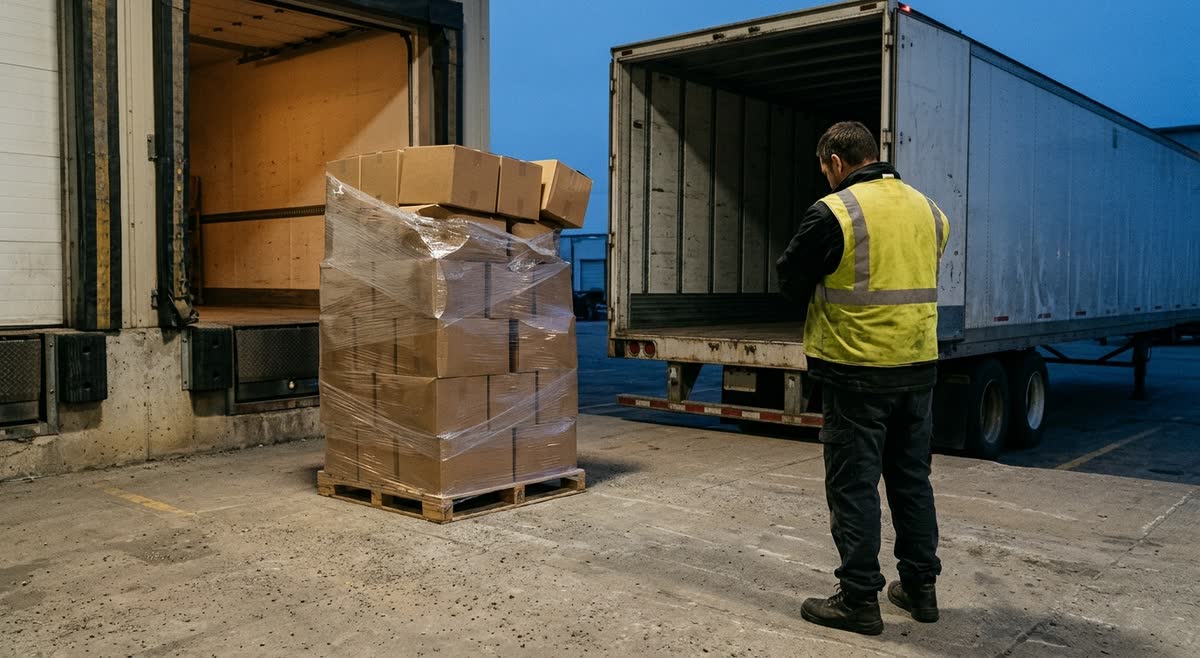
Inaccurate dimensions expose you to reclassification, correction fees, higher freight charges, over-length and cubic minimum charges, longer transit and, at the extreme, freight the carrier can send back. Overstated dimensions carry the opposite risk: you can pay for a higher class than the freight deserves, and nobody is obliged to catch it.
How does a small measuring error change the freight bill?
Density is weight divided by volume, expressed in pounds per cubic foot, so every inch you record feeds straight into the density figure and, on density-rated freight, into the class. The National Motor Freight Traffic Association (NMFTA) warned on 19 June 2025 that even a small difference in how dimensions are calculated can move an item into a different class, with reclassifications, back charges or shipping delays as the result.
Here is how that plays out, using an example of our own. Take a 500 lb pallet entered on the bill of lading at 48 x 40 x 54 inches. That is 60 cubic feet and 8.33 pounds per cubic foot. On the 13-step density scale in Item 26 of XPO's tariff CNWY 199-AK.2, effective 18 May 2026, it falls in the band "8 but less than 10", which is class 100.
Now suppose a carton hangs 2 inches past the pallet edge and the real height is 56 inches. The shipment now measures 48 x 42 x 56, which is 65.33 cubic feet and 7.65 pounds per cubic foot. That lands in "6 but less than 8", class 125. Four inches of error moved the freight one class, and the weight never changed.
An error costs money when it crosses a line. A pallet in the middle of a band can absorb a wrong inch; one near the edge cannot, and you only know which you have after measuring properly.
What does a wrong dimension cost after the carrier inspects it?
You face two costs: the re-rated freight and a fee on top. XPO's Item 26 makes every shipment subject to inspection at any time. When an inspection corrects density, lineal foot, cubic capacity or classification and the linehaul rises by $1 or more, XPO adds a $47.85 correction fee and adjusts freight, fuel surcharge and accessorials to match.
The figures below come from two published tariffs, XPO's and ABF Freight's ABF 111-AU, last revised 21 August 2026. Account pricing can carry exceptions, so check the tariff named in your own agreement.
| Trigger | XPO (CNWY 199-AK.2) | ABF Freight (ABF 111-AU) |
|---|---|---|
| Carrier corrects the shipment | $47.85 when linehaul rises by $1 or more (Item 26) | $55 per freight bill when a description or classification correction moves net charges by $10 or more (Item 420) |
| Shipper asks to change the bill of lading | $49.80 per correction, with conclusive documentary proof (Item 205) | $54 per change; a change in description or weight needs satisfactory documentation (Item 362) |
| Piece reaches 8 ft, under 11 ft | $460 per shipment, on length (Item 238) | $375 per shipment per trailer, on any dimension (Item 670) |
| Piece reaches 20 ft or more | $4,950 per shipment, on length (Item 238) | $1,450 up to 27 ft; $3,000 above 27 ft if it moves at all, on any dimension (Item 670) |
| Tall freight | 96 inches used for the cube at 75 inches or taller (Item 26) | 8 ft used for the cube when top loading is precluded, including height over 60 inches (Item 110) |
Timing adds a risk of its own. Under 49 U.S.C. § 13710, a carrier seeking more than it billed and collected has 180 days from receipt of the original bill to issue the additional one. A shipment that looked profitable at booking can change long after you have invoiced your own customer, which is how brokers and 3PLs can lose margin on freight they never touched. See also the true cost of reweigh and reclass charges.
Which measurements trigger charges that are not about class?
Some tariff rules behave like cliffs: one measurement crosses a line and a different calculation applies.
Height. XPO uses 96 inches as the vertical dimension for any article 75 inches or taller, unless the actual measurement is greater. In a second example of ours, an 800 lb pallet at 48 x 40 x 74 inches is 82.22 cubic feet, 9.73 pounds per cubic foot and class 100 on XPO's scale. Read it at 75 inches and the cube is figured at 96: 106.67 cubic feet, 7.50 pounds per cubic foot, class 125. ABF sets its line lower, using 8 feet when top loading is precluded, and shipment height above 60 inches is one of the listed reasons.
Length. A crate logged at 94 inches that really measures 96 has reached 8 feet, which brings the $460 or $375 charge in the table above.
Width. ABF uses a minimum width of 8 feet in its effective occupancy calculation once the extreme width of a shipment reaches 6 feet.
Trailer space. XPO's Item 233 applies a cubic capacity minimum to shipments of 350 to under 750 cubic feet below 3 pounds per cubic foot, and to shipments of 750 cubic feet or more below 6 pounds per cubic foot. It multiplies total cubic feet by 6 to reach a rated weight, then rates that at class 125. Under the same item, the shipment pays the higher of this rate or the customer's otherwise applicable pricing.
A carrier's number may not match the size of the carton. ABF's Item 110 uses the "greatest (most extreme) straight-line dimensions" of the space a shipment occupies, so one protruding corner can set the number for the whole shipment. Our guide to measuring irregular shaped freight covers how to capture those points.
Can inaccurate dimensions delay or stop a shipment?
Yes. ABF adds two days to advertised transit times for over-dimension freight under Item 670, which starts at 8 feet, so a delivery date promised from a standard transit time is already two days short.
Past a certain size the shipment itself is in question. ABF states it is not obligated to pick up or transport articles with a dimension over 27 feet, and that it may return one it picked up by mistake. Dimensions can also change who does the work at the dock: under Item 750, the customer handles loading or unloading regardless of weight when, for example, freight exceeds 4 feet in any two dimensions. A receiver expecting a standard pallet may not be ready for that.
What happens if you overstate dimensions to be safe?
You can end up overpaying, because padding is not a safe hedge. A bigger recorded cube means lower density, which can mean a higher class that you pay for from the first invoice. XPO's Item 26 says the carrier is not obligated to inspect, so no one has to catch the overpayment for you.
Fixing it afterwards is uncertain. XPO's Item 205 allows changes within 30 days after the shipment is accepted, but it will not accept a corrected bill of lading changing density or cubic feet without conclusive documentary proof, and the decision rests in its sole discretion. ABF's Item 362 permits a change in description or weight only with satisfactory documentation. A shipper contesting a bill has 180 days from receiving it under § 13710, but that is a right to contest and does not promise a refund.
Leaving dimensions off carries its own price. XPO's Item 28 assesses charges initially at class 150 when actual density is not shown and the shipment is inadvertently accepted. ABF applies its minimum height and width to each individual piece when shipment dimensions are not available.
Does the measuring device itself create a risk?
It can, if you charge someone based on the measurement. Section 5.58 of NIST Handbook 44, 2026 edition, applies to dimension and volume measuring devices used to calculate freight, storage or postal charges. It sets maintenance and acceptance tolerances at plus or minus 1 division, and information offered "available upon request" must be kept by the party issuing the invoice for at least 30 calendar days after invoicing.
How that code applies to you depends on your state's weights and measures rules, the device and how you use it. If you rebill customers or charge storage on measured dimensions, ask your state office before you rely on any tool, and read our article on certified dimensioning equipment.
How do you reduce these risks at the dock?
- Measure last. Measure once the freight is wrapped and on its pallet, at its extreme points. NMFTA's advice is to measure down to the inch and always include pallets or packaging.
- Record every handling unit. Do not copy a typical pallet size from a spreadsheet.
- Flag thresholds before printing the bill of lading. Check height at 60 and 75 inches, width at 6 feet and length at 8 feet against the tariffs of the carriers you actually use.
- Calculate density before booking. See how close the result sits to a band edge, and take a second measurement when it is close.
- Keep the proof. XPO's Item 205 names a commercial invoice or packing slip, with a pre-printed specification sheet or catalog page listing the description, weight and shipping dimensions, as acceptable proof. Our guide to documenting shipment dimensions covers what else to file.
- Review every correction. A correction that repeats on the same product points to wrong master data, not to one bad reading.
Consistency is the hard part with a tape, because two people can read the same overhang differently. FreightSizer is an iPhone and iPad app that measures freight dimensions with LiDAR, calculates density and determines LTL freight class in line with NMFTA guidelines, so the measurement and the density check can happen where the pallet stands, without a tape measure or dedicated dimensioning hardware. Whichever tool you use, FreightSizer included, the carrier's tariff still decides how a measurement is applied.
Frequently Asked Questions
Can a carrier change my freight class after pickup?
Yes. XPO's tariff makes shipments subject to inspection at any time, and ABF's provides for correcting description and classification errors on the bill of lading. A correction brings re-rated freight and, once the tariff's threshold is met, a fee.
Does a small dimension error always change the class?
No. On density-rated freight the class changes only when density crosses a band on the scale, which a rule such as the height lines above can force by changing the cube. Freight with an NMFC item that is not density-based can respond differently, and ABF's tariff says freight-all-kinds provisions take precedence over other published provisions for the customer or third-party payor, subject to its Item 765.
Is it safer to round dimensions up?
No. Rounding up lowers density and can push freight into a higher class from the start, and correcting it later takes documentation and, at XPO and ABF, a fee. Record what you measured: ABF's Item 564 rounds to the nearest inch, so 0.5 inch or more goes up and anything less goes down.
How long can a carrier wait to bill more for wrong dimensions?
Under 49 U.S.C. § 13710, a carrier seeking additional charges must issue the bill within 180 days of receipt of the original bill to keep the right to collect them if the payor contests. A shipper has 180 days from receiving a bill to contest it. Your contract may set different terms, so check it as well.