
How to Measure Irregular Shaped Freight Accurately in 2026
Measuring irregular shaped freight accurately is crucial for determining correct LTL freight class, optimizing shipping costs, and avoiding costly reclassification charges, with traditional methods often leading to significant discrepancies. In 2026, advancements in technology are revolutionizing how logistics professionals tackle this challenge, offering precision and efficiency previously unattainable. This article will guide you through the best practices and modern solutions for measuring irregularly shaped freight, ensuring compliance with evolving industry standards like the NMFC standards effective July 19, 2025.
Key Takeaways
- Accurate measurement of irregular freight is paramount for correct LTL freight classification.
- Traditional methods like tape measures and visual estimation introduce significant error margins, often exceeding 15%.
- Understanding LTL freight classes, defined by the National Motor Freight Classification (NMFC), is essential for accurate billing.
- Density calculation is a primary factor in determining freight class for most shipments.
- Modern dimensioning technology, utilizing LiDAR, offers a significant improvement in measurement accuracy and speed.
- Compliance with the NMFC standards, updated as of July 19, 2025, requires precise dimensional data.
Why is Measuring Irregular Shaped Freight So Challenging?
Measuring irregular shaped freight presents significant challenges due to its non-uniform geometry, making standard cubic measurement difficult. Unlike rectangular pallets, items with protrusions, curves, or odd angles do not fit neatly into simple length x width x height calculations. This inherent complexity often leads to under or overestimation of volume, directly impacting freight class determination and subsequent shipping costs.
The primary difficulty lies in capturing the true external dimensions that a carrier will encounter. Protrusions, gaps, or uneven surfaces mean that a single tape measurement might not represent the maximum extents. This ambiguity is a fertile ground for errors, especially when relying on manual methods. Without a consistent and accurate volumetric capture, the risk of incorrect classification and potential penalties from carriers increases substantially.
How Do Carriers Determine Freight Class for Irregular Items?
Carriers determine freight class for irregular items by applying the National Motor Freight Classification (NMFC) system, which categorizes shipments based on density, handling, stowability, and liability. For irregular shapes, the process begins with accurately capturing the maximum external dimensions to calculate the total volume. This volume, combined with the actual weight, yields the shipment's density.
Density is a critical determinant, with shipments falling into different classes based on their weight per cubic foot. For example, a shipment with a density between 2 and 3 pounds per cubic foot might fall into Class 70, while a denser shipment of 10-12 pounds per cubic foot could be Class 50. The NMFC's Item 100 classification often applies to shipments that do not fit standard commodity descriptions, further emphasizing the need for precise dimensional data.
What Are the Most Common Errors When Measuring Irregular Freight Manually?
The most common errors in manually measuring irregular freight stem from inconsistent application of measurement points and subjective estimation of volume. Using a tape measure on curved or angular surfaces can lead to inaccurate readings if not applied tautly and across the absolute extremes. Furthermore, visual estimation of volume for complex shapes is inherently prone to bias and significant inaccuracies, often by 10% or more.
These errors compound when calculating density. An overestimation of volume will result in an artificially low density, potentially leading to a lower (and incorrect) freight class and underpaid shipping charges. Conversely, underestimating volume can result in an artificially high density, leading to an overpaid charge. The NMFC standards effective July 19, 2025, place even greater emphasis on precise dimensional data, making manual methods increasingly unreliable.
What Technologies Can Accurately Measure Irregular Shaped Freight?
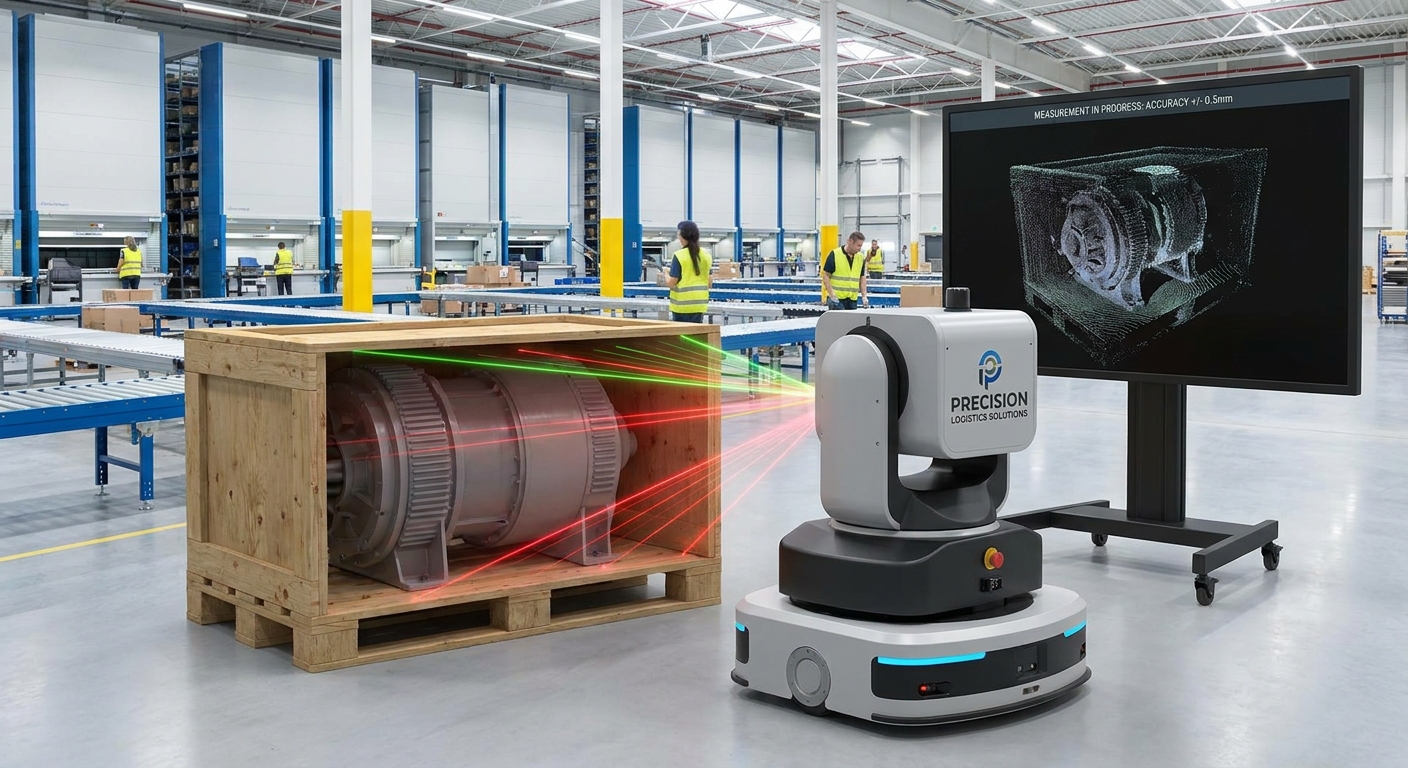
Modern technologies, particularly those leveraging LiDAR (Light Detection and Ranging), offer unparalleled accuracy and efficiency in measuring irregular shaped freight. LiDAR scanners emit laser pulses and measure the time it takes for them to return, creating a precise 3D point cloud of the object's geometry. This data can then be processed to calculate exact volume and dimensions, even for highly complex shapes.
These systems eliminate the subjectivity of manual measurements. They capture the absolute maximum extents of the freight, ensuring that calculations for density and subsequent freight class are based on factual, repeatable data. This is a significant leap from traditional methods, moving towards a more data-driven and accurate logistics process.
How Does LiDAR Technology Work for Freight Dimensioning?
LiDAR technology works by emitting millions of laser pulses per second from a sensor. These pulses travel outwards and reflect off the surfaces of the object being measured. The sensor then detects the returning pulses and calculates the distance to each point on the object based on the time-of-flight of the laser pulse.
This process generates a dense, three-dimensional "point cloud" – a collection of millions of individual data points, each with its own X, Y, and Z coordinates. Sophisticated algorithms process this point cloud to define the object's outer boundaries, identify its true length, width, and height, and then precisely calculate its total volume, regardless of its shape.
What are the Benefits of Using LiDAR-Based Dimensioning Tools?
The benefits of using LiDAR-based dimensioning tools are manifold, directly addressing the challenges of irregular freight measurement. They provide objective, highly accurate volumetric data, eliminating human error and subjective interpretation. This leads to more precise LTL freight classification, reducing the likelihood of costly reclassification fees and disputes with carriers.
Furthermore, these tools significantly speed up the measurement process. Instead of multiple manual measurements and calculations, a single scan can capture all necessary dimensional data in seconds. This efficiency boost is critical in fast-paced logistics environments. The enhanced accuracy also supports better warehouse slotting, optimized trailer loading, and more reliable freight spend analysis.
How Does Freight Density Influence LTL Freight Class?
Freight density is a primary determinant for LTL freight class, as outlined by the NMFC. The NMFC uses density brackets to assign a freight class, which is a numerical value from 50 to 500. Generally, the lower the density (more space occupied per pound), the higher the freight class and the higher the shipping cost. Conversely, higher density shipments are typically assigned lower classes and cost less to ship.
For example, a shipment weighing 100 pounds and occupying 10 cubic feet has a density of 10 pounds per cubic foot. This might place it in a lower, more economical class. If the same 100-pound shipment occupied 50 cubic feet, its density would be 2 pounds per cubic foot, likely resulting in a much higher freight class and significantly increased shipping costs. Accurate density calculation is therefore fundamental to fair and accurate LTL billing.
Understanding Density Brackets and Their Impact on Class
Density brackets are specific ranges of weight per cubic foot defined by the NMFC. Each bracket corresponds to a particular freight class. For instance, under the current NMFC guidelines, a shipment with a density between 2.0 and 3.99 lbs/cu ft might fall into Class 70. If the density increases to between 4.0 and 5.99 lbs/cu ft, the class could drop to Class 65.
This sensitivity means that even a small error in measuring dimensions, which directly affects the calculated volume and thus density, can lead to a jump to a higher freight class. This is particularly problematic for irregular shapes where accurate volume calculation is inherently difficult. Adhering to the NMFC standards effective July 19, 2025, requires precise adherence to these density brackets.
How to Calculate Density for Irregular Freight
To calculate density for irregular freight, you first need to determine its precise external volume. This involves measuring the absolute maximum length, width, and height that the freight occupies in three-dimensional space. For irregular shapes, this is where manual methods fall short. Once the volume in cubic feet (cu ft) is accurately determined, you divide the total weight of the shipment in pounds (lbs) by this volume.
The formula is: Density (lbs/cu ft) = Weight (lbs) / Volume (cu ft).
For example, if an irregularly shaped item weighs 150 lbs and its accurately measured external volume is determined to be 25 cu ft, its density is 150 lbs / 25 cu ft = 6.0 lbs/cu ft. This density value is then cross-referenced with the relevant NMFC tariff to assign the correct freight class.
What is the NMFC and Why is Compliance Crucial in 2026?
The National Motor Freight Classification (NMFC) is a publication developed by the National Motor Freight Traffic Association (NMFTA) that categorizes all types of commodities shipped via LTL freight. It assigns a specific freight class to each commodity based on its density, handling characteristics, stowability, and liability. Compliance with the NMFC is crucial for accurate billing, dispute resolution, and avoiding penalties.
In 2026, with the NMFC standards updated as of July 19, 2025, the emphasis on precision in dimensional data and density calculation is stronger than ever. Carriers are increasingly leveraging technology to audit shipments, and any discrepancies found in freight class based on inaccurate measurements can lead to significant back charges and administrative burdens. Understanding and adhering to these updated standards is not optional; it is a necessity for efficient LTL operations.
What Changes Were Introduced with the NMFC Standards Effective July 19, 2025?
The NMFC standards effective July 19, 2025, introduced several refinements aimed at increasing accuracy and reducing ambiguity in freight classification. While the core principles of density, handling, stowability, and liability remain, there was a particular focus on standardizing the measurement of dimensional weight and clarifying requirements for irregularly shaped items.
These updates often involve adjustments to density brackets, introducing new sub-classes, or providing more explicit guidance on how to measure items that do not conform to standard pallet dimensions. The goal is to ensure that all parties—shippers, carriers, and brokers—are working from a common, data-driven understanding of shipment characteristics, thus minimizing disputes and ensuring fair pricing.
How Can Shippers Ensure Compliance with NMFC Standards?
Shippers can ensure compliance with NMFC standards by implementing rigorous internal processes for freight measurement and classification. This begins with a thorough understanding of the NMFC publication and its specific requirements for the commodities being shipped. Investing in accurate dimensioning technology is paramount, especially for irregular shapes.
Utilizing tools that can precisely capture external dimensions and calculate density automatically reduces the risk of human error. Furthermore, maintaining detailed records of all measurements, weights, and classifications for each shipment provides a robust defense against carrier audits and reclassification challenges. Regularly reviewing and updating classification data based on the latest NMFC revisions is also essential.
What Are the Consequences of Incorrect LTL Freight Classification?
The consequences of incorrect LTL freight classification can be substantial, impacting both financial and operational aspects of a business. The most immediate impact is financial, as incorrect classification often leads to underpayment of freight charges. When carriers audit shipments, they will reclassify the freight based on their measurements and NMFC guidelines, resulting in back charges for the difference.
These back charges can include the difference in freight cost, plus potential administrative fees, interest, and penalties. Beyond direct costs, incorrect classification can damage relationships with carriers, lead to increased scrutiny of future shipments, and disrupt supply chain planning due to unpredictable freight expenses. For shippers of irregular freight, where measurement errors are common, these consequences are a significant risk.
How Can Technology Help Mitigate Reclassification Charges?
Technology, particularly advanced dimensioning systems, can significantly mitigate reclassification charges by providing irrefutable, accurate data. Systems that utilize LiDAR to capture precise external dimensions and automatically calculate volume and density eliminate the subjective errors common in manual measurement. This objective data serves as a strong basis for initial freight classification.
When a carrier audits a shipment, having a digital record of precise measurements taken at the point of origin can be used to verify the initial classification. This data-driven approach reduces the carrier's ability to arbitrarily reclassify based on potentially flawed independent measurements. It fosters transparency and trust in the billing process, thereby minimizing disputes and associated charges.
What Tools are Available for Measuring Irregular Freight Accurately?
For logistics professionals seeking to accurately measure irregular freight and avoid classification issues, modern solutions are available that replace outdated methods. Tools that leverage advanced sensor technology are becoming indispensable.
For instance, a dedicated mobile application like FreightSizer utilizes an iPhone or iPad's LiDAR scanner to capture detailed 3D measurements of freight. This app calculates volume and density according to NMFC standards, directly addressing the challenges of irregularly shaped items. It replaces the need for manual tape measurements and separate dimensioning hardware, streamlining the process and enhancing accuracy significantly. By providing precise dimensional data, it supports correct LTL freight classification and helps prevent costly reclassification fees.
Comparing Traditional vs. Modern Freight Dimensioning Methods
The evolution from traditional to modern freight dimensioning methods represents a critical shift towards accuracy and efficiency in LTL logistics. Traditional methods, such as using tape measures and visual estimation, are prone to significant human error, often resulting in volume discrepancies of 10-15% or more. This leads directly to inaccurate density calculations and incorrect freight class assignments.
Modern methods, particularly those employing LiDAR technology, offer a stark contrast. They capture precise 3D data, producing highly accurate volumetric measurements with minimal error margins, often less than 1%. This accuracy translates into correct density calculations, reliable freight class assignments, and a significant reduction in disputes and reclassification charges. The speed and ease of use of modern tools also contribute to operational efficiencies.
| Feature | Traditional Methods (Tape Measure, Visual) | Modern Methods (LiDAR App) |
|---|---|---|
| Accuracy | Low (10-15% error margin common) | High (sub-1% error margin possible) |
| Speed | Slow (requires multiple measurements) | Fast (single scan captures all data) |
| Objectivity | Subjective, prone to user bias | Objective, data-driven |
| Complexity | Difficult for irregular shapes | Handles complex shapes with ease |
| Data Recording | Manual, prone to transcription errors | Automated, digital records, cloud storage |
| Cost | Low initial hardware cost | Moderate initial investment, often subscription-based |
| Compliance (2025+ NMFC) | Increasingly insufficient | Designed to meet stringent data requirements |
Frequently Asked Questions
How do I measure the volume of a freight item that isn't a standard box?
For non-standard shapes, you need to capture the absolute maximum external dimensions in length, width, and height. Advanced tools like LiDAR-based apps can scan the entire object, creating a 3D model to calculate its precise volume automatically, eliminating subjective measurements.
What if my freight has protrusions that stick out?
Protrusions must be included in the overall measurement as they represent the total space the freight will occupy. LiDAR scanners accurately capture these external features, ensuring the volume calculation accounts for all parts of the shipment, no matter how irregular.
Can a simple length x width x height calculation work for irregular freight?
No, a simple L x W x H calculation is only accurate for perfectly rectangular or cubic items. For irregular shapes, it will either overestimate or underestimate the actual volume, leading to incorrect density and freight class.
How often are NMFC standards updated?
The NMFC standards are typically updated periodically, with significant revisions occurring annually. The NMFC standards effective July 19, 2025, represent the latest comprehensive update, and staying informed about future changes is crucial for ongoing compliance.
What is the best way to document my freight measurements for carrier audits?
The best practice is to maintain digital, timestamped records of your measurements. Using dimensioning apps that generate reports with the captured data, including 3D models or point clouds, provides strong evidence to support your freight classification.
Conclusion
Accurately measuring irregular shaped freight is no longer an insurmountable challenge in 2026. The complexities introduced by non-uniform geometries have historically led to significant errors in freight classification and costly reclassification charges. However, by embracing modern dimensioning technologies, logistics professionals can achieve unprecedented levels of precision and efficiency. Adopting solutions that leverage LiDAR for precise 3D scanning ensures that density calculations are accurate, freight classes are correctly assigned according to the latest NMFC standards effective July 19, 2025, and operational costs are better managed. Investing in these advanced tools is essential for any freight forwarder, LTL carrier, 3PL provider, warehouse team, or shipper aiming to optimize their logistics operations and maintain compliance in today's data-driven environment.