
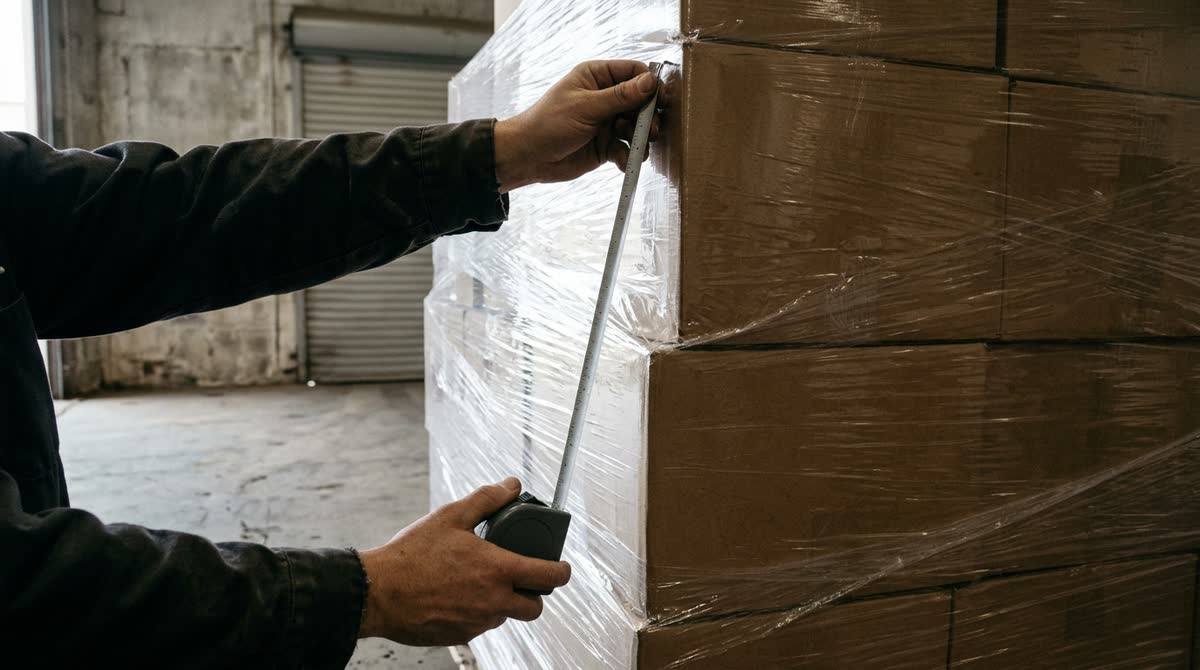
Shippers should measure and weigh their own freight and write the dimensions of every handling unit on the bill of lading, then treat the carrier's dimensioner as a check on those numbers, not a replacement for them. If you leave the measuring to the carrier, you learn your freight class from the invoice, after the freight has moved, when the only tool left is a dispute.
That answer has become firmer since density started deciding the class of so much LTL freight.
Why does it matter who measures the freight?
Because for density-rated freight, the dimensions, together with the weight, set the class. The National Motor Freight Traffic Association's Disposition Bulletin 1371, dated 21 March 2025, set 19 July 2025 as the effective date for Docket 2025-1 and moved the amended items onto the standard 13-subprovision density scale. On that scale, freight of 12 to less than 15 pounds per cubic foot rates at class 85, and freight of 15 to less than 22.5 pounds per cubic foot rates at class 70.
A few inches of height can push a pallet across that line. Take a 48 × 40 inch pallet that weighs 1,000 pounds:
| Measured height | Cubic feet | Density (lb per cubic foot) | Class on the 13-sub scale |
|---|---|---|---|
| 52 inches | 57.8 | 17.3 | 70 |
| 62 inches | 68.9 | 14.5 | 85 |
The weight did not change. Only the recorded height did, and the class moved from 70 to 85. Whoever records that height decides which row you pay for, so it should be you, before the truck arrives, not a machine at the carrier's terminal after it leaves.
Carriers enforce this. FedEx Freight began enforcing the NMFC updates on 1 December 2025, and said shipments with incomplete or inaccurate information on the bill of lading could be subject to an inspection surcharge.
What do you give up by relying on the carrier's dimensions?
Carriers are making wider use of dimensioners. In a Transport Topics report of 14 August 2026, Dayton Freight Lines' chief operating officer, Anthony Rocco, said the carrier now has more than 60 dimensioners to aid measurement of the length, width, height and weight of packages or pallets. In the same report, R+L Carriers' senior vice president of sales, Jason Cox, spoke of "the wider use of dimensioning" and said many shippers "still aren't completing the bill of ladings correctly, describing the freight properly."
When your bill of lading is blank or wrong, the carrier's reading becomes the number you are billed on. Three things follow:
- You learn the class late. The rate you quoted, and perhaps passed on to your own customer, was built on a class you guessed. The correction arrives as a rebill.
- You can pay for the inspection as well as the difference. On top of the higher class, an inaccurate or incomplete bill of lading can bring an inspection surcharge, as the FedEx Freight enforcement shows.
- You have nothing to argue with. A dispute without your own measurement, weight and photo from the day of shipping is your word against the carrier's device reading.
Rocco's advice to shippers in that report was to check the packaging and the NMFC item, "then put the length, width, height on it, and then go to the 13-tier density scale and see if it fits there," because the carrier would rather not bill and then rebill.
Is the carrier's dimensioner more accurate than your tape measure?
A device built to the code is held to tight tolerances, but it measures something different from what many shippers measure. Dimensioners used to calculate freight charges fall under Section 5.58 of NIST Handbook 44, the code for multiple dimension measuring devices. Its 2026 edition sets maintenance and acceptance tolerances of plus or minus one division, and says the National Type Evaluation Program accepts for evaluation only devices that meet every requirement of the code.
The detail that catches shippers is in the same code: the dimensions a dimensioner reports are those of the smallest box (a hexahedron) the measured object could be enclosed in, not those of the object itself. A carton standing proud on top of the stack, a corner of product hanging over the deck, stretch wrap pulled out on one side: the device boxes all of it. In the table above, the 62-inch reading could be one carton sitting on top of a 52-inch stack.
So a higher carrier reading does not necessarily mean the machine is wrong. It can come from the shipper measuring the neat part of the load, or measuring before the final wrap, while the carrier measures the outer envelope. When that is the cause, it is a dock-procedure problem, and you can fix it on your side.
How should shippers measure freight themselves?
Measure each handling unit exactly as it will be tendered, the way a dimensioner will see it:
- Finish the unit first. Measure after wrapping, banding and labelling, with the pallet included.
- Measure to the extreme points. Length and width at the widest points, overhang included; height from the floor to the highest point, not to the top of the main stack. Our guide on how to measure a pallet for LTL shipping covers the awkward cases.
- Weigh it on a scale, not from the product master. Density is weight divided by cubic feet, so a weight error moves the class just as a dimension error does.
- Work out density and class before you quote, and see how close you are to a break point. A unit that sits just above or below a boundary deserves a second measurement. The arithmetic is in how to calculate freight density for LTL shipments.
- Write length, width, height and weight for each handling unit on the bill of lading, next to the NMFC item and class.
- Photograph the unit with its measurements visible, and file the photo with the shipment record.
The tape measure is the slow, error-prone step. A LiDAR app on an iPhone or iPad, such as FreightSizer, measures the dimensions, calculates density and determines the LTL class in line with NMFTA guidelines, including the NMFC standards effective 19 July 2025, so the dimensions, density and class on the bill of lading come from one workflow instead of tape readings copied into a calculator. It replaces the tape measure for this job; it does not stop a carrier from inspecting the freight.
When is it reasonable to lean on the carrier's numbers?
There are cases where measuring every shipment from scratch buys little:
- Freight with a fixed class. After the changes, FedEx Freight described standardized density scales for freight with no handling, stowability and liability issues, and unique identifiers for commodities with special needs. If your commodity carries a fixed class rather than a density scale, a few inches of height will not move its class, although accurate dimensions on the bill of lading still help.
- Identical repeat units far from a break point. If a SKU always ships in the same pallet pattern and sits well inside one density band, measure it carefully once, document it, and measure again whenever the packaging, the pallet or the pattern changes.
- Rebills as feedback. When a corrected invoice arrives, compare the carrier's reading with your record. It shows which packing station, product or shift drifts, which is more useful than measuring everything twice.
What you should not do is skip your own declaration because measuring takes too long. If the tape measure is the bottleneck, change the tool: an app like FreightSizer replaces both the tape and dedicated dimensioning hardware. Leaning on the carrier should mean accepting its check, not handing it the job.
What should you do when the carrier's dimensions differ from yours?
Start with the record. Handbook 44 lists the information a dimensioner's user has to give or make available to the customer, and says information "available upon request by customer" must be kept by the party that issued the invoice for at least 30 calendar days after the date of invoicing. Ask for the dimensioner reading, and any photo, as soon as the corrected invoice lands.
Then compare like with like. If the carrier's height beats yours, check your photo for a carton or overhang above the main stack, because the device reports the smallest enclosing box. If your record shows the unit as tendered and the difference remains, dispute it with the photo, your measurements, the scale ticket and the bill of lading. Our articles on documenting shipment dimensions to win disputes and how to dispute a freight reclassification charge walk through the paperwork.
Mind the clock. Under 49 U.S.C. § 13710, a carrier must issue any bill for charges beyond those originally billed within 180 days of the receipt of the original bill to keep the right to collect them, and a shipper must contest the original or a later bill within 180 days of receiving it to keep the right to contest those charges. A dispute filed in the first week with your own measurements attached is a far easier conversation than one filed in the fifth month with nothing.
Frequently Asked Questions
Does writing dimensions on the bill of lading stop the carrier from reclassifying my freight?
No. The carrier can still inspect and measure the freight, and bill on its own reading if it differs from yours. Your dimensions avoid the incomplete-bill problem that can bring an inspection surcharge, and they give you a record to point to if the carrier's number differs.
Why is the carrier's height higher than mine when I measured carefully?
A dimensioner reports the smallest box the whole unit fits inside, so the highest carton, wrap or product corner sets the height. Measure from the floor to the highest point of the finished, wrapped unit, and take a photo that shows it.
How long do I have to dispute a reclassification or reweigh charge?
Under 49 U.S.C. § 13710, a shipper must contest a bill within 180 days of receiving it to keep the right to contest those charges. Ask for the dimensioner record early, because Handbook 44 only requires information held "available upon request" to be kept for 30 calendar days after invoicing.
Which shipments are most worth measuring ourselves?
Units whose density sits close to a break point on the 13-subprovision scale, irregular or overhanging loads, and anything with new or changed packaging. Those are the shipments where a few inches move the class, and where your own measurement and photo count most if the carrier disagrees.