
NMFC Reclassification: What Shippers Must Do Differently Now in 2026
Shippers must proactively adapt their freight classification and measurement processes to comply with updated NMFC standards and avoid unexpected reclassification charges, particularly with the NMFC 1000-1100 series amendments effective July 19, 2025, which impact density calculations and class determinations for a broader range of goods. The logistics landscape in 2026 demands greater precision and adherence to evolving regulatory frameworks to maintain cost predictability and operational efficiency.
A recent industry survey indicated that 38% of LTL shipments experienced reclassification in 2025, leading to an average of 15% in additional freight costs for affected shippers. This highlights the critical need for a paradigm shift in how freight data is captured and classified.
This article will delve into the core changes brought about by the NMFC amendments, explore the critical role of accurate freight measurement, and provide actionable strategies for shippers to navigate these evolving requirements successfully. We will examine the implications for various stakeholders within the supply chain and offer insights into best practices for ensuring compliance and optimizing LTL freight operations.
Key Takeaways
- Mandatory Density Recalculation: Shippers must now recalculate freight density using precise dimensional data for all LTL shipments, as the NMFC 2025 updates emphasize volumetric efficiency.
- Proactive Classification Audits: Conduct regular internal audits of freight classifications against the updated NMFC standards to identify potential discrepancies before carrier billing.
- Standardized Measurement Protocols: Implement standardized, technology-assisted measurement protocols to ensure consistent and accurate capture of freight dimensions across all shipments.
- Carrier Collaboration on Data: Establish clear communication channels with LTL carriers regarding freight dimensions, density, and classification to facilitate accurate billing and dispute resolution.
- Focus on Packaging Optimization: Re-evaluate packaging strategies to maximize density and minimize wasted space, as this directly influences freight class and cost.
- Leverage Technology for Accuracy: Invest in modern dimensioning tools that integrate with TMS and WMS systems to automate data capture and reduce manual errors.
Why Are NMFC Reclassification Charges Becoming More Prevalent in 2026?
Reclassification charges are increasing in 2026 primarily due to the NMFC 2025 amendments that mandate stricter adherence to density calculations and introduce more granular classification criteria, forcing shippers to adopt more precise data collection and verification methods. The previous reliance on estimates or less accurate measurement techniques is no longer sufficient, as carriers are equipped with better tools and algorithms to identify discrepancies.
The National Motor Freight Classification (NMFC) is a document published by the National Motor Freight Traffic Association (NMFTA) that provides a uniform classification system for all commodities transported by LTL motor carriers in North America. It assigns a freight class to each commodity based on its density, stowability, handling, and liability. The effective date of July 19, 2025, for the updated NMFC 1000-1100 series represented a significant overhaul, focusing on incentivizing efficient use of trailer space.
Understanding the Core NMFC Changes Effective July 19, 2025
The NMFC amendments effective July 19, 2025, introduced substantial changes, most notably a refined methodology for calculating freight density and a more dynamic approach to assigning classes based on a wider array of shipment characteristics. Shippers need to understand these specific shifts to avoid misclassification.
The NMFC 1000-1100 series amendments were designed to better reflect the actual space utilization and handling requirements of freight. Key changes include:
- Enhanced Density Thresholds: New and adjusted density thresholds for various classes have been implemented. This means that freight previously falling into one class might now belong to another due to these revised metrics.
- Emphasis on Cubic Feet: The calculation of density now places a greater emphasis on the precise cubic volume occupied by the freight, moving away from simpler linear measurements where applicable.
- Stricter Stowability and Handling Rules: Guidelines for stowability and handling have been clarified and, in some cases, tightened, impacting how freight is categorized, especially for irregularly shaped or hazardous items.
- Introduction of New Subclasses: In certain commodity groups, new subclasses have been introduced to provide more specific classification for items with unique characteristics not adequately covered by broader categories.
These changes are not merely administrative; they directly influence the cost of shipping LTL. Carriers are increasingly leveraging technology to verify these metrics at dockside or through advanced scanning, making accurate upfront classification paramount.
How Do Density and Stowability Impact Freight Class?
Freight class is fundamentally determined by density, stowability, handling, and liability, with density often being the most significant factor influencing the final class number from 50 to 500. Higher density generally leads to a lower freight class, indicating more efficient use of trailer space and lower perceived risk.
- Density: This is the measure of weight per unit of volume (e.g., pounds per cubic foot). The NMFC provides specific density ranges for each class. For instance, freight that is denser (more weight in less space) typically falls into lower classes.
- Stowability: This refers to how easily freight can be loaded and stored in a trailer. Items that are fragile, hazardous, over-dimensional, or require special handling might be penalized with a higher class, even if their density is within a lower range.
- Handling: Considerations include whether the freight requires specialized equipment, multiple people for loading/unloading, or specific securement methods. Difficult-to-handle items can lead to a higher class.
- Liability: This relates to the inherent risk of damage or loss associated with the commodity. Perishable goods, high-value items, or those prone to breakage might be assigned a higher class to account for increased insurance and risk management costs.
The 2025 NMFC updates have intensified the focus on precise density calculations, making the accurate measurement of all three dimensions (length, width, height) critical.
What Are the New Requirements for Measuring Freight Dimensions?
The new requirements for measuring freight dimensions mandate the use of precise, often technology-assisted, methods to capture length, width, and height accurately, directly impacting density calculations and subsequent freight class assignments. Gone are the days of quick tape measure approximations; consistency and verifiable data are now essential.
The NMFC amendments implicitly, and many carriers explicitly, require a higher standard of dimensional data. This means:
- Accurate Length, Width, and Height: Each dimension must be measured to the nearest inch, and these measurements are used to calculate the cubic volume.
- Measurement of the Pallet/Skid: When freight is palletized, the dimensions of the pallet itself, along with the freight stacked upon it, must be considered. The total occupied space is what matters.
- Handling Irregular Shapes: For non-uniform shapes, the maximum dimensions encompassing the freight must be used. This often requires careful consideration to avoid under-measurement.
- No Overlapping Dimensions: When multiple pieces of freight are consolidated, their dimensions should be measured as a single unit, ensuring that no space is counted twice or ignored.
This shift necessitates tools and processes that can capture these measurements reliably and consistently. For example, using a smartphone app like FreightSizer equipped with LiDAR technology can provide highly accurate, repeatable dimension captures, reducing the potential for manual error that often leads to reclassification.
How Can Shippers Ensure Accurate Dimension Capture?
Ensuring accurate dimension capture involves implementing standardized procedures, training personnel, and leveraging appropriate technology to eliminate guesswork and manual transcription errors. This proactive approach is key to preventing disputes and unexpected charges.
To achieve this, shippers should:
- Standardize Measurement Zones: Designate specific areas in the warehouse or dock for freight measurement to ensure consistent lighting and accessibility.
- Train Staff Rigorously: Provide comprehensive training on measurement techniques, emphasizing the importance of measuring to the furthest extent of the freight and including any overhangs.
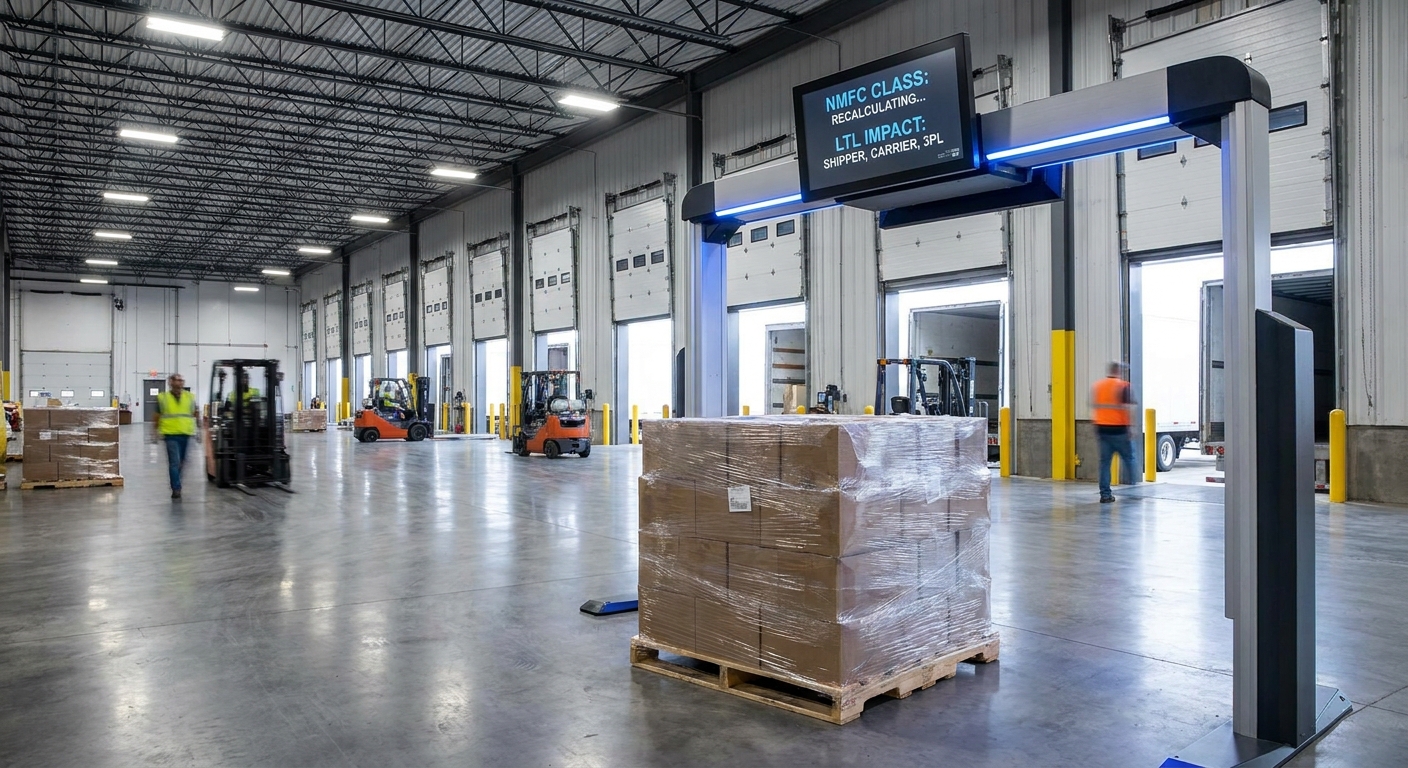
- Utilize Technology: Employ dimensioning hardware or software solutions that automate the capture of length, width, and height. This minimizes human error and provides a digital record.
- Document Everything: Maintain detailed records of all measurements, including the date, time, personnel involved, and the specific dimensions recorded. This documentation is crucial for audits and dispute resolution.
- Regular Audits of Measurement Practices: Periodically review measurement processes and accuracy with staff to identify and correct any deviations.
What Technology Solutions Exist for Accurate Dimensioning?
Several technology solutions are available to assist shippers in accurately capturing freight dimensions, ranging from advanced scanning systems to mobile applications that utilize device sensors. The goal is to replace manual methods with automated, precise data collection.
Here’s a look at common solutions:
| Technology Type | Description | Key Benefits | Potential Drawbacks |
|---|---|---|---|
| LiDAR-Based Apps | Utilizes device's LiDAR sensor (e.g., iPhone/iPad) to scan and measure freight dimensions, often calculating volume and density automatically. | High accuracy, portability, cost-effective for mobile use, integrates with workflows. | Requires compatible device, dependent on lighting conditions. |
| Fixed Dimensioning Systems | Overhead or side-mounted scanners (e.g., laser, photogrammetry) installed at dock doors or conveyor belts. | High throughput, fully automated, minimal human intervention. | High upfront cost, requires fixed installation. |
| Handheld Scanners | Barcode scanners with integrated dimensioning capabilities, often using infrared or laser technology. | Portable, versatile for various warehouse tasks. | Accuracy can vary, may require more manual operation. |
| Manual Measurement Tools | Traditional tape measures, rulers, and measuring wheels. | Low cost, universally available. | Prone to human error, time-consuming, lacks digital record. |
For many LTL operations, especially those involving a high volume of diverse shipments, a mobile solution like FreightSizer offers a flexible and precise alternative to traditional methods, enabling accurate dimension and density calculations directly at the point of shipment.
How Should Shippers Calculate Freight Density Now?
Shippers must now calculate freight density by dividing the net weight of the shipment by its total cubic volume, ensuring that all dimensions are accurately measured and consistently applied according to NMFC guidelines. This requires a shift from simple weight-based estimations to a precise volumetric calculation.
The formula for density is:
Density = Net Weight (lbs) / Total Cubic Volume (cu ft)
To implement this correctly:
- Determine Net Weight: This is the weight of the commodity itself, excluding the weight of the pallet, dunnage, and packaging materials. This information should be available from scales or product specifications.
- Measure Dimensions Accurately: As discussed, obtain precise length, width, and height measurements of the entire shipment footprint.
- Calculate Cubic Volume: Multiply Length x Width x Height. Ensure all dimensions are in the same unit (e.g., inches) and then convert the total cubic inches to cubic feet by dividing by 1728 (12 inches x 12 inches x 12 inches).
- Apply the Formula: Divide the net weight by the calculated cubic volume to get density in pounds per cubic foot (lbs/cu ft).
This calculated density is then compared against the NMFC tables to determine the appropriate freight class.
What Are the New Density Thresholds and Their Implications?
The NMFC 2025 updates have revised density thresholds, meaning that freight previously classified under one tier may now fall into a different class based on these updated weight-per-volume metrics. Shippers must consult the latest NMFC publications for precise figures.
While specific figures vary by commodity and are detailed within the NMFC tariff, the general implication is that shippers who are more efficient in packing and consolidating freight will benefit from lower classes. Conversely, shipments with significant empty space will likely face higher classes.
For example, a commodity that previously qualified for Class 70 might now require Class 77.5 if its density falls below a newly established threshold. This can significantly increase shipping costs.
| Density Range (lbs/cu ft) | Example Freight Class | Implication for Shippers |
|---|---|---|
| 0.5 - 1.0 | Class 500 | Very low density, high volume. Likely to incur significant reclassification charges if not optimized. |
| 1.1 - 2.0 | Class 300 | Low density, inefficient space utilization. Careful measurement and packaging are crucial. |
| 2.1 - 4.0 | Class 175 | Moderate density. Potential for class improvement through better packing. |
| 4.1 - 6.0 | Class 100 | Good density. Adherence to accurate measurement is key to maintaining this class. |
| 6.1 - 9.0 | Class 77.5 | High density. Efficient use of space. May benefit from further optimization to reach lower classes. |
| 9.1 - 12.0 | Class 70 | Very high density. Typically indicates optimal packing. |
| 12.1+ | Class 55 | Extremely high density. Often achievable with dense, heavy materials. |
Note: This table provides illustrative examples. Actual NMFC classes and density ranges are specific to commodity items and are subject to change.
How to Handle Shipments with Irregular Shapes or Mixed Commodities?
Handling shipments with irregular shapes or mixed commodities requires a standardized approach to measurement, often involving calculating the maximum bounding box dimensions and applying specific rules for combined items. This ensures that the space occupied is accurately represented.
For irregular shapes:
- Measure the longest dimension of the item.
- Measure the widest dimension perpendicular to the length.
- Measure the tallest dimension perpendicular to both length and width.
- These maximum dimensions define the bounding box used for volume calculation.
For mixed commodities on a single pallet:
- Measure the overall dimensions of the combined shipment.
- Determine the total weight of all commodities on the pallet.
- Calculate density based on the overall dimensions and total weight.
- The NMFC may have specific rules for mixed shipments, often defaulting to the highest class of any single commodity within the shipment if not properly segregated or classified as a unit.
What Actions Must Shippers Take to Avoid NMFC Reclassification Charges?
To avoid NMFC reclassification charges, shippers must implement a multi-faceted strategy encompassing accurate data capture, proactive classification, and robust verification processes, supported by technology and clear communication with carriers. This proactive stance is the most effective defense against unexpected costs.
Key actions include:
- Invest in Accurate Dimensioning Technology: Utilize tools that provide precise and repeatable measurements. This is the foundational step.
- Establish Standard Operating Procedures (SOPs): Develop clear, documented procedures for measuring, weighing, and classifying every LTL shipment.
- Train and Certify Staff: Ensure all personnel involved in freight handling and preparation are thoroughly trained on the latest NMFC guidelines and measurement techniques.
- Conduct Regular Internal Audits: Periodically review a sample of past shipments to identify any discrepancies in classification, measurement, or weight.
- Leverage Your TMS/WMS: Integrate your dimensioning and classification data into your Transportation Management System (TMS) or Warehouse Management System (WMS) for automated checks and reporting.
- Communicate with Carriers: Foster open dialogue with your LTL carriers regarding classification policies and dispute resolution processes.
- Understand Your Commodities: Maintain a comprehensive database of your commodities, including their properties relevant to classification (density, fragility, hazard class, etc.).
How to Proactively Classify Freight Based on NMFC Guidelines?
Proactive freight classification involves meticulously reviewing the NMFC tariff, understanding commodity descriptions, and accurately applying density, stowability, handling, and liability factors before a shipment is tendered. This requires dedicated expertise or reliable tools.
Steps for proactive classification:
- Identify the Correct Commodity Description: Find the most accurate description for your product within the NMFC tariff. This is critical, as misidentification is a common source of error.
- Determine Density: Measure dimensions and weigh the shipment to calculate density accurately.
- Assess Stowability and Handling: Consider factors like fragility, shape, and whether special equipment is needed.
- Evaluate Liability: Assess the risk of damage, loss, or claims associated with the commodity.
- Assign the Class: Based on the above factors, determine the lowest applicable freight class from the NMFC tariff.
For shippers dealing with a wide variety of goods or those who find the NMFC tariff complex, utilizing specialized software or services can ensure accuracy and compliance.
What Role Does Data Verification and Auditing Play?
Data verification and auditing are crucial for catching errors before they result in reclassification charges, allowing shippers to correct inaccuracies and refine their processes. These steps act as a critical quality control layer.
- Pre-Shipment Verification: Before tendering a load, verify that the recorded dimensions, weight, and classification align with the actual shipment and NMFC rules.
- Post-Shipment Auditing: Regularly audit carrier invoices against your internal records and the NMFC tariff. This helps identify discrepancies that may have been missed initially.
- Dispute Resolution: Maintain thorough documentation of your measurements and classification rationale to support any disputes with carriers over reclassification charges.
In 2026, with the increasing sophistication of carrier auditing tools, a robust internal verification and auditing process is no longer optional but a necessity for cost control.
Frequently Asked Questions
What is the primary goal of the NMFC 2025 amendments for shippers?
The primary goal is to ensure that freight classifications accurately reflect the actual space utilization and handling characteristics of shipments, thereby promoting efficiency in LTL transportation.
How often should I update my understanding of NMFC guidelines?
NMFC guidelines are updated periodically, with significant revisions like those effective July 19, 2025. Shippers should stay informed about these updates, ideally consulting NMFTA publications or industry resources quarterly.
Can a single piece of freight be reclassified if it's part of a larger shipment?
Yes, if a shipment contains multiple items and the overall density or handling characteristics change due to the combination, or if one item's characteristics necessitate a higher class for the entire unit, reclassification can occur.
What happens if my carrier incorrectly classifies my freight?
Shippers have the right to dispute incorrect classifications. This requires providing evidence of accurate measurements, weight, and classification rationale, supported by documentation and adherence to NMFC rules.
Does the NMFC consider the packaging of goods when determining class?
Yes, packaging affects stowability and handling. Secure, efficient packaging that maximizes density and minimizes damage risk generally supports a lower freight class.
Conclusion
The evolution of NMFC standards, particularly with the 2025 amendments, mandates a significant shift in how shippers approach freight classification and measurement. In 2026, precision, technology adoption, and proactive compliance are paramount to avoiding costly reclassification charges and maintaining predictable LTL logistics costs. By embracing accurate dimensioning, rigorous density calculation, and diligent auditing, shippers can navigate these changes successfully and optimize their supply chain operations.