
How to Determine Freight Class Under the New NMFC Density Rules (2026)
Determining freight class under the new NMFC density rules effective July 19, 2025, involves accurately measuring freight dimensions and weight to calculate density, then applying the National Motor Freight Classification (NMFC) Item 100 guidelines. The updated NMFC standards place a greater emphasis on density, impacting how shipments are classified and priced, with over 160 freight classes now defined by distinct density ranges. This article will guide LTL stakeholders through the updated classification process, explain the nuances of density calculations, and highlight how these changes affect logistics operations.
Key Takeaways
- The NMFC density rules updated on July 19, 2025, significantly refine freight classification based on precise density metrics.
- Accurate measurement of freight dimensions (length, width, height) and weight is paramount for correct density calculation.
- Understanding the new NMFC Item 100 subclasses is crucial for assigning the correct freight class and avoiding reclassification charges.
- Shippers and carriers must adapt their processes to incorporate advanced dimensioning and weight capture for compliance and cost management.
- The updated rules aim to create a more equitable pricing structure by better reflecting the actual space and weight utilization of LTL shipments.
What are the New NMFC Density Rules Effective July 19, 2025?
The NMFC density rules updated on July 19, 2025, fundamentally shift LTL freight classification by introducing more granular density-based tiers within Item 100. These revised guidelines establish over 160 distinct freight classes, each tied to specific ranges of pounds per cubic foot (pcf). This granular approach ensures that pricing more accurately reflects the actual space and weight a shipment occupies on a carrier's trailer.
The NMFC, managed by the National Motor Freight Traffic Association (NMFTA), periodically updates its standards to reflect industry changes and ensure fair pricing. The 2025 revisions are particularly significant for LTL operations, as they introduce narrower density brackets. This necessitates a more precise approach to measuring freight dimensions and weight. For instance, a shipment previously falling into a broad density range might now straddle two or three new, more specific classes, requiring careful calculation to assign the correct one.
How is Freight Density Calculated Under the New Standards?
Freight density is calculated by dividing the shipment's total weight in pounds by its total cubic feet. Under the new NMFC standards, this calculation requires meticulous measurement of each piece of freight. The formula is: Density (pcf) = Total Weight (lbs) / Total Volume (cu ft).
The total volume is derived by multiplying the length, width, and height of each individual shipment item and then summing these volumes. For example, a pallet measuring 48 inches long, 40 inches wide, and 50 inches high would have a volume of (48 40 50) / 1728 cubic inches/cubic feet = 111.11 cu ft. If this pallet weighs 500 lbs, its density is 500 lbs / 111.11 cu ft = 4.5 pcf.
This precise calculation is critical because the updated NMFC Item 100 uses these density figures to assign specific freight classes, often within a range of 1 to 160. For example, a density between 4.0 and 4.5 pcf might fall into a different class than a shipment with a density between 4.5 and 5.0 pcf.
What are the Key Changes in NMFC Item 100?
The primary change in NMFC Item 100 is the expansion and refinement of freight classes based on density. Instead of broader categories, the updated system features more numerous, narrowly defined density brackets. This granular approach means that slight variations in density can now result in a different freight class assignment.
These changes are designed to create a more equitable LTL pricing environment. Previously, a shipment with a slightly higher density might have been priced the same as a less dense shipment if both fell within a broad class. The updated Item 100 aims to eliminate such discrepancies. For LTL carriers and freight forwarders, this requires robust systems for capturing accurate dimensions and weights to ensure correct classification and avoid revenue leakage or customer disputes due to reclassification.
How Do Shippers and Carriers Adapt to the New Density Rules?
Adapting to the new NMFC density rules requires a strategic shift in how LTL shipments are measured, classified, and managed by both shippers and carriers. This involves investing in accurate dimensioning technology and ensuring personnel are trained on the updated NMFC guidelines.
Shippers must focus on precise measurement and accurate weight capture at the point of packing or staging. Carriers need to verify these measurements upon pickup or at their facilities. The adoption of advanced technology can significantly streamline this process. For example, using a mobile application that leverages LiDAR technology to measure freight dimensions can replace manual tape measurements and reduce errors.
The transition also necessitates clear communication and data sharing between shippers and carriers. Establishing standardized processes for reporting dimensions, weights, and ultimately freight class is essential to avoid disputes and ensure efficient operations.
What are the Implications of Increased Density Granularity?
The increased granularity in density classification under the new NMFC standards has several significant implications for the LTL logistics ecosystem. For shippers, it means a heightened need for accuracy to avoid potential reclassification charges, which can substantially increase shipping costs. For LTL carriers, it presents an opportunity for more precise revenue management and better trailer utilization.
A key implication is the greater emphasis on the "actual" versus "billed" weight and density. Carriers are now better equipped to identify shipments that are classified too low due to inaccurate measurements. This can lead to more frequent audits and reclassifications, impacting the bottom line for those who do not adapt.
Furthermore, the new rules encourage the optimization of packaging and load-building strategies. Shippers might explore ways to consolidate shipments or optimize pallet configurations to achieve a more favorable density and, consequently, a lower freight class.
How Does Accurate Dimensioning Impact Freight Classification?
Accurate dimensioning is the cornerstone of correct freight classification under the new NMFC density rules. Without precise measurements of length, width, and height, the calculated density will be inaccurate, leading to an incorrect freight class assignment. This directly impacts pricing and can result in unexpected surcharges.
The NMFC standards are built upon the principle that freight class should reflect the space a shipment occupies relative to its weight. If dimensions are overstated, the calculated density will be lower than it actually is, potentially assigning a shipment to a lower, cheaper class than it deserves. Conversely, understated dimensions lead to a higher calculated density and a potentially higher, more expensive class.
The reliance on accurate measurements is amplified by the 2025 NMFC updates, which have narrowed the density brackets. A difference of even a few cubic inches can now push a shipment into a different class. This underscores the need for reliable measurement tools and processes.
What are the Best Practices for Measuring Freight for Classification?
Implementing best practices for measuring freight ensures accuracy and compliance with the updated NMFC density rules. These practices should be integrated into daily operations for both shippers and carriers.
Standardized Measurement Procedures
Establish clear, standardized procedures for measuring every piece of freight. This includes defining which dimension is length, width, and height consistently. For irregular shapes, a standardized method for approximating volume must be adopted and consistently applied.
Consistent Units of Measure
Always use consistent units of measure. The NMFC typically uses inches for dimensions and pounds for weight. Ensure that all measurements are converted to these units before calculating cubic feet and density. For example, converting centimeters to inches and kilograms to pounds accurately is crucial.
Palletized vs. Non-Palletized Freight
Differentiate measurements for palletized and non-palletized freight. For palletized shipments, the dimensions should include the pallet itself. For shipments where freight extends beyond the pallet, the outermost dimensions of the entire shipment must be used.
Overhang and Strapping
Account for any freight overhang beyond the pallet edges. Additionally, consider how strapping or shrink wrap affects the overall dimensions. The measurement should reflect the maximum external dimensions occupied by the shipment, including any packaging or securing materials that add to its volume.
Weight Verification
Weight is the other critical component of density calculation. Ensure that the weight recorded is the actual weight of the shipment, including packaging and pallet. Using scales that are regularly calibrated is essential.
Technology for Precision
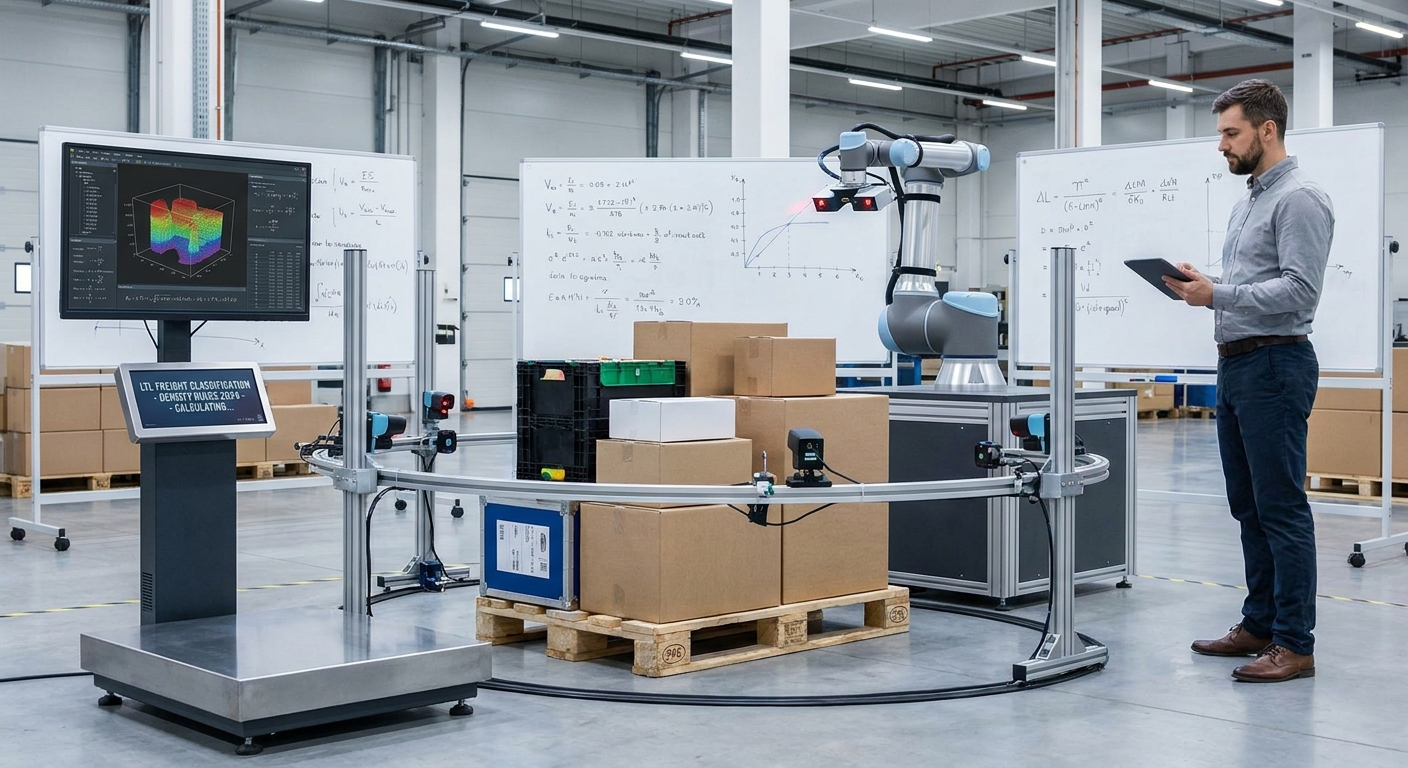
Leverage technology to enhance measurement accuracy and efficiency. Tools that utilize advanced sensors, such as LiDAR, can capture precise freight dimensions rapidly. This minimizes human error and speeds up the process, which is vital in busy logistics environments. For instance, the FreightSizer app on iPhone and iPad utilizes LiDAR to capture freight dimensions, calculate density, and help determine LTL freight class, replacing manual measurement tools and dedicated hardware.
Training and Auditing
Regularly train personnel on measurement procedures and the NMFC guidelines. Implement an auditing process to verify the accuracy of measurements and classifications. This helps identify any systematic errors or areas for improvement.
How Can Technology Improve LTL Freight Classification Accuracy?
Technology offers significant advantages in improving LTL freight classification accuracy, especially with the increased complexity of the new NMFC density rules. Automated dimensioning and data capture systems can drastically reduce errors associated with manual measurements.
LiDAR-Based Dimensioning
LiDAR (Light Detection and Ranging) technology, as found in applications like FreightSizer, can scan freight and generate highly accurate 3D models, from which precise length, width, and height measurements are derived. This eliminates the subjectivity and potential inaccuracies of tape measures. The app then calculates the density based on these dimensions and the entered weight.
Automated Data Capture and Integration
Modern logistics software can integrate with dimensioning hardware or apps to automatically capture and record freight data. This data can then be directly fed into transportation management systems (TMS) or carrier rating engines, streamlining the classification process and reducing manual data entry.
Real-Time Classification Assistance
Some advanced systems provide real-time assistance in determining freight class. By inputting measured dimensions and weight, these tools can cross-reference the data against the latest NMFC guidelines, including the updated Item 100, to suggest the most appropriate class.
Reduced Reclassification Charges
By ensuring accurate initial classification, technology helps minimize costly reclassification charges. These charges often occur when carriers discover that a shipment's actual dimensions or weight do not match the information provided by the shipper, leading to back-billing.
Enhanced Operational Efficiency
Automating measurement and classification tasks frees up staff to focus on other critical logistics functions. This improved efficiency contributes to faster turnaround times at warehouses and docks.
What is the Impact of the 2025 NMFC Changes on LTL Pricing?
The 2025 NMFC changes, with their emphasis on density and more granular classification, are poised to have a substantial impact on LTL pricing structures. The core objective is to align pricing more closely with the actual cost of transporting freight, which is heavily influenced by space utilization and weight.
For shipments that were previously misclassified due to imprecise measurements, these changes will likely lead to price adjustments. Shippers who were benefiting from lower classifications due to inaccurate density calculations may see their costs increase. Conversely, those who accurately measured and classified their freight may find more competitive pricing opportunities.
Carriers will benefit from more predictable revenue streams and improved trailer utilization. By accurately classifying shipments based on density, they can better plan loads and optimize how they fill their trailers, reducing wasted space. This can lead to more efficient operations and potentially more stable pricing in the long run, though the transition period may see some fluctuations as the market adjusts.
Frequently Asked Questions
How does the new NMFC density rule affect shipments measured in cubic meters?
Shipments measured in cubic meters must be accurately converted to cubic feet for NMFC classification. The conversion factor is 1 cubic meter = 35.3147 cubic feet. Ensure consistent application of this conversion for accurate density calculation.
What happens if my freight dimensions are irregular?
For irregular shapes, you must determine the maximum length, width, and height that enclose the freight. This might involve approximating a bounding box. The NMFC guidelines provide specific instructions on how to measure and calculate volume for non-standard shapes.
Will the new rules increase the number of freight classes?
Yes, the updated NMFC Item 100 effective July 19, 2025, introduces more granular density ranges, effectively increasing the number of distinct freight classes to over 160 to better reflect varying densities.
How can I ensure my warehouse staff are measuring freight correctly?
Provide comprehensive training on the latest NMFC guidelines and standardized measurement procedures. Utilize checklists and consider implementing technology that automates measurement to reduce human error and ensure consistency.
What is the penalty for misclassifying LTL freight under the new rules?
Misclassifying LTL freight can lead to reclassification charges from the carrier, which often include the difference in freight charges, plus administrative fees. These charges can be substantial and are applied retroactively.
Conclusion
The updated NMFC density rules effective July 19, 2025, represent a significant evolution in LTL freight classification. By mandating a more precise calculation of density through accurate dimension and weight measurement, the NMFC aims to create a fairer and more transparent pricing structure. For freight forwarders, LTL carriers, 3PL providers, warehouse teams, and shippers, adapting to these changes is not just about compliance; it's about optimizing costs, improving operational efficiency, and ensuring competitive positioning in the logistics market. Embracing accurate measurement practices and leveraging modern technology will be key to navigating this new landscape successfully and avoiding costly reclassification charges.