
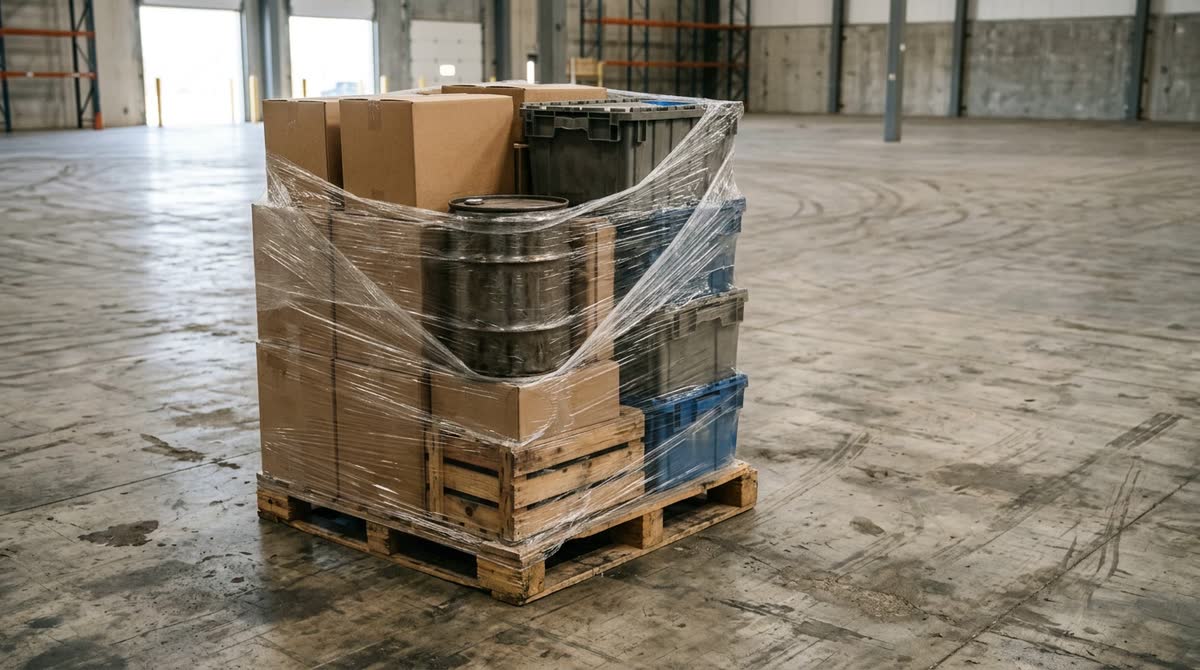
You class a mixed pallet in one of two ways: the whole pallet takes the class of the highest-classed product on it, or you itemize every product, with its own description and total weight, on the bill of lading so that each one is charged at its own class. If your paperwork does not itemize the products the way NMFC Item 640 requires, the carrier applies the highest class to the entire pallet.
What does NMFC Item 640 say about a mixed pallet?
Item 640, "Mixed Shipments and Articles Classified by Weight or Quantity", governs it. NMFTA reproduced its present text in the Docket 2026-2 analysis of Item 640, and two parts of Section 3 decide how a mixed pallet is charged.
Section 3(a) is the default. A pallet, platform, rack or skid that meets the requirements of Item 265 and carries differently classed articles is charged at the class of the highest-classed article on it. You do not have to list every product: you name one of the articles that takes the highest class and add the notation "And other articles classed the same or lower", which may be shortened to "RS or L".
Section 3(b) is the exception. When products of different classes, each in the packaging that its own classification description authorizes, are securely unitized on a pallet that meets Item 265, each product is charged at its own actual weight and its own class, provided the shipment meets the conditions listed in that section. Those conditions are the paperwork described below.
NMFTA's Classification 101 article, posted on 16 May 2024, gives the plain-language version. If a pallet holds six items that would individually rate class 50, 100, 150, 200, 250 and 300, and the shipper has not itemized them on the bill of lading, the carrier treats the entire pallet as class 300. The rule protects carriers, who would otherwise have to break down the skid to classify every item on it.
Did the mixed pallet rule change in 2026?
No. The FCDC, the NMFTA body that votes on changes to the classification, considered two rewrites of Item 640 in 2026 and disapproved both. Disposition Bulletin 1373, dated 20 March 2026, lists the Docket 2026-1 proposal as disapproved and says the current provisions will continue to apply.
Disposition Bulletin 1374, dated 9 October 2026, does the same for the Docket 2026-2 proposal. That version would have required every article on a mixed shipment to be listed separately and would have classified each handling unit on the density scale, keeping the highest-class treatment only for units holding an article marked with the handling, stowability and liability symbol or the hazardous-materials symbol, or rated on something other than density. It was not adopted, so Sections 3(a) and 3(b) as quoted above are still what carriers apply.
Should you itemize or accept the highest class?
Itemize when a small share of the pallet's weight is pulling the whole pallet up. Take a hypothetical pallet carrying 600 lb of dense hardware that rates a low class and two cartons, 40 lb in total, of a light, bulky product that rates a much higher class. Under Section 3(a), all 640 lb, plus the pallet itself, move at the bulky product's class. Under Section 3(b), the 600 lb moves at the hardware's class, the 40 lb at its own class, and the weight of the pallet and wrap at the lowest class applicable to any article that makes up at least 5 percent of the unitized weight, which here is the hardware's.
Accept the highest class when the products already rate the same or neighboring classes, or when the high-class product is most of the weight. Itemizing then adds paperwork for little difference in the charge, and a single description with "RS or L" is harder to get wrong.
There is a third option: build separate pallets. Section 2 of Item 640 charges differently classed articles that are separately packaged at the class applicable to each. If the high-class product fits on a pallet of its own, each pallet carries a single class and the mixed-pallet rule never comes into play. You trade a second handling unit for simpler paperwork.
How do you itemize a mixed pallet on the bill of lading?
Section 3(b) of the present Item 640 text sets the conditions. In practice they come down to seven steps:
- Pack each product the way its own classification description allows. Products in boxes that meet the complying-box requirements, secured on a pallet that meets Item 265, take the classes that apply to the same products tendered in boxes.
- On both the bill of lading and the shipping order, list each article separately with its total weight on the pallet. Item 640 does not ask for more, but adding the NMFC item and class you claim on each line makes it easier for the carrier to check the freight against your paperwork.
- Add the notation "The above contained on (number) pallets", using platforms, racks or skids instead where that is what you ship on.
- Fix a packing slip to the shipment that lists each article and its total weight on the pallet.
- Show the weight of the pallet and any unitizing material on the bill of lading and the shipping order.
- List any article in the shipment that is not on the pallet separately, at its own class.
- If the products are unitized inside a fiberboard box, fill the empty space between the inner packages and the top of the box with packing devices strong enough to stop the box collapsing when other freight is loaded on it.
Section 3(a) applies "except as provided in Sec. 3(b)", so a pallet whose paperwork does not meet these conditions moves at the highest class.
How does density fit in after the 2025 NMFC changes?
On 19 July 2025 the classifications in Docket 2025-1 moved from commodity-based to density-based, and a 13-subprovision density scale replaced the old 11-tier one, adding classes 50 and 55, as Old Dominion's NMFC resource page sums up. For a mixed pallet, that means many products no longer have one fixed class: you need each product's density before you can say which class to claim for its line on the bill of lading.
The calculation is the one in NMFTA's explainer: multiply length by width by height in inches, divide by 1,728 to get cubic feet, then divide the weight in pounds by the cubic feet. See also how to calculate freight density for LTL shipments.
Two points apply to mixed pallets in particular. First, Item 110, Section 8(d), quoted in the same NMFTA analysis, says that when a shipment has several handling units, density is calculated on each handling unit, but where the shipping papers show only one total weight for all of them, density may be calculated from the total weight and the total cube. If you want each pallet judged on its own figures, put each pallet's weight on the bill of lading.
Second, Item 640 itself does not spell out how density is taken for one product that shares a pallet with others. The disapproved Docket 2026-2 proposal would have used the weights and dimensions of each handling unit shown on the original bill of lading. Until the rule says more, measure and weigh each product's packages as they go onto the pallet, record the figures, and agree with your carrier how it will check density on your mixed pallets.
What mistakes get a mixed pallet reclassed?
These are the slips that send a mixed pallet back to the highest class or get it rerated at the dock:
- Describing the pallet by a lower-class product. Under Section 3(a), the description has to name one of the highest-classed articles. If an inspector finds a higher-classed product under the wrap, the carrier can rerate the whole pallet at that product's class.
- Itemizing on the bill of lading but not on the freight. Section 3(b) asks for a packing slip on the shipment listing each article and its weight.
- Weights that do not add up. If the carrier finds that the stated weight of the pallet is wrong, it corrects it, and the difference is added to or subtracted from the highest-classed article on the pallet, unless you prove it belongs to another article. Weigh each product accurately before it goes on.
- Products in the wrong packaging. The itemization exception covers articles in the packages or shipping forms their own classification descriptions authorize. A product wrapped onto the pallet in a form its description does not list falls outside it.
- Leaving out the pallet weight. Section 3(b) requires it on the bill of lading and the shipping order.
If a mixed pallet has already been reclassed, start by comparing the inspection report against these conditions; why carriers reclassify shipments and how to dispute a reclassification charge cover the next steps.
How do you keep records that hold up for a mixed pallet?
Measure and weigh each product's cartons before they are stacked, then the finished pallet after wrapping. Photograph the packing slip and label, and keep the figures with the bill of lading. They are your evidence if the carrier's inspection disagrees with your itemization; the guide to documenting shipment dimensions to win disputes covers what to keep.
If your team measures with a LiDAR-equipped iPhone or iPad, FreightSizer measures freight dimensions with LiDAR, calculates density and determines LTL freight class in line with NMFTA guidelines, including the NMFC standards effective 19 July 2025. Measuring each product's cartons that way before you build the pallet gives you the density figure behind each line you itemize.
Frequently Asked Questions
Can a carrier charge my whole mixed pallet at the highest class?
Yes. Under Section 3(a) of NMFC Item 640, a pallet carrying differently classed articles is charged at the class of the highest-classed article unless the shipment meets the itemization conditions of Section 3(b). Listing each article and its weight on the bill of lading, adding the pallet notation, showing the pallet weight and fixing a packing slip to the shipment is what lets each product take its own class.
What does "RS or L" mean on a bill of lading?
It is the abbreviation Item 640 allows for "And other articles classed the same or lower". You use it when you choose not to itemize: you describe one of the highest-classed articles on the pallet, add the notation, and the whole pallet moves at that class.
Did NMFTA change Item 640 in 2026?
No. A rewrite was disapproved in Docket 2026-1 (Disposition Bulletin 1373, 20 March 2026) and another in Docket 2026-2 (Disposition Bulletin 1374, 9 October 2026). In both cases the FCDC stated that the current provisions continue to apply.
How do I find the class of each product on a mixed pallet?
Look up each product's NMFC item first. If the item is density-based, measure and weigh that product's packages, calculate pounds per cubic foot and read the class from the item's density subprovisions. A LiDAR app such as FreightSizer can take the measurements and work out the density on an iPhone or iPad.