
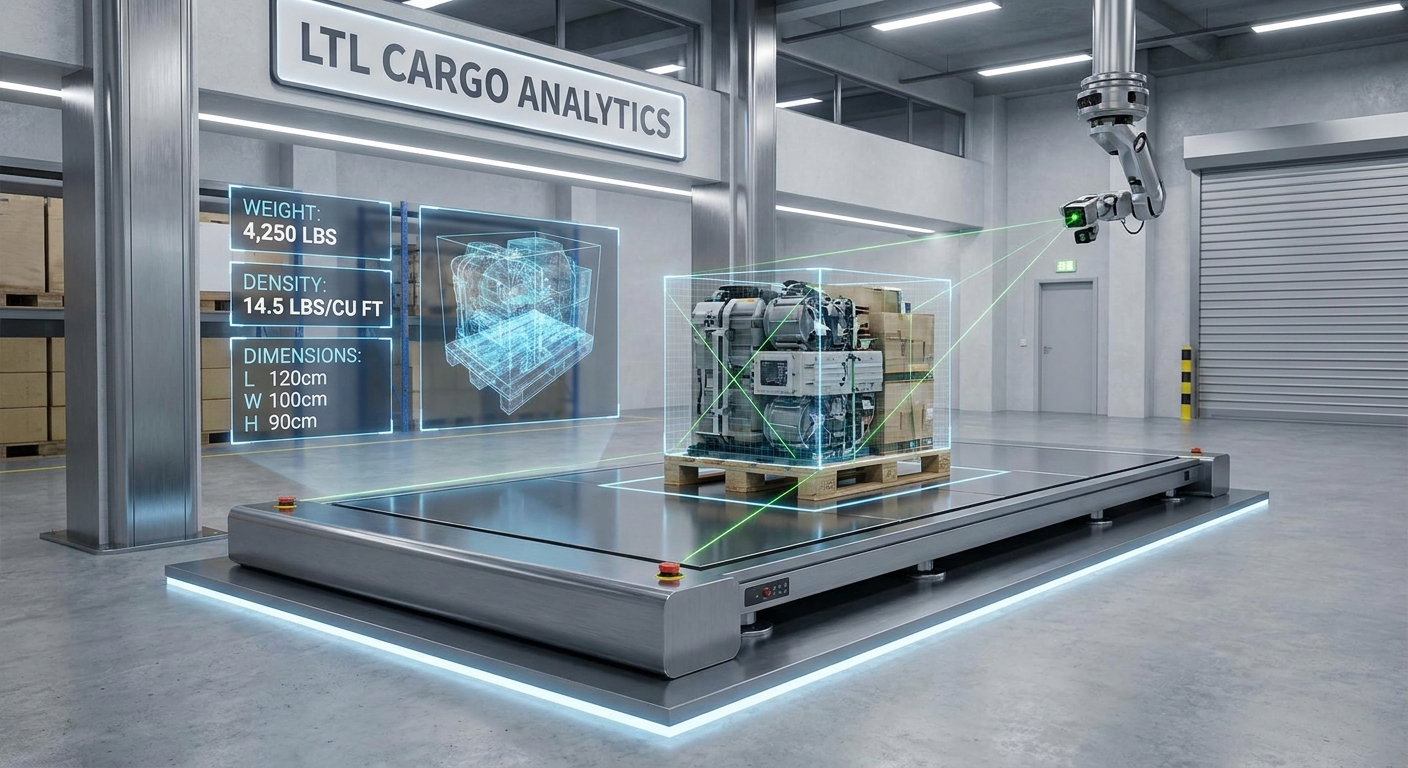
For NMFC freight class, only actual weight counts. Density is the actual weight of the handling unit as tendered divided by its cubic feet at the greatest dimensions, and for density-based items that density picks the class (NMFTA, Calculating Density Best Practices (updated 21 October 2026)). Dimensional weight, a billable weight calculated from a package's size with a divisor, is a pricing method used mainly for parcels; it has no role in NMFC classification. Some LTL carriers do publish their own space-based rules in their tariffs, so check yours.
What is the difference between actual weight and dimensional weight?
Actual weight is what the shipment weighs on a scale. Dimensional weight is a calculated weight: length × width × height divided by a divisor that the carrier sets, billed when it is higher than the actual weight. Each carrier publishes its own divisor and rounding rules in its service guide.
Does LTL freight use dimensional weight?
Not in the NMFC. LTL classification accounts for space through density instead. NMFTA's method: multiply the greatest straight-line length, width and height of the handling unit in inches, including all projections; divide by 1,728 for cubic feet; then divide the weight of the handling unit as tendered by the cubic feet (NMFTA density guide).
The class then determines which rate applies in the carrier's tariff or your pricing agreement (NMFTA, NMFC Classification Glossary of Terms (updated 16 March 2026)), and the charge is based on the actual weight. Carriers can also have their own space-based rules in their rules tariffs, for example for shipments that take up an unusually large share of a trailer; those come from the carrier, not from the NMFC.
How does density do the job dimensional weight does for parcels?
Both make light, bulky freight cost more. Dimensional weight raises the billable weight of a light box; density moves light, bulky freight into a higher class. Example: a pallet measuring 48 x 40 x 36 inches and weighing 250 pounds is 40 cubic feet and 6.25 pounds per cubic foot, which is class 125 on the standard scale. The same pallet at 500 pounds is 12.5 pounds per cubic foot, class 85 (NMFTA Disposition Bulletin 1371, Docket 2025-1 (21 March 2025)). The weight on the bill stays the actual weight; the class changes.
What is the NMFC density scale?
For NMFC items that are classed by density, the standard scale is the 13-subprovision scale adopted in Docket 2025-1 and in effect since 19 July 2025 (Bulletin 1371). It replaced the earlier 11-subprovision scale, whose top step put everything at 30 pounds per cubic foot or more in class 60; classes 55 and 50 were added above it (NMFTA FAQ on the 13-subprovision scale (updated 7 April 2026)). Not every commodity uses this scale: items with handling, stowability or liability concerns are not fully density-based, so the NMFC item for your commodity decides which classes apply (NMFTA, NMFC Classification FAQs (updated 7 April 2026)).
| Sub | Density (pounds per cubic foot) | Class |
|---|---|---|
| 1 | Less than 1 | 400 |
| 2 | 1 but less than 2 | 300 |
| 3 | 2 but less than 4 | 250 |
| 4 | 4 but less than 6 | 175 |
| 5 | 6 but less than 8 | 125 |
| 6 | 8 but less than 10 | 100 |
| 7 | 10 but less than 12 | 92.5 |
| 8 | 12 but less than 15 | 85 |
| 9 | 15 but less than 22.5 | 70 |
| 10 | 22.5 but less than 30 | 65 |
| 11 | 30 but less than 35 | 60 |
| 12 | 35 but less than 50 | 55 |
| 13 | 50 or greater | 50 |
Why do shippers mix the two up?
Many shippers send parcels and LTL freight from the same dock, and parcel software shows dimensional weight next to actual weight. For LTL, putting a dimensional weight on the bill of lading as if it were the shipment's weight misstates it, and carriers may verify both weight and dimensions (NMFTA, updates to Item 250100 in Supplement 2025-2 (updated 16 March 2026)). Declare the actual weight and the item, sub and class instead.
How do you measure LTL freight correctly?
- Weigh each handling unit as tendered, pallet and packaging included (NMFTA density guide).
- Measure its greatest length, width and height, including overhang and projections. See measuring freight with overhang and pallet dimensions.
- Calculate density per handling unit; use total weight and total cube only when the shipping papers show just a total weight (NMFTA, How to classify a mixed-freight package, skid, or crate (updated 16 March 2026)).
- Read the class from the density table of your commodity's NMFC item, not from a parcel dim-weight calculator.
FreightSizer measures handling units with an iPhone or iPad LiDAR scanner, calculates density and determines the LTL class in line with NMFTA guidelines, including the standards effective 19 July 2025. For a full walk-through, see how to calculate freight density for LTL shipments.
Frequently Asked Questions
Do LTL carriers charge by dimensional weight?
Not under the NMFC, which uses density. Some carriers have their own space-based rules, so read your carrier's rules tariff.
Which weight goes on the bill of lading?
The actual weight of the handling units as tendered, together with the NMFC item number, sub provision and class (Item 250100 summary).
Did the 2025 NMFC update introduce dimensional weight?
No. Docket 2025-1 changed commodity items and the density scale (Bulletin 1371); NMFC rule changes were not within its scope (NMFTA).
Is density the same as dimensional weight?
No. Density is pounds per cubic foot and decides the class of a density-based item; dimensional weight is a billable weight in pounds used in parcel pricing.