
NMFC Item 100 Changes Explained for Shippers in 2026: Navigating LTL Classification Updates
The NMFC Item 100 classification system has been updated, effective July 19, 2025, introducing revised guidelines for density calculations and freight class assignments that significantly impact LTL shipping costs and operational accuracy for shippers and carriers alike. These changes necessitate a proactive approach to freight measurement and classification to avoid unexpected surcharges and ensure compliance with National Motor Freight Classification (NMFC) standards.
In 2023, LTL carriers reported an average of 12% of shipments being re-billed due to incorrect freight class, costing shippers an estimated $850 million annually in reclassification fees and administrative overhead. Understanding the specifics of the NMFC Item 100 revisions is paramount for freight forwarders, LTL carriers, 3PL providers, and warehouse teams to maintain cost control and operational efficiency. This article will delve into the key alterations, their implications, and strategies for adapting to the new landscape.
What are the Core NMFC Item 100 Changes Effective July 19, 2025?
The primary NMFC Item 100 changes focus on refining the methodology for calculating freight density and updating specific item classifications to better reflect modern shipping practices and material handling. These updates aim to enhance the accuracy of freight class assignments, reduce disputes between shippers and carriers, and ensure a more equitable pricing structure across the LTL industry. The revised guidelines provide clearer parameters for measurement and classification, especially for less-than-truckload shipments.
The updated NMFC Item 100 introduces a more granular approach to density calculation, moving away from broad cubic foot ranges to more precise weight-per-cubic-foot metrics. This aims to capture variations in how goods are packed and palletized, impacting the actual space utilization within a trailer. Furthermore, several specific freight items have been reclassified or had their descriptions amended to align with current market realities and common shipping commodities.
How Will NMFC Item 100 Changes Affect Freight Density Calculations?
Freight density calculations will become more precise under the revised NMFC Item 100, requiring a closer examination of the actual volume occupied by freight relative to its weight. The new standards emphasize exact measurements rather than estimations, directly impacting the LTL freight class assigned to shipments and potentially leading to increased reclassifications if not accurately managed. This shift mandates a more rigorous approach to data collection at the point of shipment.
The updated guidelines stipulate that density will be calculated by dividing the total weight of the shipment (in pounds) by its total cubic feet. The threshold for each density bracket has been adjusted, meaning a shipment that previously fell into one class based on estimated density might now fall into a different class due to more accurate measurement. For instance, a class 100 shipment with a density of 6 pounds per cubic foot might now be re-evaluated based on a precise measurement that reveals it is closer to 5.5 pounds per cubic foot, potentially shifting it to a higher class.
Understanding the New Density Thresholds
The NMFC has introduced revised density tiers to accommodate a wider range of shipment characteristics. These tiers are crucial for determining the appropriate freight class and, consequently, the transportation cost. Shippers must familiarize themselves with these new thresholds to accurately classify their goods.
| Old Density Range (lbs. per cu. ft.) | New Density Range (lbs. per cu. ft.) | Potential Freight Class Impact |
|---|---|---|
| 0-5 | 0-5.9 | Lower Class |
| 5-10 | 6-9.9 | Mid-Range Class |
| 10-15 | 10-14.9 | Mid-Range Class |
| 15-20 | 15-19.9 | Higher Class |
| 20+ | 20+ | Highest Class |
Note: These are illustrative ranges and specific NMFC Item 100 classifications may have unique density requirements.
The shift towards more granular density calculations means that any inaccuracies in measuring the length, width, and height of a shipment can lead to an incorrect density figure. This, in turn, can result in the assignment of an inappropriate freight class, potentially leading to significant cost discrepancies and disputes with carriers. The emphasis is on precision to ensure fair pricing based on actual space and weight utilization.
What are the Key LTL Freight Class Adjustments in NMFC Item 100?
Beyond density, specific LTL freight items have undergone reclassification or description amendments within NMFC Item 100 to better align with current industry practices and commodity types. These adjustments are designed to improve the classification accuracy for a variety of goods, from manufactured products to raw materials, reflecting changes in packaging, handling, and the nature of the goods themselves.
For example, certain types of electronics packaging or specialized industrial components may have seen their classifications revised due to changes in their typical density, fragility, or stowability. The NMFC periodically reviews these classifications to maintain relevance and fairness. Shippers need to consult the updated NMFC publication to identify specific item number changes that affect their commodities.
How to Identify Your Specific NMFC Item
Locating the correct NMFC item number for your goods is the foundational step in accurate classification. The NMFC Item 100 book is organized into various sections, typically by commodity type. Each item number has a description, which includes rules for classification, minimum density requirements, and other relevant factors.
The process involves:
- Identifying the commodity: Clearly define the product being shipped.
- Consulting the NMFC index: Use the index to find potential item numbers related to your commodity.
- Reviewing item descriptions: Read the detailed description for each potential item number to ensure it accurately matches your product's characteristics, including its packaging, handling requirements, and density.
- Verifying with the carrier: Always confirm the classification with your LTL carrier, as they are the ultimate arbiters of freight class.
The revisions effective July 19, 2025, mean that descriptions for some items may have been updated to include new packaging standards or to better define the scope of the item. Ignoring these changes can lead to incorrect classifications and subsequent charges.
How Can Shippers Prepare for NMFC Item 100 Changes in 2026?
Proactive preparation is essential for shippers to navigate the NMFC Item 100 changes effectively and mitigate potential cost increases or operational disruptions. This involves a multi-faceted approach focusing on accurate data capture, updated internal processes, and enhanced communication with LTL carriers. Implementing robust measurement and classification protocols will be key to maintaining compliance and cost control.
The critical first step is to thoroughly review the updated NMFC Item 100 guidelines published by the National Motor Freight Traffic Association (NMFTA). Understanding the nuances of the new density calculation rules and any specific item reclassifications that affect your freight is paramount. This review should involve your logistics, warehouse, and compliance teams to ensure a comprehensive understanding.
Implementing Accurate Freight Measurement and Dimensioning
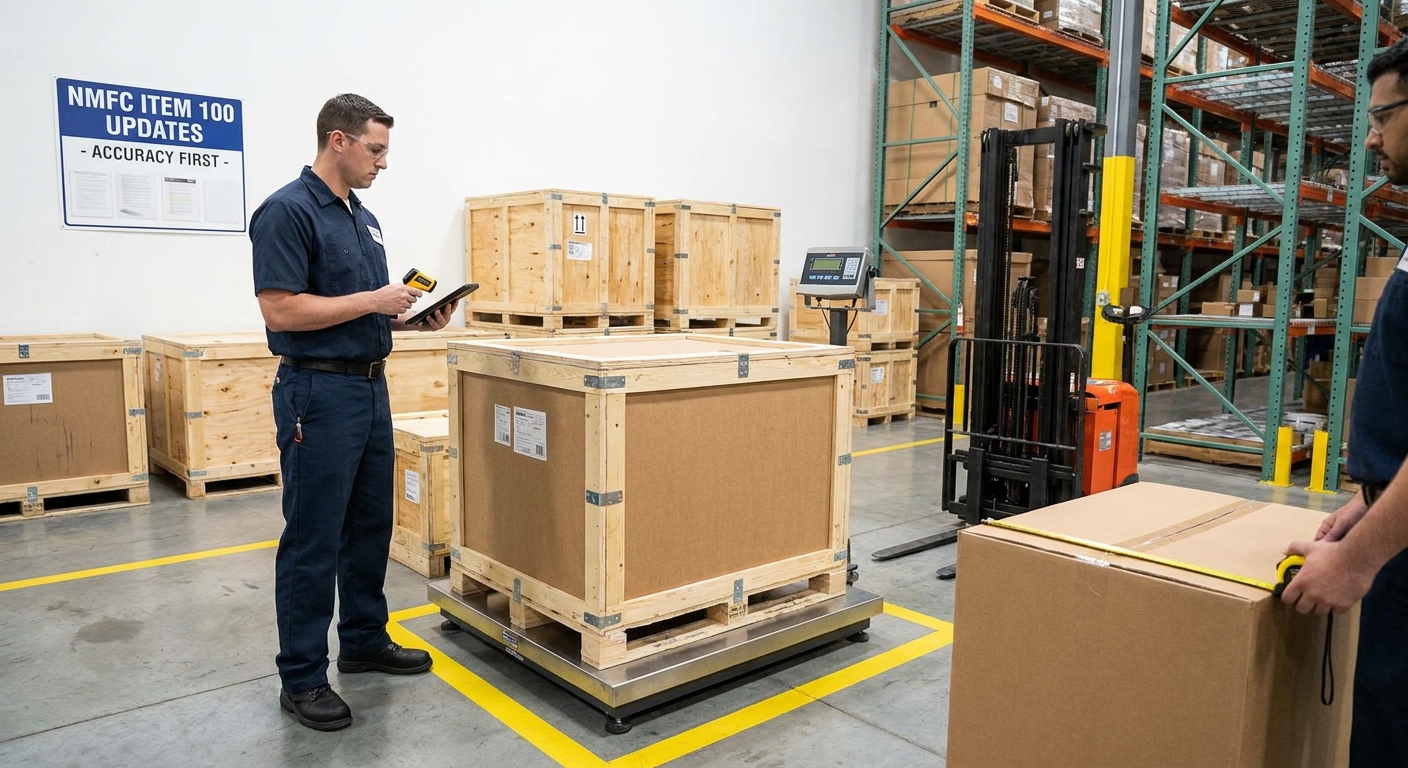
Accurate measurement of freight dimensions is no longer a secondary concern but a critical component of LTL freight classification. The revised NMFC Item 100 places a greater emphasis on precise volume calculations, making manual measurement methods prone to errors. Investing in technology that can accurately capture dimensions is becoming increasingly important for maintaining compliance and avoiding reclassification charges.
Manual measurement using tape measures can be time-consuming and susceptible to human error, leading to discrepancies in density calculations. This, in turn, can result in incorrect freight class assignments. Modern solutions can automate this process, ensuring consistency and accuracy. For instance, using a device that leverages LiDAR technology for precise freight dimensioning and density calculation can significantly reduce errors.
Updating Internal Classification Processes
Shippers must audit and update their internal freight classification processes to align with the new NMFC Item 100 standards. This includes re-training personnel responsible for freight classification, updating software systems that may store classification data, and establishing new quality control checkpoints for measurements and class assignments. Ensuring that all team members understand the implications of the changes is vital.
This audit should cover:
- Data collection protocols: How are dimensions and weights recorded?
- Classification logic: What rules are used to assign freight class?
- Carrier verification: How is the assigned class confirmed with the carrier?
- Dispute resolution: What is the process for addressing reclassification disputes?
By systematically reviewing and updating these processes, businesses can build a more resilient classification system that accounts for the 2025 NMFC updates.
Enhancing Carrier Communication and Collaboration
Open and consistent communication with LTL carriers is more crucial than ever in the wake of NMFC Item 100 changes. Shippers should proactively discuss the updated guidelines with their carrier partners, clarifying any ambiguities and ensuring alignment on measurement and classification methodologies. Establishing a collaborative relationship can help prevent disputes and ensure smoother operations.
Engaging carriers in discussions about the new rules allows for a shared understanding of expectations. Carriers will be implementing their own systems to interpret the updated NMFC. By discussing how your company is adapting, you can ensure your measurements and classifications are likely to be accepted. This collaboration can also help identify specific items or shipment types where disputes have historically been common, allowing for focused attention.
What are the Potential Financial and Operational Impacts of Non-Compliance?
Failing to adapt to the updated NMFC Item 100 guidelines can lead to significant financial penalties and operational inefficiencies. The most immediate impact is typically an increase in freight spend due to incorrect classifications, followed by administrative burdens associated with dispute resolution. Operational flow can also be disrupted by delays caused by re-billing and re-routing of shipments.
The financial implications stem from the direct relationship between freight class and LTL shipping rates. A higher freight class translates to a higher per-pound rate. If a shipment is incorrectly classified at a lower class, the carrier will eventually discover the discrepancy during their own audit or at the destination, leading to back charges. These reclassification fees often include administrative surcharges on top of the difference in freight charges.
Understanding Freight Reclassification Charges
Freight reclassification charges are typically levied when a shipment is found to be misclassified by the shipper. These charges can be substantial, often including the difference in freight cost between the originally declared class and the correct class, plus an administrative fee. For example, if a shipment was declared as Class 50 but should have been Class 100, the shipper could face charges for the higher rate for the entire shipment, plus a handling fee that can range from $75 to $250 per shipment.
These charges can accumulate rapidly, especially for high-volume shippers. Furthermore, the process of disputing a reclassification charge can be lengthy and resource-intensive, requiring detailed documentation and evidence to support the original classification.
Operational Disruptions and Delays
Beyond direct financial costs, non-compliance with NMFC Item 100 can cause significant operational disruptions. Shipments may be held at the carrier's terminal pending reclassification and payment of additional charges. This can lead to missed delivery windows, impacting customer satisfaction and potentially incurring penalties from consignees.
The administrative burden of managing these exceptions is also considerable. Logistics teams will spend valuable time chasing down reclassification notices, gathering proof of original classification, and negotiating with carriers. This diverts resources from more strategic tasks such as optimizing routes or improving warehouse efficiency.
Frequently Asked Questions
What is the primary goal of the NMFC Item 100 changes?
The primary goal is to improve the accuracy of freight classification by refining density calculation methods and updating item descriptions, ensuring fairer pricing and reducing disputes between shippers and carriers.
How does the new density calculation differ from previous methods?
The new method emphasizes precise measurement of length, width, and height to calculate cubic feet, leading to a more accurate weight-per-cubic-foot figure than older, often estimated, ranges.
Can I use my existing freight classification data after July 19, 2025?
No, existing classification data must be reviewed and updated to align with the revised NMFC Item 100 guidelines to ensure compliance and avoid reclassification charges.
What should I do if my shipment is reclassified by the carrier?
Gather all original shipping documentation, including proof of measurement and weight, and contact your carrier to understand the basis for the reclassification. Initiate a formal dispute if you believe the reclassification is incorrect.
How frequently does the NMFC update its guidelines?
The NMFC periodically reviews and updates its classifications and guidelines to reflect changes in the transportation industry, commodity types, and packaging standards. These updates are typically announced with an effective date for implementation.
Conclusion
The NMFC Item 100 changes effective July 19, 2025, represent a significant evolution in LTL freight classification, demanding a more rigorous and precise approach from all stakeholders in the supply chain. For freight forwarders, LTL carriers, 3PL providers, and warehouse teams, understanding and adapting to these updates is not merely a matter of compliance but a strategic imperative for cost control and operational efficiency. By embracing accurate dimensioning, updating internal processes, and fostering strong carrier communication, businesses can successfully navigate these changes and ensure their LTL shipments are classified correctly, avoiding costly reclassification charges and maintaining a competitive edge in 2026 and beyond.