
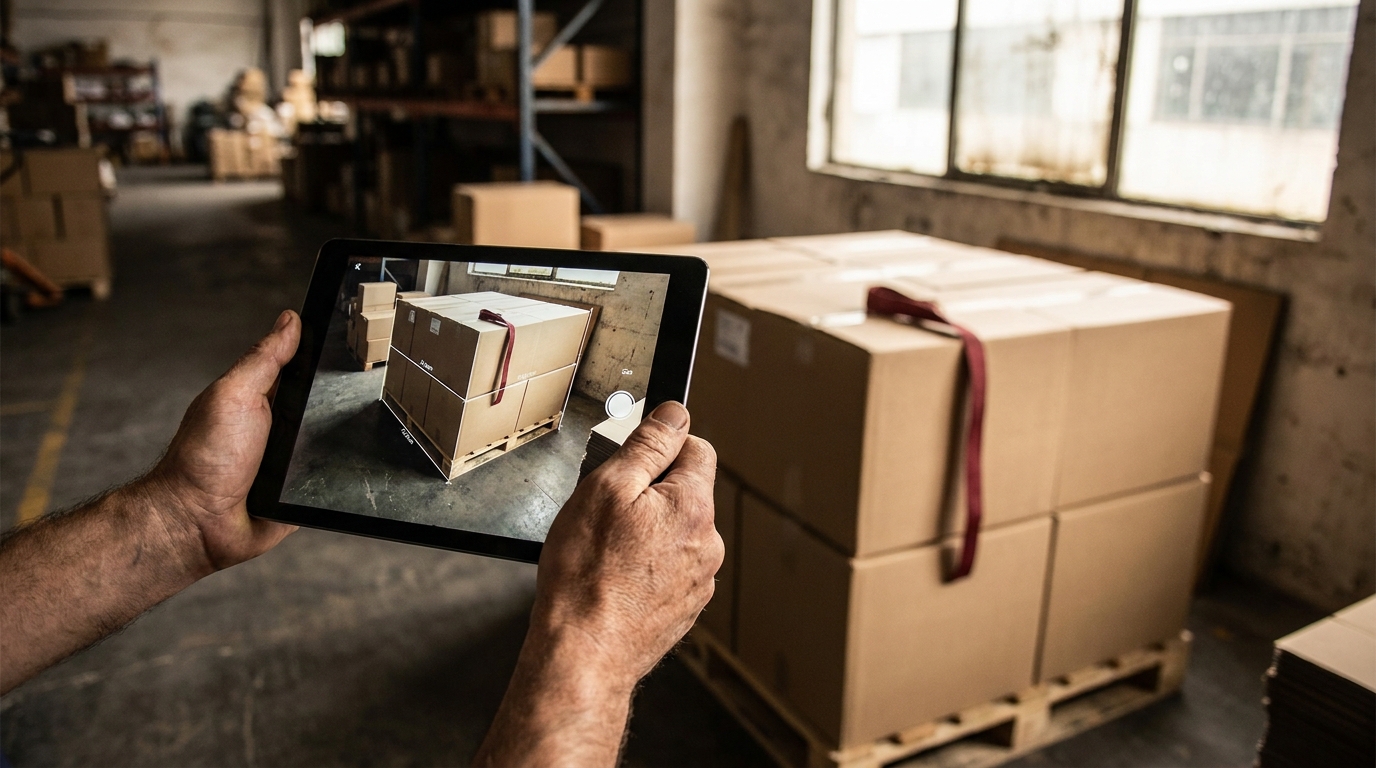
Accurately measuring freight dimensions involves precisely determining the length, width, and height of a shipment using methods ranging from traditional tape measures to advanced LiDAR-based mobile applications, ensuring compliance, preventing reclassification fees, and optimizing shipping costs by correctly calculating density and freight class.
Why is accurate freight dimension measurement critical?
Accurate freight dimension measurement is critical for several reasons, primarily to ensure correct billing, prevent costly reclassification fees, and optimize cargo space. It directly impacts the calculation of freight class, especially for Less-Than-Truckload (LTL) shipments, where density is a key factor in determining shipping costs and carrier profitability.
Incorrect measurements can lead to significant financial penalties. Carriers often re-weigh and re-dimension freight, and if their measurements differ from the shipper's, reclassification charges are applied. These charges can be substantial, sometimes doubling or tripling the original shipping cost, and can also lead to billing disputes and delays. Beyond cost, accurate dimensions are essential for efficient load planning, maximizing trailer space, and ensuring the safety and stability of cargo during transit. For instance, knowing the precise dimensions allows carriers to determine if a shipment will fit through a specific door or on a certain pallet.
What are the common methods for measuring freight dimensions?
Common methods for measuring freight dimensions include manual measurement with a tape measure, using dedicated dimensioning systems (dims scanners), and leveraging mobile applications with advanced technologies like LiDAR. Each method offers varying levels of accuracy, speed, and cost, suitable for different operational scales and specific freight types.
Manual measurement with a tape measure is the most basic and widely accessible method. It involves physically measuring the longest length, widest width, and tallest height of the freight. While inexpensive, it is prone to human error, can be time-consuming, and may pose safety risks when measuring large or unstable items. The accuracy typically ranges from 0.5 to 1 inch, depending on the operator's care and the freight's regularity.
Dedicated dimensioning systems, often referred to as "dims scanners" or "dimensioners," use infrared, ultrasonic, or laser technology to automatically capture freight dimensions. These fixed or mobile units offer high accuracy, typically within 0.1 to 0.2 inches, and significantly increase measurement speed. They are ideal for high-volume operations but represent a substantial capital investment, ranging from several thousand to tens of thousands of dollars per unit.
Mobile applications, particularly those utilizing LiDAR technology on devices like iPhones and iPads, represent a newer, highly accessible method. These apps allow users to quickly scan freight, providing dimensions with accuracy comparable to or exceeding manual methods, often within 0.5 inches. They combine the portability of a tape measure with the speed and reduced error of automated systems, at a significantly lower cost, often being free to download.
How do you measure irregular or oddly shaped freight?
Measuring irregular or oddly shaped freight requires identifying the longest, widest, and tallest points of the shipment, treating it as if it were enclosed within an imaginary rectangular box. This "cubing out" method ensures all extremities are accounted for, preventing underestimation of the space the freight will occupy.
For items with protrusions, such as pipes extending beyond a pallet or machinery with uneven components, it's crucial to measure from the absolute furthest point on each axis. For example, if a machine has a control panel that extends 6 inches beyond its main frame, that extension must be included in the overall width measurement. Similarly, if a part extends upward, that is the "height."
This method, often called the "extreme dimensions" or "greatest dimensions" principle, is standard practice in the logistics industry. Carriers base their charges on the cubic space required to transport the item, not just its internal volume. Therefore, even if an item is mostly compact but has a small, protruding part, that protrusion dictates the minimum space it will occupy in a trailer. This is particularly important for LTL shipments where space utilization directly impacts cost and available capacity.
What tools are available for dimensioning freight?
A variety of tools are available for dimensioning freight, ranging from basic manual instruments to sophisticated automated systems and mobile applications. The choice of tool depends on factors such as required accuracy, measurement volume, budget, and the type of freight being handled.
| Tool Type | Description | Typical Accuracy | Speed | Cost | Best For |
|---|---|---|---|---|---|
| **Tape Measure** | Manual retractable tape for length, width, height. | 0.5 - 1 inch | Slow | Very Low (e.g., $10-$30) | Low volume, irregular shapes, budget-conscious |
| **Measuring Wheel** | Wheel with a counter for measuring longer lengths on the ground. | 1 - 2 inches | Moderate | Low (e.g., $50-$150) | Large, flat items (e.g., carpet rolls) |
| **Fixed Dimensioner** | Automated system (laser/ultrasonic) mounted over a conveyor or scale. | 0.1 - 0.2 inches | Very Fast | High (e.g., $10,000-$50,000+) | High-volume warehouses, distribution centers |
| **Mobile Dimensioner** | Automated system (laser/ultrasonic) on a cart, often integrated with a scale. | 0.1 - 0.3 inches | Fast | Medium-High (e.g., $5,000-$20,000+) | Mid-volume, varied locations within a facility |
| **Mobile LiDAR App** | Smartphone/tablet app using LiDAR sensors for 3D scanning. | 0.5 inches | Fast | Very Low (e.g., Free on App Store) | Varied volume, on-demand, field use, budget-friendly |
Manual tools, like tape measures and measuring wheels, are simple and inexpensive but rely heavily on human precision and are slower. They are suitable for operations with low shipment volumes or for verifying measurements. However, they are prone to parallax errors and inconsistencies.
Dedicated dimensioning systems, both fixed and mobile, offer superior speed and accuracy. Fixed systems are integrated into existing material handling processes, providing highly accurate measurements for high-throughput environments. Mobile dimensioners offer flexibility, allowing measurements to be taken at various points within a warehouse. These systems often integrate with warehouse management systems (WMS) for seamless data transfer.
Mobile LiDAR applications, such as FreightSizer, leverage the LiDAR scanner found in newer iPhones and iPads to create a 3D model of the freight. This allows for rapid and accurate dimension capture, often within 0.5 inches, by simply scanning the object with the device. These apps provide a cost-effective alternative to traditional dimensioning hardware, offering portability and ease of use, making them excellent for freight forwarders, 3PLs, and warehouse teams needing on-demand accuracy without significant investment. They are particularly useful for those who deal with freight class, density, and reclassification charges, as they can also calculate density and determine LTL freight class in line with NMFTA guidelines.
How does LiDAR technology improve freight dimensioning accuracy?
LiDAR (Light Detection and Ranging) technology improves freight dimensioning accuracy by emitting laser pulses and measuring the time it takes for them to return, creating a precise 3D map of the object. This allows mobile applications to capture dimensions quickly and with high fidelity, significantly reducing the potential for human error inherent in manual measurements.
Unlike traditional camera-based measurements that rely on visual cues and can be affected by lighting or angles, LiDAR directly measures depth. This means it can accurately determine the exact boundaries of a package, even in challenging environments. The resulting 3D point cloud allows the software to identify the longest, widest, and tallest points of the freight automatically, providing consistent and objective measurements.
For logistics professionals, this translates to more reliable data for calculating density and freight class, helping to avoid costly reclassification fees. The accuracy of LiDAR-enabled apps, often within 0.5 inches, is a substantial improvement over typical manual tape measure errors, which can easily exceed an inch, especially on larger or irregularly shaped items.
What is the impact of inaccurate dimensions on LTL freight class and costs?
Inaccurate dimensions have a significant negative impact on LTL freight class and shipping costs, primarily through incorrect density calculations and subsequent reclassification fees. The National Motor Freight Traffic Association (NMFTA) guidelines for LTL freight classification heavily rely on density, among other factors like stowability and liability.
If a shipper provides dimensions that are smaller than the actual freight, the calculated density will be higher than reality. This might lead to an incorrect, lower freight class (e.g., Class 70 instead of Class 100). When the carrier re-measures the freight and finds it larger, the density will decrease, resulting in an upward reclassification to a higher, more expensive freight class. This reclassification often comes with additional administrative fees, significantly increasing the total shipping cost, sometimes by 20% to 50% or more.
Conversely, overestimating dimensions can lead to a higher calculated freight class than necessary, causing the shipper to pay more than required upfront. While less common, this still represents a financial loss. The goal is to achieve an accurate freight class (e.g., Class 92.5 for an item with 10-12 lbs/cu ft density) to ensure fair pricing. For more detailed information on how these classifications work, you might find our article "What Changed in the NMFC Freight Classification" helpful. Consistent accuracy is paramount to avoid these costly discrepancies and maintain healthy relationships with carriers.
How can technology help prevent LTL reclassification fees?
Technology, particularly automated dimensioning systems and mobile LiDAR applications, significantly helps prevent LTL reclassification fees by providing consistent, accurate, and verifiable freight dimensions. By reducing human error and standardizing the measurement process, these tools ensure that the initial declared dimensions closely match the carrier's measurements.
Automated dimensioners, whether fixed or mobile, capture precise measurements rapidly, eliminating subjective interpretation. This data can be directly integrated into shipping documentation and carrier portals, ensuring transparency and reducing discrepancies. The high accuracy, often within 0.1 to 0.3 inches, minimizes the chance of a carrier finding a significant difference upon re-measurement.
Mobile LiDAR apps, like FreightSizer, offer a highly accessible and cost-effective technological solution. By using a device like an iPhone or iPad, warehouse teams and shippers can quickly scan freight, obtain accurate dimensions, and calculate density and freight class on the spot. This empowers them to declare the correct freight class from the outset, proactively addressing potential reclassification issues. The ability to capture and store visual evidence of the measurement further strengthens the shipper's position in case of a dispute. For further strategies on mitigating these charges, consider reading "How to Avoid LTL Reclassification Fees."
What are the best practices for consistent freight dimensioning?
Implementing best practices for consistent freight dimensioning involves standardizing procedures, utilizing appropriate tools, and regularly training personnel to minimize errors and ensure compliance. Consistency across all shipments helps build trust with carriers and prevents unexpected costs.
Firstly, always measure the "greatest dimensions" of the freight, meaning the longest length, widest width, and tallest height, including any protrusions, packaging, or pallet overhangs. The goal is to capture the full cubic space the shipment will occupy. This prevents underestimation and subsequent reclassification.
Secondly, standardize your measurement tools and processes. If using tape measures, ensure they are calibrated and that all personnel follow the exact same steps every time. Better yet, invest in technology like mobile LiDAR apps or dedicated dimensioning systems to automate and improve accuracy. For example, using an app like FreightSizer ensures that measurements are taken consistently, regardless of the operator.
Thirdly, provide thorough and ongoing training for all staff involved in dimensioning. This training should cover not only how to use the tools but also the importance of accurate measurements, the impact on freight class and costs, and how to handle irregular freight. Regular audits of measurements can help identify and correct inconsistencies.
Finally, document everything. Keep records of measurements, including photos or digital scans where possible. This documentation serves as proof in case of a dispute with a carrier and helps in continuous process improvement. Clear labeling of freight with its dimensions and weight is also a good practice.
Key Takeaways
- Accuracy is Paramount: Precise freight dimensioning directly impacts shipping costs, preventing reclassification fees and ensuring correct LTL freight class calculation based on density.
- Measure Extreme Dimensions: Always capture the longest length, widest width, and tallest height, including all protrusions and packaging, to reflect the true cubic space occupied by the freight.
- Leverage Technology: Automated dimensioning systems and mobile LiDAR applications (like FreightSizer, free on the App Store) offer superior speed and accuracy compared to manual methods, reducing human error and standardizing the measurement process.
- Understand LTL Impact: Inaccurate dimensions lead to incorrect density calculations, resulting in costly LTL reclassification (e.g., from Class 70 to Class 100) and additional administrative fees from carriers.
- Standardize and Train: Implement clear, consistent measurement procedures, use calibrated tools, and provide regular training to all personnel to ensure uniformity and minimize discrepancies across all shipments.
FAQ
Q1: What is the most common mistake made when measuring freight dimensions?
The most common mistake is failing to measure the "greatest dimensions" of the freight, overlooking protrusions or pallet overhangs. This leads to underestimating the actual space required, resulting in lower density calculations and subsequent reclassification to a higher, more expensive freight class by the carrier.
Q2: How accurate do my freight measurements really need to be?
Your freight measurements need to be accurate to within 0.5 to 1 inch to reliably determine LTL freight class and avoid reclassification. While dedicated dimensioners offer 0.1-0.3 inch accuracy, mobile LiDAR apps provide about 0.5-inch accuracy, which is generally sufficient to prevent significant discrepancies that trigger carrier reclassification fees.
Q3: Can a mobile app truly replace a dedicated dimensioning system?
For many operations, a mobile app, especially one utilizing LiDAR technology, can effectively replace or supplement dedicated dimensioning hardware. While dedicated systems offer slightly higher precision and throughput for very high-volume, integrated lines, mobile LiDAR apps provide excellent accuracy (around 0.5 inches), portability, and cost-effectiveness for on-demand measurements and varied operational needs.
Q4: What are "reclassification fees" and how are they calculated?
Reclassification fees are surcharges applied by LTL carriers when the actual dimensions or weight of a shipment differ significantly from what was declared by the shipper, leading to a change in its freight class. These fees typically include the difference in freight charges for the higher class, plus an administrative fee, which can significantly increase the total shipping cost.