
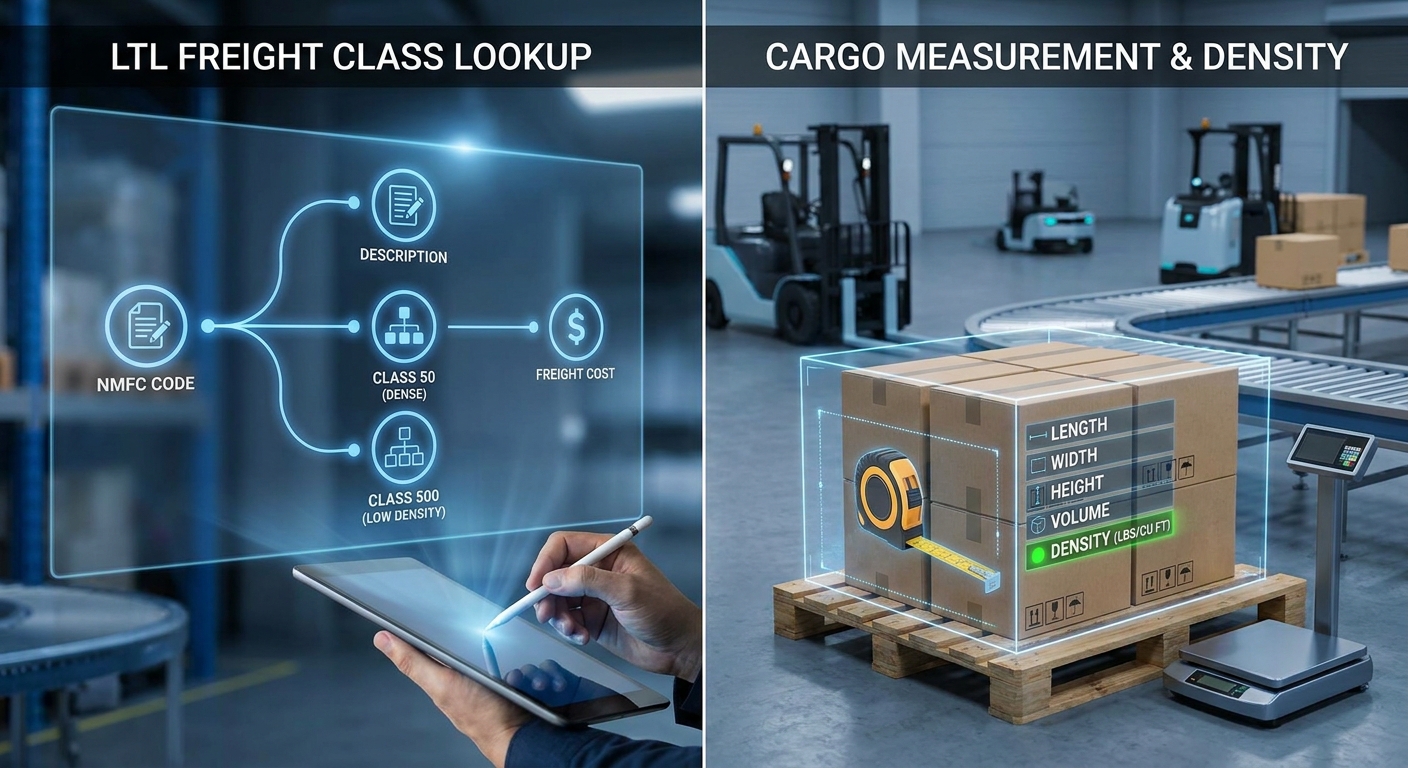
Freight Class Lookup vs. Density Calculation: Navigating LTL Classification in 2026
Understanding the precise freight class of your Less-Than-Truckload (LTL) shipments is paramount for accurate billing and cost control, and in 2026, this distinction hinges on a sophisticated interplay between freight class lookup and density calculation, with density often serving as the definitive arbiter. While traditional methods relied heavily on static lookup tables, modern logistics demands a dynamic approach where measured density directly influences or confirms class assignment, especially with evolving NMFTA (National Motor Freight Association) standards, such as those effective July 19, 2025. This article will dissect the nuances of freight class lookup versus density calculation, providing freight forwarders, LTL carriers, 3PLs, warehouse teams, and shippers with actionable insights for optimal LTL freight management.
Key Takeaways
- Density is a primary factor in determining LTL freight class under current NMFTA guidelines, often overriding manual lookups.
- Accurate density calculation requires precise measurement of freight dimensions and weight.
- The NMFC (National Motor Freight Classification) standards, updated July 19, 2025, place a greater emphasis on density-driven classification.
- Utilizing technology for dimensioning and density calculation can reduce reclassification errors and disputes.
- Freight forwarders and carriers must adapt their processes to incorporate real-time density data for efficient LTL operations.
Why is Density Calculation Crucial for LTL Freight Class in 2026?
Density calculation is the linchpin for accurate LTL freight classification because it quantifies the space a shipment occupies relative to its weight, directly aligning with the NMFC's objective to ensure equitable pricing based on transportability and liability. As of the NMFC standards effective July 19, 2025, density is not merely a secondary consideration but a foundational metric used to assign or verify freight class, particularly for items not explicitly listed or when characteristics deviate from standard descriptions. This shift aims to mitigate the historical inaccuracies and disputes arising from subjective interpretations of freight class lookup tables.
The NMFC system categorizes shipments into 18 distinct classes, ranging from Class 50 to Class 500, based on four key characteristics: density, stowability, handling, and liability. While density is arguably the most quantifiable and often the most impactful of these, its accurate determination is essential. For instance, a shipment of lightweight but bulky items might appear to fit a lower class based on a superficial lookup, but its low density would dictate a higher class, reflecting the inefficient use of trailer space. Conversely, dense, heavy items that fit compactly would typically fall into lower classes.
The evolution of the NMFC, particularly with the 2025 updates, reflects the industry's move towards more objective, data-driven classification. This necessitates a move away from solely relying on manual freight class lookup tools, which can be prone to human error or outdated information. Instead, the focus is on measuring the actual physical properties of the freight.
How is LTL Freight Density Calculated?
LTL freight density is calculated by dividing the total weight of a shipment by the total cubic feet it occupies. The formula is straightforward: Density = Weight (in pounds) / Volume (in cubic feet). To accurately apply this formula, precise measurements of both weight and dimensions are indispensable.
Weight is typically obtained from the shipping documents, such as a bill of lading or a certified scale reading. Dimensions—length, width, and height—must be measured accurately for each piece of freight, and then aggregated to determine the total volume. For palletized shipments, this involves measuring the pallet and the freight stacked upon it. The resulting density value is then compared against the thresholds defined in the NMFC tariff.
For example, if a shipment weighs 500 pounds and occupies a volume of 40 cubic feet, its density is 12.5 pounds per cubic foot (500 lbs / 40 cu ft). This calculated density is then cross-referenced with the NMFC tables to determine the appropriate freight class. If the NMFC specifies that shipments between 10 and 15 pounds per cubic foot fall into Class 125, then this shipment would be assigned Class 125.
The challenge often lies in obtaining these precise measurements consistently and efficiently, especially within busy warehouse environments. This is where technological solutions are increasingly becoming vital.
What are the Limitations of Traditional Freight Class Lookup?
Traditional freight class lookup, relying on static tables and manual interpretation, suffers from several significant limitations that lead to errors, increased costs, and operational inefficiencies. These tables, while historically foundational, often fail to account for the granular variations in freight characteristics that directly impact transportation economics.
One primary limitation is the potential for human error during the lookup process. Navigating extensive tariff books or online databases can be complex, and misinterpreting descriptions or selecting the incorrect sub-category can lead to misclassification. Furthermore, these tables are often generalized, meaning they may not perfectly capture the unique dimensions or density of specific shipments, especially for non-standard items.
Another drawback is the static nature of lookup tables. While the NMFC is updated periodically, the real-time variability of freight—how it’s packed, its exact dimensions, and its precise weight—is not reflected. This can result in shipments being assigned a class that doesn't accurately represent their actual space utilization or handling requirements, leading to potential revenue shortfalls for carriers or unexpected reclassification charges for shippers.
The reliance on outdated or generalized information is a critical issue. Without precise measurement of density and dimensions, the lookup process becomes an educated guess, which is insufficient for the precision required in modern logistics.
How Does Density Calculation Improve LTL Classification Accuracy?
Density calculation significantly improves LTL classification accuracy by providing an objective, quantifiable metric that directly reflects a shipment's space efficiency, a core principle of LTL pricing. This data-driven approach minimizes the subjectivity inherent in traditional freight class lookup methods.
When density is accurately measured, it provides a clear benchmark against the NMFC class structure. For example, a shipment of electronics might be described in a lookup table, but if the actual density is lower than typical due to bulky packaging, calculating the precise density will reveal this, leading to a higher, more appropriate class assignment. This prevents shippers from underpaying and carriers from being compensated below market rates for the space utilized.
The NMFC standards, particularly those revised and in effect from July 19, 2025, increasingly emphasize density as a primary determinant. This means that accurately measuring density allows for direct alignment with these updated guidelines, reducing the likelihood of disputes and reclassifications. This is especially true for shipments that don't fit neatly into predefined categories, where density becomes the most reliable indicator of their transportational characteristics.
Furthermore, consistent and accurate density calculation fosters better forecasting and operational planning for carriers. Knowing the actual density distribution of freight allows for more efficient load building and route optimization, reducing wasted capacity.
What Factors Influence Density Calculation Accuracy?
Several critical factors influence the accuracy of freight density calculations, and overlooking any of them can lead to misclassification and subsequent financial discrepancies. These factors range from the precision of measurement tools to the consistency of the measurement process itself.
The most fundamental factor is the accuracy of the dimensional measurements. Using imprecise tools, such as a standard tape measure that can be inconsistently applied, or failing to account for irregular shapes or overhangs on pallets, will result in incorrect volume calculations. Similarly, the accuracy of the weight measurement is crucial; variances in scale calibration or not weighing the shipment in its final shipping configuration (e.g., with all packaging) can skew density figures.
The way freight is presented for measurement also plays a role. For palletized goods, the dimensions of the pallet itself, along with the height and width of the stacked freight, must be precisely recorded. If freight is not uniformly stacked or if there are gaps, these must be accounted for. For non-palletized items, measuring the longest dimension of each side and the height is essential, ensuring that the measurement captures the outermost boundaries of the freight.
Finally, the consistency of the measurement process across different personnel and locations is vital. Without standardized procedures and trained staff, variations in how measurements are taken can lead to discrepancies, even for identical shipments. Implementing a reliable system for capturing these dimensions and weights is therefore paramount.
How Does Technology Aid Density Calculation and Classification?
Modern technology, particularly smartphone-based applications utilizing LiDAR, revolutionizes density calculation and LTL freight classification by automating and enhancing the accuracy of measurements. These tools replace manual methods, significantly reducing the time and potential for error associated with traditional approaches.
Applications like FreightSizer leverage the LiDAR sensors present in newer iPhone and iPad models to capture precise three-dimensional dimensions of freight. This eliminates the guesswork and inconsistencies of manual tape measurements. By simply scanning the freight, the app can quickly generate accurate length, width, and height data.
Once dimensions are captured, the app can calculate the volume and, when combined with the shipment's weight, determine the freight density. This calculated density is then automatically compared against the NMFC guidelines. In many cases, the app can directly suggest the appropriate freight class based on the measured density and other relevant NMFC parameters, aligning with the standards effective July 19, 2025.
This technological integration streamlines the entire process from measurement to classification, ensuring that the data used for determining freight class is precise and up-to-date. This reduces the incidence of reclassification charges and improves the overall efficiency of logistics operations.
What Are the NMFC Standards Effective July 19, 2025, and How Do They Affect Classification?
The NMFC standards effective July 19, 2025, introduce refined guidelines that place a more pronounced emphasis on density as a primary driver for freight class determination, particularly for items not explicitly listed or those with characteristics that deviate from standard descriptions. These updates aim to further objectify the classification process and ensure more equitable pricing for all stakeholders in the LTL supply chain.
These revisions reinforce the principle that the physical properties of freight—how much space it takes up relative to its weight—are the most significant indicators of its transportation costs and risks. Consequently, the updated NMFC standards provide clearer density thresholds for various freight categories. This means that accurately measuring a shipment's density is no longer just a best practice; it's a critical requirement for correct classification.
For freight forwarders, carriers, and shippers, this necessitates a robust system for measuring dimensions and weight to calculate density accurately. Relying solely on manual freight class lookup tables without verifying the actual density of the shipment can lead to under-classification or over-classification, both of which result in financial penalties or lost revenue. The updated standards empower carriers to challenge classifications based on demonstrable, measured density.
The NMFC’s structure inherently links density to class. For example, a commodity might fall into Class 100 at a density of 8 pounds per cubic foot, but if its measured density is 12 pounds per cubic foot, it would shift to Class 125, reflecting its more efficient use of trailer space. The 2025 updates clarify these transition points and provide more granular data for accurate assignment.
How Does NMFC Classification Work with Density-Based Rules?
NMFC classification operates on a tiered system where density is a critical input, especially when specific item descriptions in the tariff are ambiguous or when freight characteristics vary. The system is designed to classify shipments based on their relative value, handling requirements, and space utilization, with density being a key proxy for space utilization.
When a shipment's particulars are not explicitly detailed in the NMFC, or if a shipper is uncertain about the correct classification, density becomes the primary determinant. The NMFC provides tables that outline specific density ranges, each corresponding to a particular freight class. For instance, a range might be 0-4 pounds per cubic foot (Class 200), 4-6 pounds per cubic foot (Class 150), 6-8 pounds per cubic foot (Class 125), and so on.
The process involves accurately measuring the dimensions and weight of the shipment to calculate its density in pounds per cubic foot. This calculated density is then cross-referenced with the NMFC tariff’s density-based rules. If the calculated density falls within a specific range, the corresponding freight class is assigned. This method ensures that shipments occupying more space per pound are classified higher, reflecting the increased cost to the carrier.
The NMFC standards effective July 19, 2025, further refine these density brackets and provide more explicit guidance on how to handle variations, making precise measurement and calculation indispensable for compliance.
What Are the Consequences of Incorrect LTL Freight Classification?
Incorrect LTL freight classification can lead to a cascade of negative consequences for all parties involved in the logistics chain, including financial penalties, operational disruptions, and damaged business relationships. Understanding these repercussions is crucial for implementing accurate classification practices.
For shippers, the most immediate consequence is being hit with reclassification charges. If a shipment is initially declared with a lower class than it actually warrants based on its true density or other characteristics, the carrier will audit the shipment and bill the shipper for the difference, often with added administrative fees. This can significantly inflate shipping costs and create budget unpredictability. Conversely, over-classifying a shipment means paying more than necessary, eroding profit margins.
For LTL carriers, misclassification results in revenue loss. When a shipment is classified too low, the carrier is not adequately compensated for the space, weight, and handling it requires. This can impact profitability, especially if such errors are widespread. It also leads to inaccurate data for load planning and operational efficiency.
Increased disputes and administrative burden are common outcomes for both shippers and carriers. Auditing discrepancies, challenging reclassification notices, and resolving billing errors consume valuable time and resources that could be better spent on core business functions. This can also strain relationships between trading partners.
Finally, consistent misclassification can lead to damaged trust and reputation. Shippers may view carriers as unreliable if billing is inconsistent, while carriers might perceive shippers as attempting to defraud them, leading to a breakdown in partnership.
What is the Difference Between Freight Class Lookup and Density Calculation in Practice?
In practice, freight class lookup and density calculation represent two distinct methodologies for determining LTL freight classification, with density calculation offering a more precise and verifiable approach, especially under current NMFC standards. While lookup tables provide a starting point, density calculation offers the definitive answer.
Freight Class Lookup typically involves using resources like the NMFC tariff book or online lookup tools. A user inputs a description of the commodity (e.g., "plastic toys," "packaged electronics," "automotive parts"). The system then suggests a freight class based on general characteristics, stowability, handling, and liability associated with that commodity type. This method is faster for commonly shipped items but can be prone to generalizations and subjective interpretation.
Density Calculation, on the other hand, requires precise physical measurement. It involves accurately measuring the length, width, and height of the shipment to determine its volume in cubic feet, and obtaining the shipment's exact weight in pounds. The density is then calculated (Weight / Volume). This calculated density is then compared against the NMFC’s density-based class thresholds. This method is objective, verifiable, and directly addresses the space utilization aspect of LTL pricing, which is a core principle of the NMFC.
Consider a scenario: A shipper has a shipment of custom-designed, lightweight display stands. A simple freight class lookup might suggest Class 150. However, these stands are bulky and occupy a significant amount of space relative to their weight. By using a tool to measure the dimensions and weight precisely, the calculated density might reveal it should be Class 250. In this instance, density calculation overrides the initial lookup, preventing under-classification and potential reclassification charges. The NMFC standards effective July 19, 2025, reinforce the primacy of density in such cases.
How Can Shippers and Carriers Optimize LTL Classification Processes?
Optimizing LTL classification processes requires a commitment to accuracy, efficiency, and leveraging appropriate technology. Both shippers and carriers can implement strategies to ensure correct classification from the outset, minimizing disputes and maximizing cost-effectiveness.
For shippers, the key is to accurately capture and declare shipment details upfront. This involves meticulously measuring dimensions and weighing each shipment. Investing in tools that facilitate accurate measurement, like smartphone apps with LiDAR capabilities, can significantly improve data quality. Training warehouse staff on consistent measurement procedures is also vital. Ensuring that the declared class on the Bill of Lading accurately reflects the shipment's true characteristics, including calculated density, is paramount.
LTL carriers should focus on establishing clear, standardized measurement and auditing procedures. Implementing regular checks of declared weights and dimensions during pickup or at consolidation points can catch discrepancies early. Providing clear guidelines to shippers on how to measure and declare freight, and utilizing technology for internal audits, can streamline operations. For shipments where density is a critical factor, carriers must have robust systems to verify this data, aligning with NMFC standards.
A collaborative approach is also beneficial. Open communication between shippers and carriers regarding classification can resolve ambiguities. Carriers can proactively offer guidance on classification best practices, and shippers can provide feedback on any challenges they face.
What is the Role of Technology in Modern LTL Freight Classification?
Technology plays an indispensable role in modern LTL freight classification by enhancing accuracy, speed, and transparency throughout the logistics process. As the NMFC continues to evolve, particularly with the increased emphasis on density, technological solutions are no longer a luxury but a necessity for competitive operations.
Digital dimensioning tools, such as those utilizing LiDAR on smartphones and tablets, automate the capture of accurate freight dimensions. This eliminates manual measurement errors and speeds up the process significantly. These tools can capture length, width, and height in seconds, providing precise data for volume calculations.
Once dimensions are captured, integrated software can calculate freight density automatically. This calculated density can then be cross-referenced with the NMFC tariff, either manually or through integrated classification databases. This direct comparison ensures that the freight class assigned is based on objective, measured data, aligning with the NMFC standards that became effective July 19, 2025.
Furthermore, advanced platforms can integrate with existing Transportation Management Systems (TMS) and Warehouse Management Systems (WMS), streamlining data flow and reducing redundant data entry. This not only improves accuracy but also enhances operational efficiency, allowing for better load planning, auditing, and billing. The ability to store and retrieve dimension and density data also provides auditable proof in case of disputes.
Frequently Asked Questions
What is the primary difference between freight class lookup and density calculation?
Freight class lookup relies on commodity descriptions and general characteristics, while density calculation uses precise measurements of weight and volume to determine a shipment's space utilization, which is a more objective classification method.
Are NMFC standards still relevant in 2026 for LTL classification?
Yes, NMFC standards remain highly relevant in 2026. The NMFC, with its updated guidelines effective July 19, 2025, continues to be the primary framework for LTL freight classification, with an increasing focus on density.
Can density calculation alone determine the LTL freight class?
Density calculation is a critical component, often the most influential, but it is one of four factors in NMFC classification: density, stowability, handling, and liability. However, for many shipments, density is the primary driver, especially when other factors are neutral or when specific commodity descriptions are absent.
What happens if my freight is reclassified by the carrier?
If your freight is reclassified, you will typically be billed for the difference in freight charges between the originally declared class and the new, higher class, often with additional administrative fees. This underscores the importance of accurate initial classification.
How can I ensure my freight is classified correctly from the start?
To ensure correct classification, accurately measure your shipment's dimensions and weight to calculate its density. Use this objective data to determine the freight class in line with current NMFC guidelines, rather than relying solely on general lookup tables.
Conclusion
Navigating the complexities of LTL freight classification in 2026 demands a precise and data-driven approach, moving beyond traditional freight class lookup to embrace the power of accurate density calculation. With NMFC standards, particularly those effective July 19, 2025, reinforcing density as a cornerstone of classification, carriers and shippers alike must prioritize objective measurement. By understanding the limitations of static lookup tables and the undeniable accuracy of measured density, logistics professionals can mitigate reclassification charges, optimize costs, and build more efficient, transparent supply chains. Leveraging technology for precise dimensioning and density calculation is no longer an option but a strategic imperative for success in today's LTL market.